Most counter-drone thinking starts with how big a drone is or how it is controlled. Acoustic detection starts somewhere else, with the thing that makes the noise. Electric rotors, electric pushers, piston engines and jets each sound different, carry differently and leave defenders a different number of seconds. This assessment sorts the drones flying over Ukraine by propulsion and asks what each family means for passive acoustic detection.
Published
August 2026
Subject
Threat drones grouped by propulsion and acoustic signature
Source base
Ukrainian and U.S. official statements, defence press, manufacturer claims, acoustics literature
Method
Group by what makes the noise; compare speed, warning time and radio dependence
Verdict
Sound identifies the family even when the drone is radio-silent; speed decides whether that is enough
A drone can hide its radio, its shape and its heat, but not the sound of whatever turns its propeller. Sorting the drones over Ukraine by propulsion, rather than by weight or control link, gives five families: small electric multirotors, heavy electric multirotors, electric fixed-wing munitions, piston-engined fixed-wing aircraft and jets. Each has a distinct acoustic character, and each leaves a different amount of warning. The trend is moving against defenders at both ends: fibre-optic FPVs remove the radio signature from the smallest family, and jet-powered Gerans roughly halve the warning time at the top. Acoustic sensing is one of the few layers that sees the first, and it needs to be dense and well connected to keep up with the second.
5
propulsion families that cover the threat◆ small rotors, heavy rotors, electric fixed-wing, piston, jet
≈19 s
warning per kilometre against a Shahed-type drone◆ at about 185 km/h
≈10 s
warning per kilometre against a jet Geran-3◆ at 370 km/h, Ukraine's intelligence figure
0
radio emissions from a fibre-optic FPV◆ invisible to RF detection, still audible
Key questions
Can drones be detected by sound?
Yes. A drone's propulsion makes noise it cannot switch off: propellers produce a tone at the blade-pass frequency plus harmonics, and engines add their own note. Passive acoustic sensors can detect and classify drones even when they are radio-silent.
What does a Shahed drone sound like?
Like a moped or a chainsaw. Ukraine's Operational Command South said its piston engine is loud enough to hear at night, and Ukrainians learned to recognise it by ear.
How much warning does a jet-powered Geran-3 leave?
About 10 seconds per kilometre of detection range at 370 km/h (Ukrainian intelligence's figure), against about 19 seconds per kilometre for a Shahed at 185 km/h.
The Ruler — the whole argument
Five families, five voices
The family a drone belongs to is set by its propulsion. Its role (scout, bomber, decoy, interceptor) can change from one sortie to the next; its voice cannot.
Family
What makes the noise
Examples
What it means for the listener
Small electric multirotorsFPVs, quadcopters, interceptors
Four or more small, fast propellers
FPV strike drones, fibre-optic FPVs, Sting
High-pitched whine, short range; often radio-silent
Heavy electric multirotorsnight bombers
Six or more large propellers
Vampire ("Baba Yaga") and Russian copies
Deeper, louder rotor noise; slow, so time to react
Electric fixed-wingloitering munitions
One pusher propeller on an electric motor
ZALA Lancet
The quietest family; little engine noise to hear
Piston fixed-wingone-way attack and recon
Small two- and four-stroke engines
Shahed / Geran-2, Gerbera, Orlan-10
The "moped": loud, low and heard far off
Jethigh-speed one-way attack
A small turbojet
Geran-3
Broadband roar; about twice as fast, so half the warning
Family or variant that changed the problem since 2024Long-establishedSpeeds and ranges are as reported by the sources cited below
Field 01 — The physics
Why sound sorts by propulsion
A spinning propeller pushes on the air once per blade per revolution. That produces a tone, the blade-pass frequency (number of blades multiplied by rotation speed), plus a ladder of harmonics above it. In multirotor recordings these tonal peaks typically stand 10–20 dB above the surrounding broadband noise.USPTO Research on drone acoustics places the strongest propeller peaks between roughly 100 Hz and 10 kHz, and finds acoustic sensing best suited to small, low-flying drones at short to medium range.Acta Acustica
Everything else follows from the machine that drives the propeller:
Small, fast propellers sit high in the spectrum. High frequencies are absorbed quickly by air, so these drones are heard only at short range.
Large, slow propellers sit lower and carry further.
Combustion engines add their own firing note and exhaust noise on top of the propeller, which is why piston drones are heard from much further away.
Jets replace tones with a broad roar. They are loud, but the roar is harder to tell apart from other aircraft and arrives with much less time to spare.
Role is decided by whoever holds the controller. The voice is decided by the engineer, and it does not change between sorties.
Field 02 — Small electric multirotors
The whine that radio can no longer hear
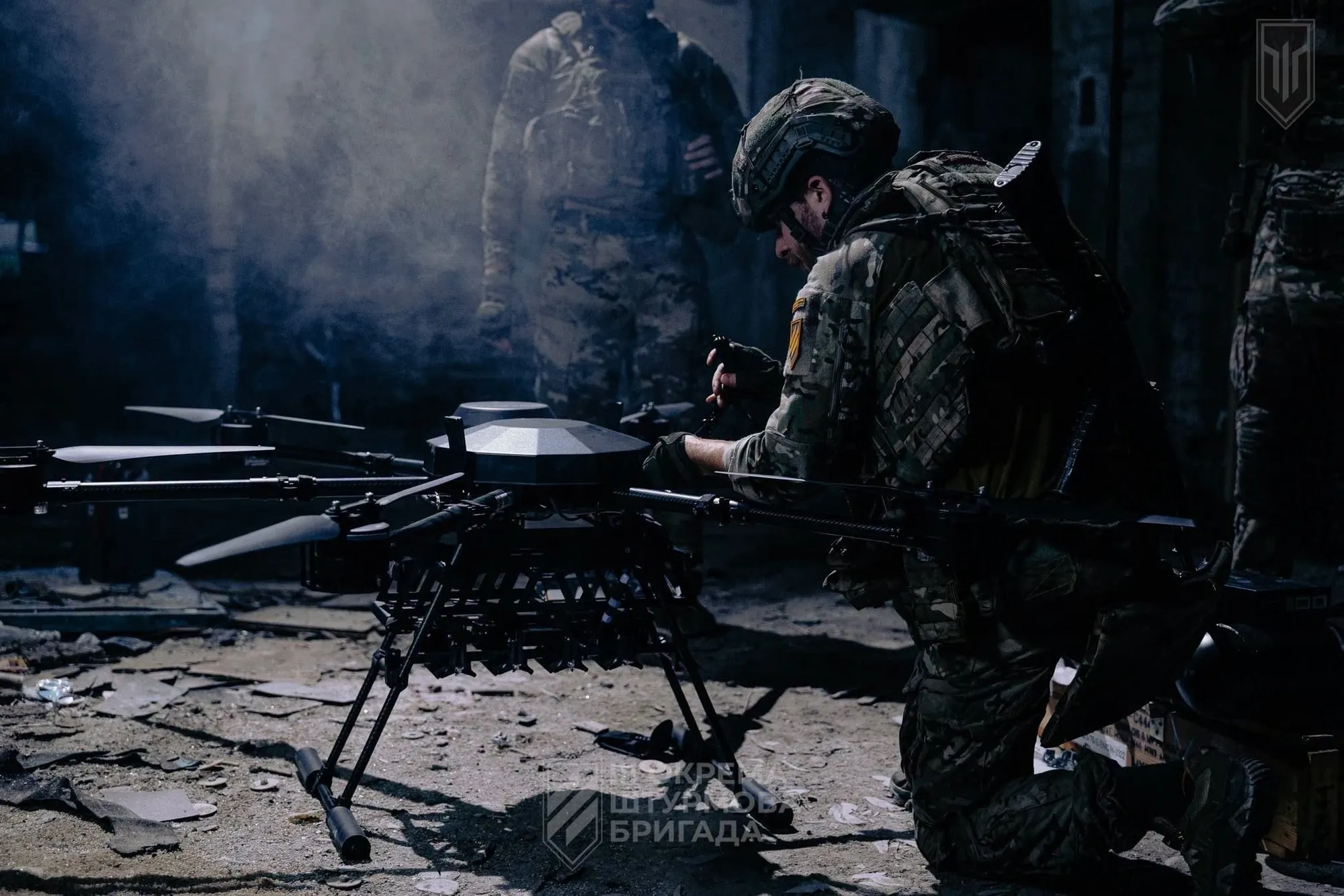
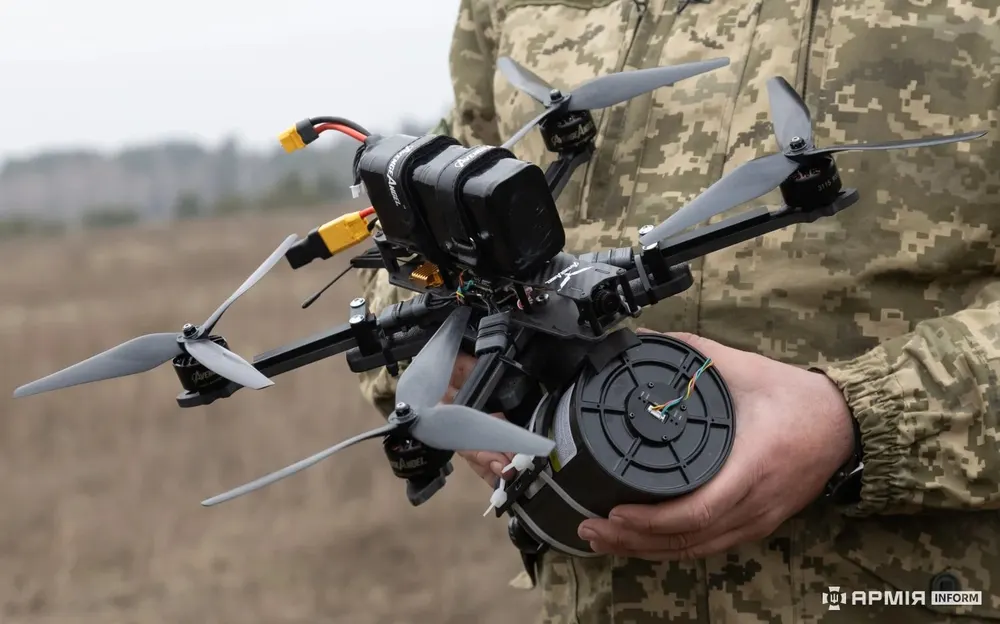
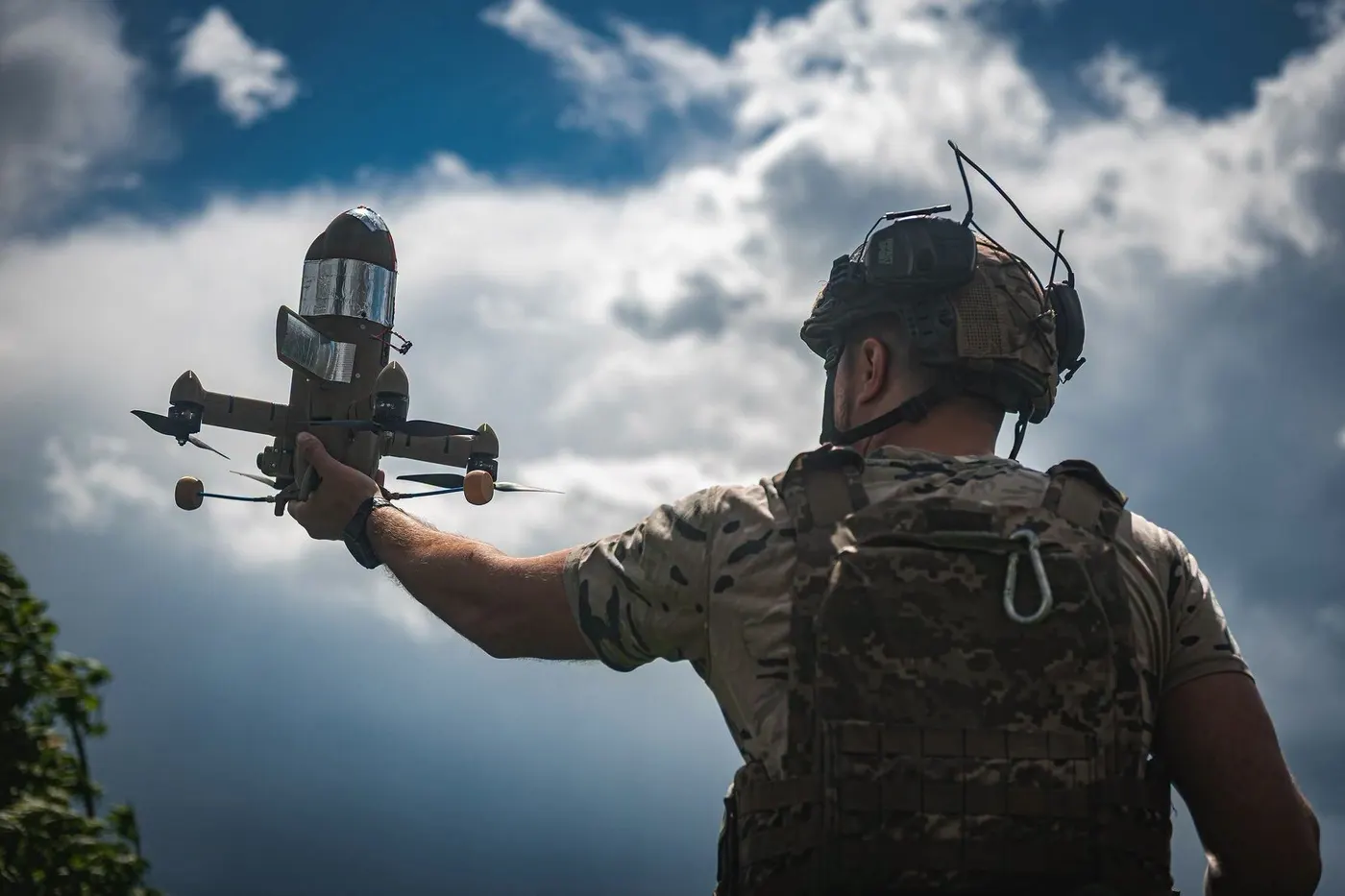
This is the largest family by number: FPV strike drones, small reconnaissance quadcopters and, increasingly, the interceptors built to shoot down other drones. All of them are small electric multirotors with fast-spinning propellers and the high-pitched whine that comes with them.
The family's most important change is the fibre-optic FPV. It is steered over a cable it unspools behind it, so it emits no radio signal for a detector to find and gives a jammer nothing to jam. Ukrainian manufacturers have put 25–30 km spools into production, and 50 km spools are still experimental.Taifun One Ukrainian firm claims combat flights at up to 50 km.Euromaidan Press Russia uses them too, including well behind the front.Euromaidan Press
The cable removes the radio signature but not the whine. That is why Ukraine is now building sensors aimed at this family specifically. Zvook's NW0, announced in January 2026, claims 360-degree detection of FPVs, fibre-optic types included, at 150–450 m, with sensors spaced 400–600 m apart.Militarnyi Those ranges are manufacturer claims, and they show the cost of the high frequencies: coverage of this family takes a dense mesh of sensors, not a few large ones.
FPV crews — the most numerous family
Small, fast propellers: a high whine heard only at short range.
The heavy hexacopter is a multirotor scaled up to carry a real load. Ukraine's Vampire, which Russian troops call "Baba Yaga" after the witch of folklore, can carry up to 15 kg over more than 20 km.Euromaidan Press It is used mainly as a night bomber, with thermal optics to find its targets. One Ukrainian soldier described it simply: "Usually, this drone flies at night, but it makes a lot of noise."Espreso
Acoustically it is the slow, loud member of the electric families. Larger propellers turn more slowly, so the blade-pass tone sits lower than an FPV's and travels further. Its low speed gives a listening network time to triangulate and cue a gun. The difficulty is recognition, not detection. Russia began fielding visual copies of the Vampire in 2025, and a Ukrainian brigade reports having shot down five.Euromaidan Press When both sides fly near-identical airframes, a sound match on its own cannot tell friend from foe.
Field 04 — Electric fixed-wing
The quiet one
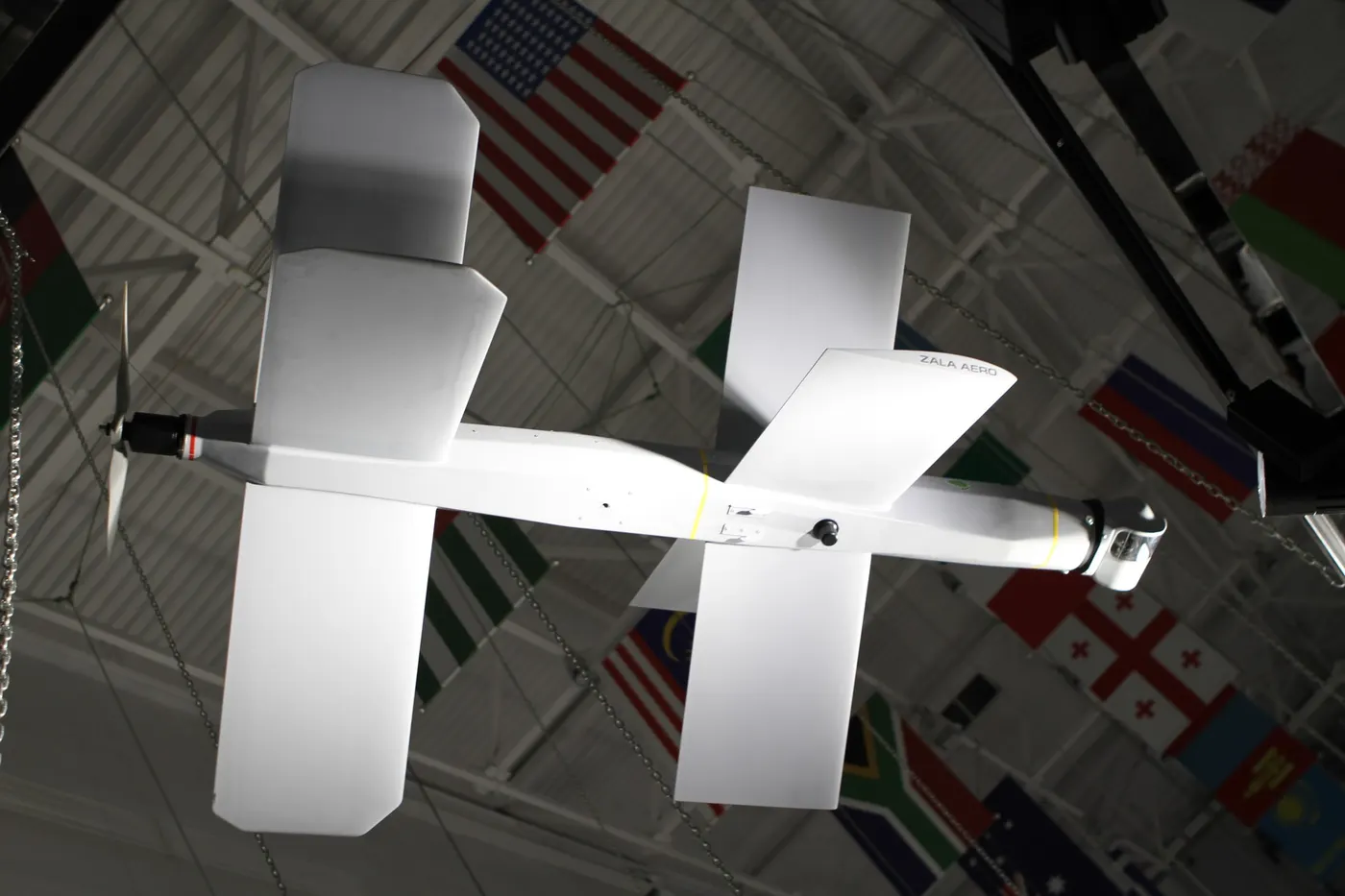
Russia's ZALA Lancet loitering munition is driven by an electric motor turning a single pusher propeller. It cruises at about 110 km/h, dives at up to 300 km/h, and has an official range of 40 km.Wikipedia
It is the hardest family to hear. One propeller and an electric motor produce far less noise than four or six rotors or a combustion engine, and a Lancet in its terminal dive is falling, not climbing on full power. A listening network may pick it up while it loiters at low altitude; it should not count on hearing the final seconds. Against this family, acoustic sensing serves as a tripwire that a munition is overhead, and radar or optics have to do the rest.
ZALA Lancet — one electric pusher, little to hear
Two cross-shaped wing sets and a single propeller at the tail. The quietest family in this assessment.
This is the family Ukrainians learned to recognise by ear. The Shahed-136 and its Russian-built Geran-2 are powered by the Iranian MD-550, a copy of a German 550 cc four-cylinder two-stroke engine, and fly at around 185 km/h.Wikipedia In September 2022, the spokeswoman for Ukraine's Operational Command South warned that they "are quite loud, you can hear them even at night. It resembles the sound of a moped or chainsaw engine."Babel Within weeks, residents were describing them as sounding like motorbikes.RFE/RL
That loudness is why Ukraine's national acoustic networks work so well against this family. It is also why the decoy matters. The Gerbera looks like a Shahed but is a foam-and-plywood airframe, about 2 m long, costing around $10,000. It is driven by a 60–70 cc hobby engine, not the 550 cc MD-550.Wikipedia A radar track cannot easily tell the two apart. An engine roughly one-eighth the displacement very likely sounds different. It is our assessment, not a field-verified result, that a well-trained acoustic classifier could help separate decoys from armed Shaheds and save interceptors for the real ones.
The family also includes reconnaissance aircraft. Russia's Orlan-10 is a small fixed-wing aircraft with a single-cylinder four-stroke piston engine, a top speed of 150 km/h and endurance of up to 16 hours.Wikipedia It is quieter than a Shahed but stays overhead for hours, and Russian forces rely on it to find targets for their artillery. Its engine note over a position is a warning that fire may follow.
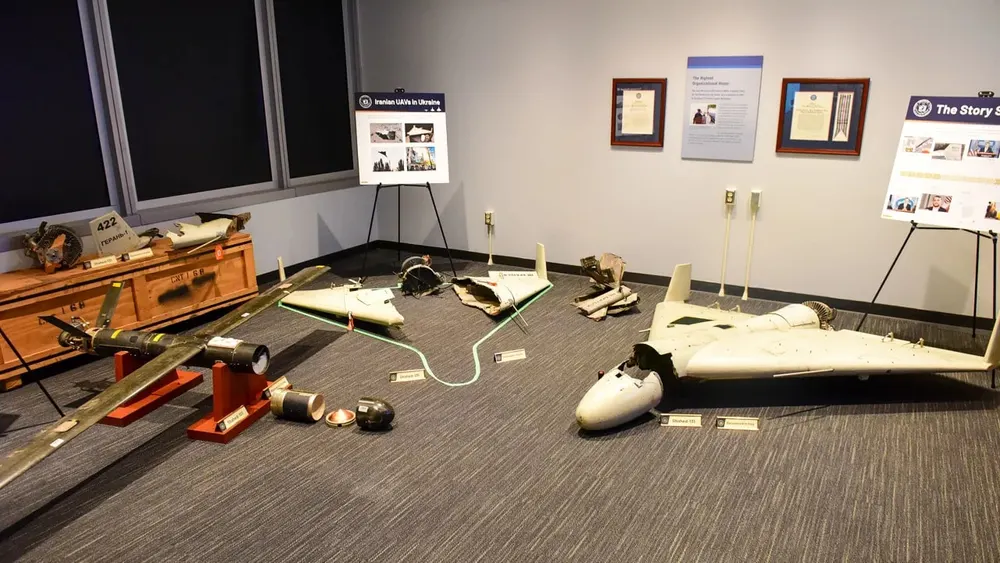
Shahed / Geran-2 — 550 cc of two-stroke
Recovered airframes from Iraq and Ukraine, examined by U.S. intelligence.
Photo: U.S. Defense Intelligence Agency · Public domain · Wikimedia Commons
Gerbera — same shape, smaller voice
A foam decoy with a 60 cc engine, built to be mistaken for a Shahed.
Photo: State Emergency Service of Ukraine · CC BY 4.0 · Wikimedia Commons
Field 06 — Jets
When the moped becomes an airplane
The newest family swaps the piston engine for a small turbojet. Ukrainian electronic-warfare specialist Serhiy Beskrestnov warned as early as January 2024 that, besides the "moped" sound of standard Shaheds, Ukrainians would also hear "the sound of an airplane."Kyiv Post Russia now flies the jet-powered Geran-3. Ukraine's Defence Intelligence (HUR) puts its speed at 300–370 km/h, with the top end reached mainly in the final dive and inside air-defence zones, a Chinese Telefly JT80 turbojet and a range of up to about 1,000 km.Ukranews Other reporting, also attributed to HUR, cites 550–600 km/h and a different engine. We treat that figure as unresolved.TSN
Speed is what changes the problem. The arithmetic is simple: every kilometre of detection range buys about 19 seconds against a drone at 185 km/h, but only about 10 seconds at 370 km/h, and about 6 seconds at 600 km/h.
Threat — speed
Seconds of warning per km detected
From 2 km of detection range
Lancet cruise110 km/h
33 s
about 65 s
Shahed / Geran-2185 km/h
19 s
about 39 s
Sting interceptor343 km/h
10.5 s
about 21 s
Geran-3, HUR figure370 km/h
10 s
about 19 s
Geran-3, higher claim600 km/h
6 s
about 12 s
Jet-poweredWarning time = distance ÷ speed, rounded; it ignores the time needed to classify and pass on an alert
For a network built to cue mobile gun crews against 185 km/h targets, halving the warning time is a doctrinal problem, not a tuning problem. Listening posts have to sit further out along likely approach routes, and alerts have to reach the guns faster.
Field 07 — The friendly sky
When your own drones sound like theirs
The fastest-growing family on the Ukrainian side is the interceptor. Wild Hornets' Sting is a 3D-printed quadcopter costing about $2,100 that flies at up to 343 km/h to destroy Shaheds valued at around $35,000.Wikipedia Acoustically it belongs to the small-multirotor family: the same whine as an enemy FPV, but much faster.
That creates a problem every acoustic network will face. The sky over a defended area is now full of the defender's own drones: interceptors, reconnaissance quadcopters and heavy bombers on their way out. A sound classifier can name the family; it cannot read a flag. Acoustic detections have to be fused with a picture of friendly launches and flight routes, or the network will waste guns and attention on its own aircraft.
Sting interceptor — a friendly whine
Same propulsion family as an enemy FPV. Only fusion with friendly flight data tells them apart.
Photo: General Staff of the Armed Forces of Ukraine · CC BY 4.0 · Wikimedia Commons
Confidence
How sure we are, and what would change it
High confidence that propulsion sets a drone's acoustic character, and that piston-engined Shahed-type drones are loud and widely recognised by ear. The physics is textbook and Ukrainian officials have said so on the record.
Moderate confidence in the specifications cited (speeds, ranges, payloads, spool lengths). Most come from manufacturers, belligerents or encyclopaedia summaries of them, and several are disputed. The Geran-3's speed in particular is reported at both 300–370 km/h and 550–600 km/h.
Low confidence, flagged as our assessment: that acoustic classification can reliably separate Gerbera decoys from armed Shaheds, and how well this works in the field. We have found no published field results.
What would change it: quieter propulsion becoming common, such as electric power in the one-way-attack family; or published detection-range data per family from Ukrainian networks.
Close — what it means
Listen for the engine, not the flag
Sorting by propulsion gives a defender something that sorting by size or link does not: a class label that survives radio silence, camouflage and darkness. A listening network can say "piston one-way attack drone, inbound" without knowing the model, and that is enough to decide whether to wake the gun crew or the interceptor team.
It also shows where the pressure is going. At the bottom of the scale, fibre-optic FPVs have made the small-rotor family invisible to radio detection, which makes sound one of the few remaining passive signatures. Covering that family takes dense, cheap meshes. At the top, jets have halved the warning time, so networks have to listen further out and pass alerts faster. In the middle, decoys and look-alike copies mean that "heard it" has to become "heard what". That needs classifiers trained on the right engines, fused with a picture of friendly traffic.
At DroSonic we work on this problem: passive acoustic detection that classifies what it hears, emits nothing and plugs into the rest of the air picture. Every drone has a voice. The job is to recognise it in time.