For years, almost no one in the United States outside four federal departments could lawfully interfere with a drone, and even detecting one could raise questions under surveillance law. That changed in December 2025, when Congress extended counter-drone authority to trained state and local police. This report sets out the new rules in plain terms: who may detect, who may stop, and why the choice of sensor still matters. It is analysis, not legal advice.
Published
October 2026
Subject
Who may detect and who may mitigate drones under U.S. law
Source base
Federal interagency advisory (2020), SAFER SKIES Act implementing rule (2026), legal and trade analysis
Method
Read the primary guidance; separate detection from mitigation; flag what remains unsettled
Verdict
The law now has two tiers; sensors that don't intercept communications sit on the firmest ground
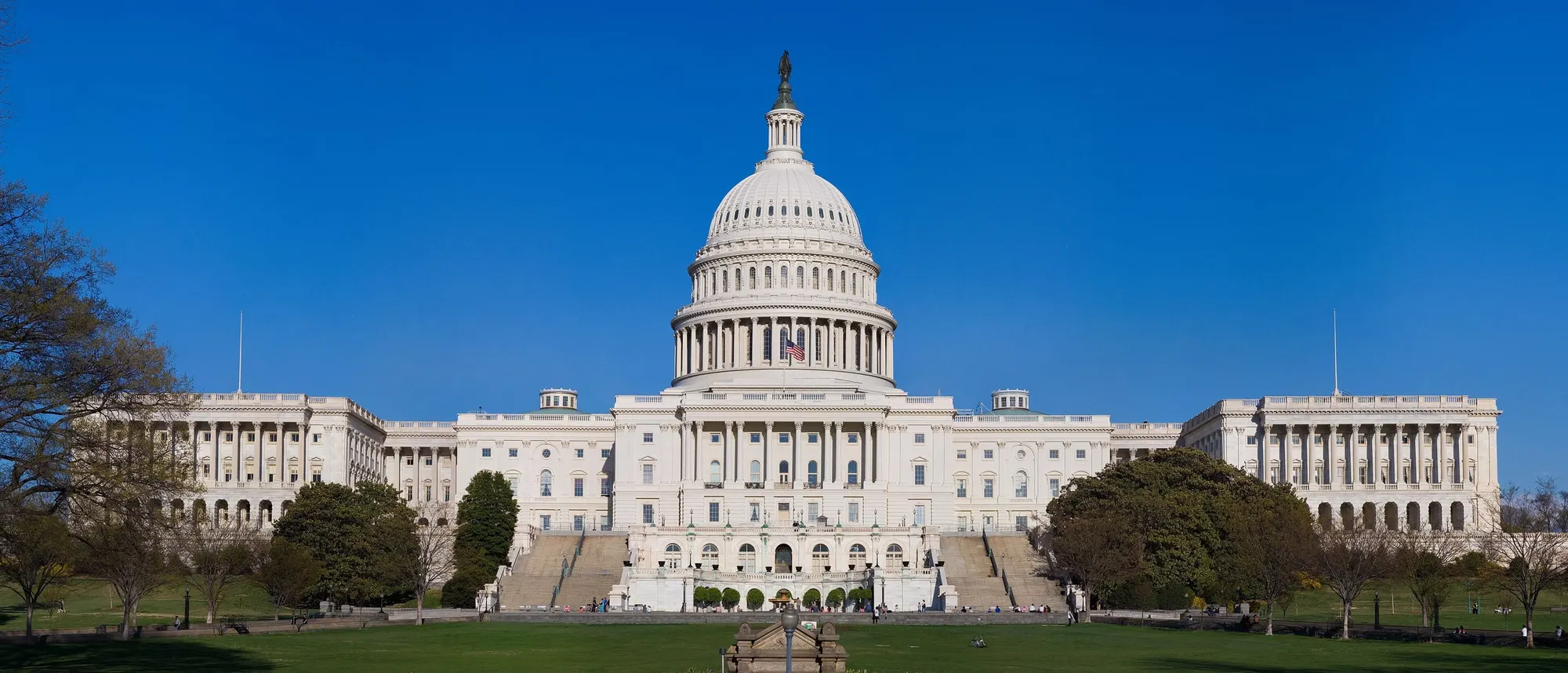
Photo: United States Capitol · Noclip · Public domain · Wikimedia Commons
Bottom line
In the United States, the right to stop a drone is now shared with trained local police, but not with the people who own the places drones threaten, and the legal position of detection depends on how the sensor works. Until December 2025, Congress had authorised only four federal departments to counter drones, and even detection systems could fall foul of federal wiretap and pen-register laws. The SAFER SKIES Act, passed in the FY2026 defence bill, lets certified state, local, tribal and territorial agencies detect drones and, with further training, disable them. Private utilities, venues and companies still have no mitigation authority. For them, and for the agencies, the federal government's 2020 guidance points to sensors that detect the drone itself (radar, optical and acoustic) as less likely to raise surveillance-law concerns than systems that intercept drone communications.
4
federal departments with counter-drone authority before 2025◆ Defense, Energy, Justice, Homeland Security
1 July 2026
state and local police gain certified C-UAS authority◆ SAFER SKIES Act implementing rule
2 tiers
detection and warning, then mitigation◆ separate FBI certification for each
0
mitigation powers granted to private operators◆ utilities, venues, companies
Key questions
Who can legally stop a drone in the United States?
Federal agencies with express authority from Congress (Defense, Energy, Justice and Homeland Security) and, since July 2026 under the SAFER SKIES Act, state, local, tribal and territorial law enforcement and correctional agencies that complete FBI certification. Private companies and property owners are not given mitigation authority.
Is it legal to detect drones in the United States?
Detection is far less restricted than mitigation, but it depends on how a system works. A 2020 federal advisory says sensors such as radar, EO/IR and acoustic systems, which sense the drone itself rather than intercepting its communications, are less likely to raise concerns under federal surveillance laws. Radar also needs an FCC licence. Operators should take legal advice.
State, local, tribal and territorial policeSAFER SKIES Act
Yes, after FBI Tier 1 certification
Yes, after FBI Tier 2 resident training
Private operatorsutilities, venues, companies, airports' own staff
Depends on the sensor and applicable law
No
Since 1 July 2026 · analysis, not legal advice; sources below
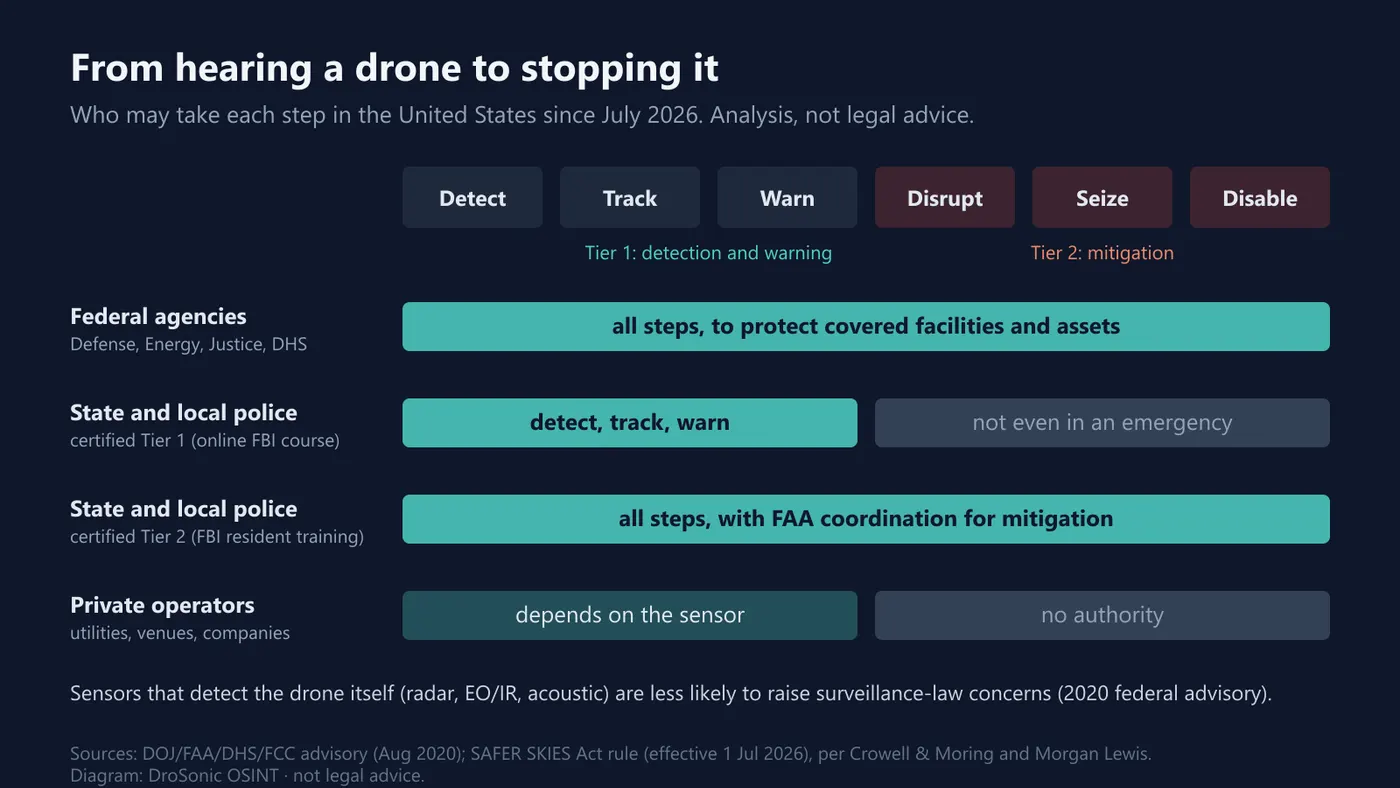
From hearing a drone to stopping it — who may take each step
The line between detection and mitigation is the line between who can act and who must call someone who can.
Diagram: DroSonic OSINT · original · from the 2020 federal advisory and the SAFER SKIES Act rule · not legal advice
Field 01 — Before 2025
Four departments and a legal minefield
For most of the drone era, U.S. law treated counter-drone activity as something only a handful of federal agencies could do. A joint 2020 advisory from the Justice Department, FAA, Homeland Security and FCC put it directly: "Congress has exclusively authorized the Departments of Defense, Energy, Justice, and Homeland Security to engage in limited UAS detection and mitigation activities" against drones threatening covered facilities, notwithstanding federal criminal laws that might otherwise apply.U.S. DOJ, FAA, DHS & FCC
The advisory's central warning concerned surveillance law. Whether a detection system risks breaching the federal Wiretap Act or Pen/Trap Statute, it said, "depends on whether it captures, records, decodes, or intercepts, in whole or in part, electronic communications transmitted to and from a UAS and/or controller." It added that the legal analysis turns on how each system actually works, "not … broad classifications of systems (e.g., active versus passive, detection versus mitigation)".U.S. DOJ, FAA, DHS & FCC
Field 02 — The sensor matters
Sensing the drone versus reading its signals
The advisory then drew the distinction that matters most for detection technology:
Detection systems "such as radar, EO/IR, and acoustic systems" sense "the sound or electromagnetic waves produced by or reflected from the UAS" and "are less likely to pose concerns under federal criminal surveillance statutes."
The reason is that such sensors "do not capture, record, decode, or intercept electronic communications." They detect the drone's physical presence, not the messages between drone and pilot. Systems that work by intercepting or decoding drone radio links are the ones that need the most careful legal analysis.U.S. DOJ, FAA, DHS & FCC
That does not make any sensor automatically lawful. The advisory stresses that every system must still comply with FCC and FAA rules, and that state and local laws may apply. Radar, for example, emits radio energy and requires an FCC Radiolocation Service licence. Passive sensors that emit nothing, such as microphones and cameras, avoid that particular requirement.
Field 03 — The change
The SAFER SKIES Act
In December 2025 Congress passed the SAFER SKIES Act as part of the FY2026 National Defense Authorization Act. It extends counter-drone authority, under 6 U.S.C. § 124n, to properly trained state, local, tribal and territorial law enforcement and correctional agencies.Crowell & Moring The Justice Department and Homeland Security issued an interim final rule, effective 1 July 2026, that sets up two tiers:
Tier 1, detection and warning: detect, identify, monitor and track drones and warn operators, after online certification.
Tier 2, mitigation: disrupt, seize control of, or disable a drone, after hands-on training at the FBI's National Counter-UAS Training Center. Tier 1 personnel cannot take Tier 2 action, "even in an emergency."
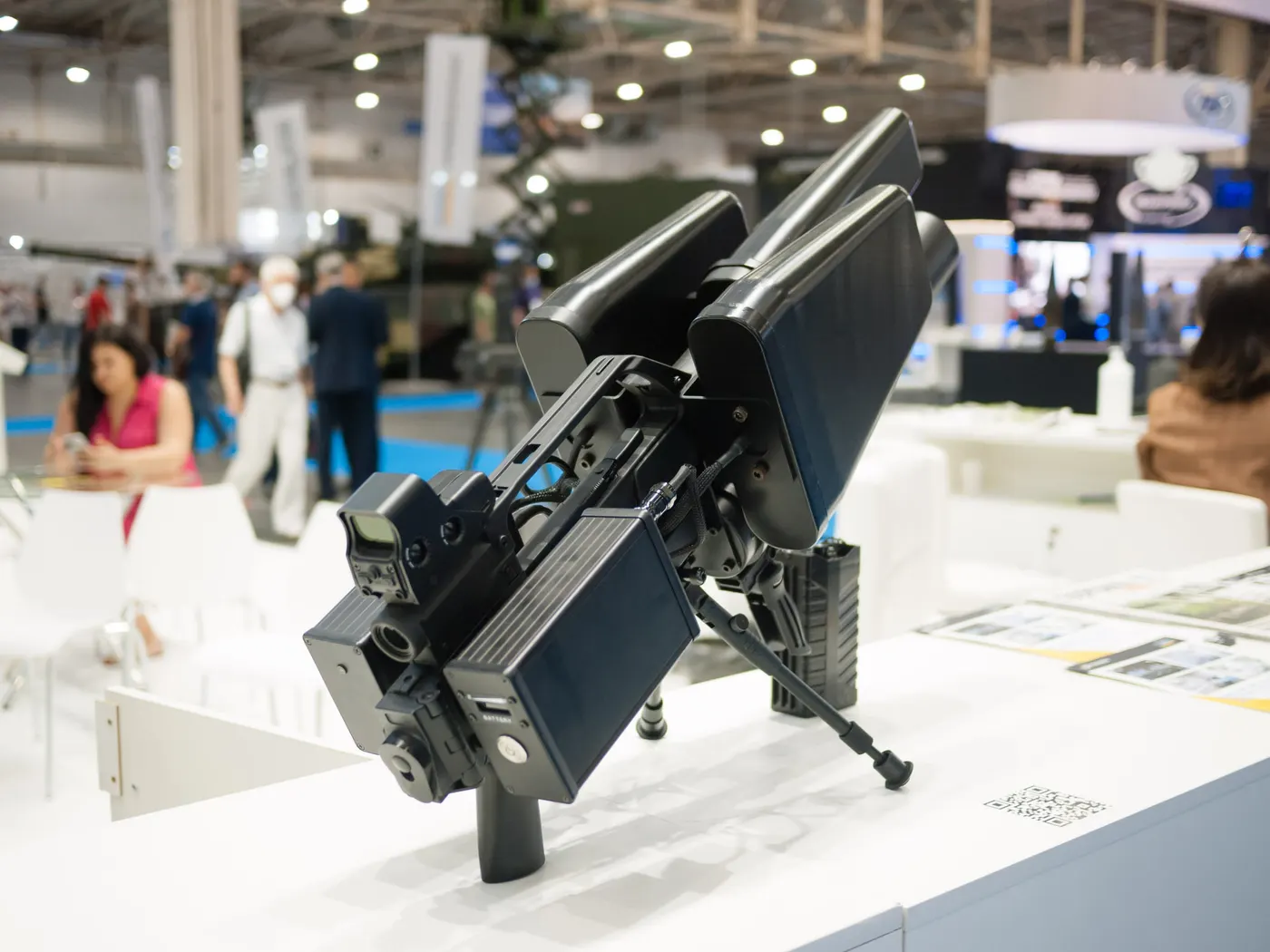
A handheld drone jammer — Tier 2 territory
Jamming is mitigation. In the United States it is reserved for certified government agencies and raises aircraft-sabotage and spectrum-law issues for anyone else.
Agencies may deploy only technologies on federally maintained authorised lists, mitigation generally requires FAA coordination and real-time notice to air traffic control, and the FCC created a temporary nationwide authority for qualifying agencies to run approved RF-based systems.Morgan Lewis Penalties for knowingly skipping required federal steps can reach $100,000 per violation.Crowell & Moring
The early lists are narrow. According to LE Drones, a law-enforcement drone supplier, radio-frequency systems were the only approved technology category as of late summer 2026, with 21 systems listed, and authority may be exercised only by an agency's own certified officers, never by contractors.LE Drones
Field 04 — What's still missing
The private operator's position
The new law helps the places drones threaten mostly through the police who protect them. Stadiums, utilities, prisons and critical-infrastructure owners benefit, but the authority sits with government agencies. Trade coverage of the Act notes that other facilities could monitor their airspace continuously only "if given the authority to do so".Facilities Dive No private operator has gained the right to jam, seize or shoot down a drone.
That leaves three open questions:
Private detection. What a utility or venue may run on its own property is still governed mainly by the 2020 analysis: the less a sensor touches drone communications, the firmer its footing.
Technology lists. Lists that start with RF-only systems leave agencies without approved options against drones that transmit nothing, the fibre-optic and autonomous drones now common in Ukraine.
Coordination. The February 2026 airspace closure at El Paso, which followed the uncoordinated use of a counter-drone laser, showed what happens when counter-drone action and aviation safety are not joined up.Wikipedia
Confidence
How sure we are, and what would change it
High confidence in the primary texts quoted: the 2020 interagency advisory and the existence, date and two-tier structure of the SAFER SKIES rule.
Moderate confidence in details of the implementing rule (approved-technology lists, FCC actions), which come from law-firm and trade analysis of a rule still open to revision after its comment period.
This is not legal advice. Anyone deploying detection or mitigation technology should consult counsel familiar with federal and state surveillance, aviation and communications law, as the 2020 advisory itself recommends.
Close — what it means
Detection is where the law leaves room
The legal map of U.S. drone defence now has a clear shape. Stopping drones is for certified government agencies, under federal training and supervision. Detecting them is open more widely, and its legal footing depends on how the sensor works. Sensing the drone itself (its echo, image or sound) is on firmer ground than intercepting what it says.
That is one reason passive acoustic detection suits critical-infrastructure operators and the agencies that protect them. It emits nothing, needs no spectrum licence, and senses a drone's sound rather than its communications, including drones that send no radio signal at all. At DroSonic we expect approved-technology lists to widen beyond RF as fibre-optic and autonomous drones spread, and we are building for that. Our explainer What a Microphone Can Hear covers how the technology works.