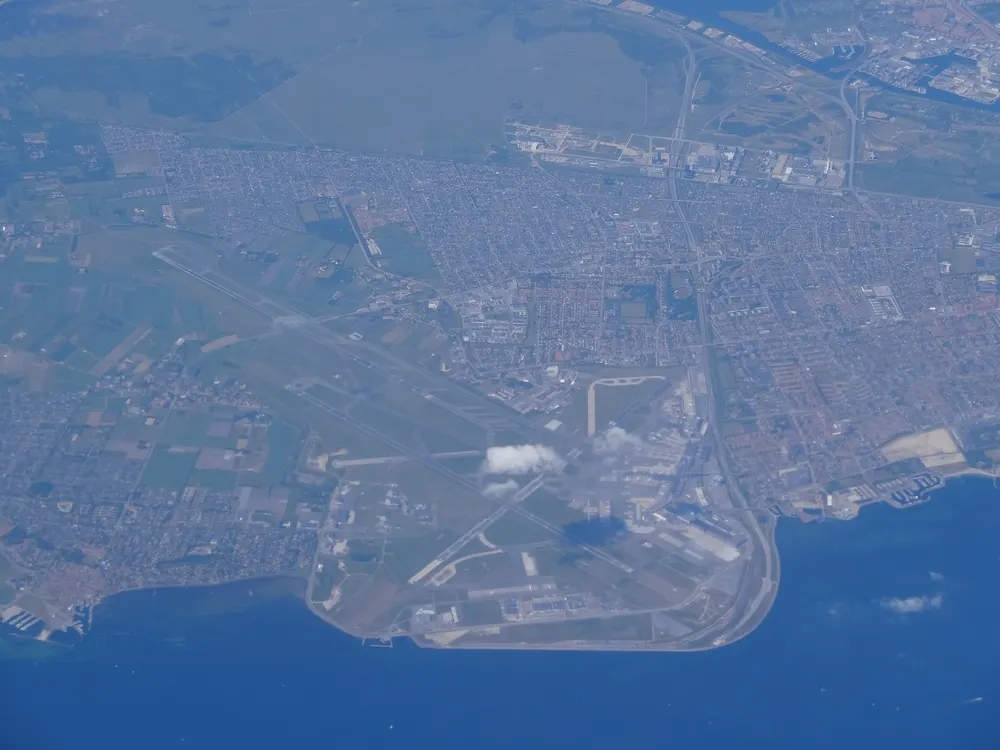
Since 2018, drone reports have closed some of Europe's busiest runways for hours at a time, and in August 2026 an explosive-laden drone reached the apron at Leipzig/Halle. The striking pattern is not that airports lack ways to shoot drones down. It is that they often cannot say for certain whether a drone was there at all. This report looks at why, and at what an airport needs to know in the first five minutes.
Published
October 2026
Subject
Why drone sightings close airports, and what airport detection lacks
Source base
Incident records and press reporting, government statements, FAA testing programme
Method
Compare incidents by what was detected, confirmed and recovered
Verdict
The common failure is confirmation, not interception
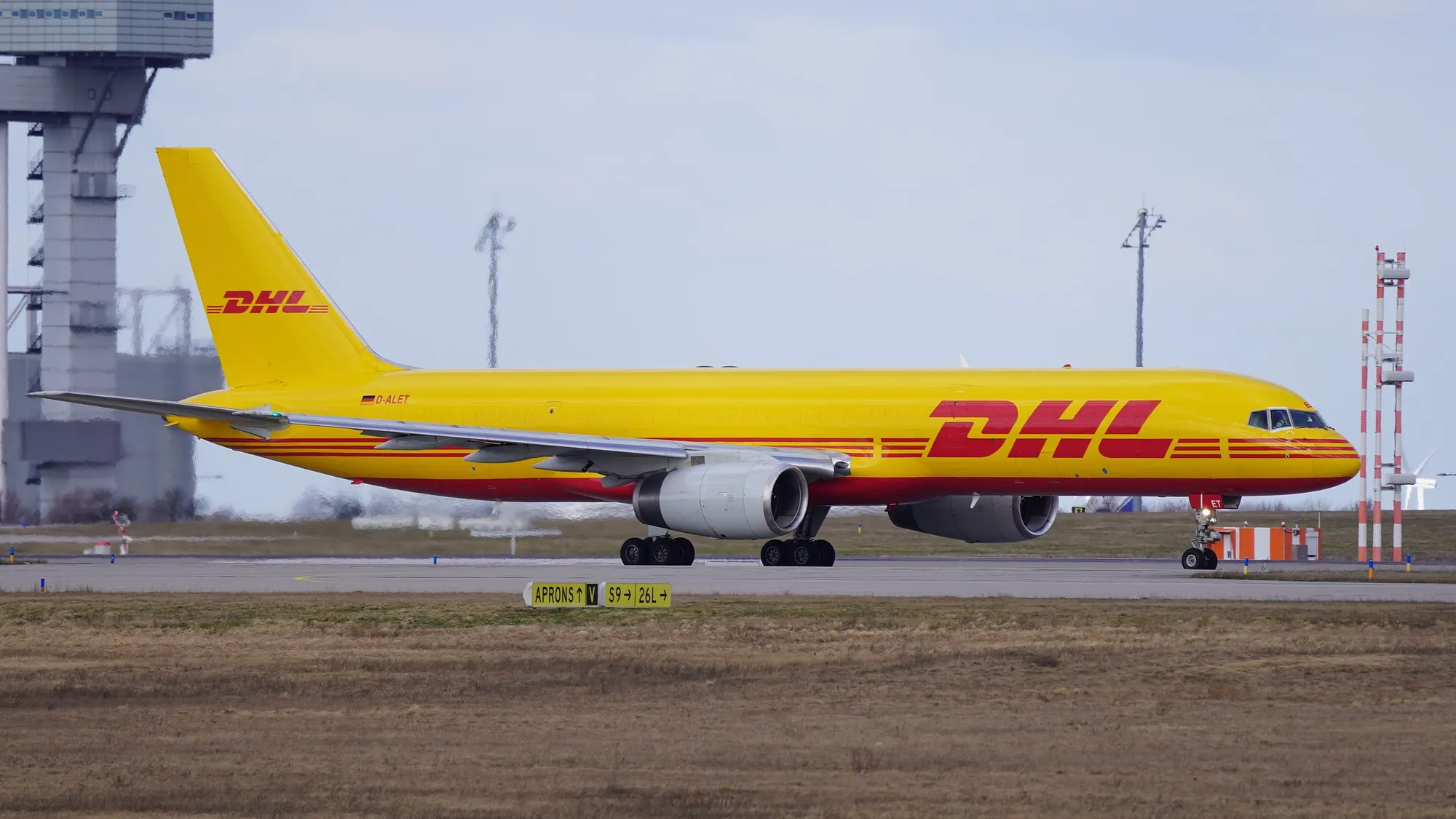
Photo: European Air Transport Leipzig / DHL Boeing 757 at Leipzig/Halle · MarcelX42 · CC BY-SA 4.0 · Wikimedia Commons
Bottom line
Airports are not closing because they cannot shoot drones down. They are closing because they cannot tell, quickly and with confidence, whether a drone is there and where. At Gatwick in 2018, about 140,000 passengers were stranded by sightings that produced no photograph, video or recovered drone. In autumn 2025 a wave of reports closed Copenhagen, Oslo, Munich, Brussels and other airports; nine months later Danish police said they could neither prove nor rule out the Copenhagen drones. Then in August 2026 a real drone carrying explosives reached the apron at Leipzig/Halle, reportedly unseen by the airport's anti-drone system. The lesson is the same in every case. Airports need to confirm and locate a drone within minutes, with sensors that do not depend on the drone transmitting.
≈ 140,000
passengers hit by Gatwick's 2018 drone closure◆ no drone evidence ever produced
≈ 9,500
passengers affected by Munich's two closures◆ 2 and 3 October 2025
9 months
before Copenhagen police said they could neither prove nor deny the drones◆ September 2025 sightings
Key questions
Why do airports close when drones are reported?
Because a collision with an aircraft on approach or take-off could be catastrophic, and most airports cannot quickly confirm or rule out a drone. Without reliable detection and location, the safe response to a credible sighting is to stop flights.
Can airport anti-drone systems miss a drone?
Yes. At Leipzig/Halle in August 2026, reports say a drone flew over the airport undetected because a SIM card made it look like an ordinary mobile phone to the airport's anti-drone system. Systems that listen only for drone radio links miss drones that don't use them.
The Ruler — the whole argument
Four airports, one failure
Incident
What happened
What could be confirmed
GatwickDec 2018
Runway closed on and off over three days; ~1,000 flights affected
Visual sightings only; no drone evidence produced
Copenhagen and OsloSep 2025
Copenhagen closed about four hours; Oslo closed the same night
Police later could neither prove nor deny the drones
MunichOct 2025
Two closures in 24 hours; ~3,000 then ~6,500 passengers affected
No drone identified or recovered
Leipzig/HalleAug 2026
Explosive drone found by a Ukrainian An-124; a freighter struck on approach
A real attack, reportedly missed by the airport's anti-drone system
The first confirmed armed drone at a European airport in this sample · sources below
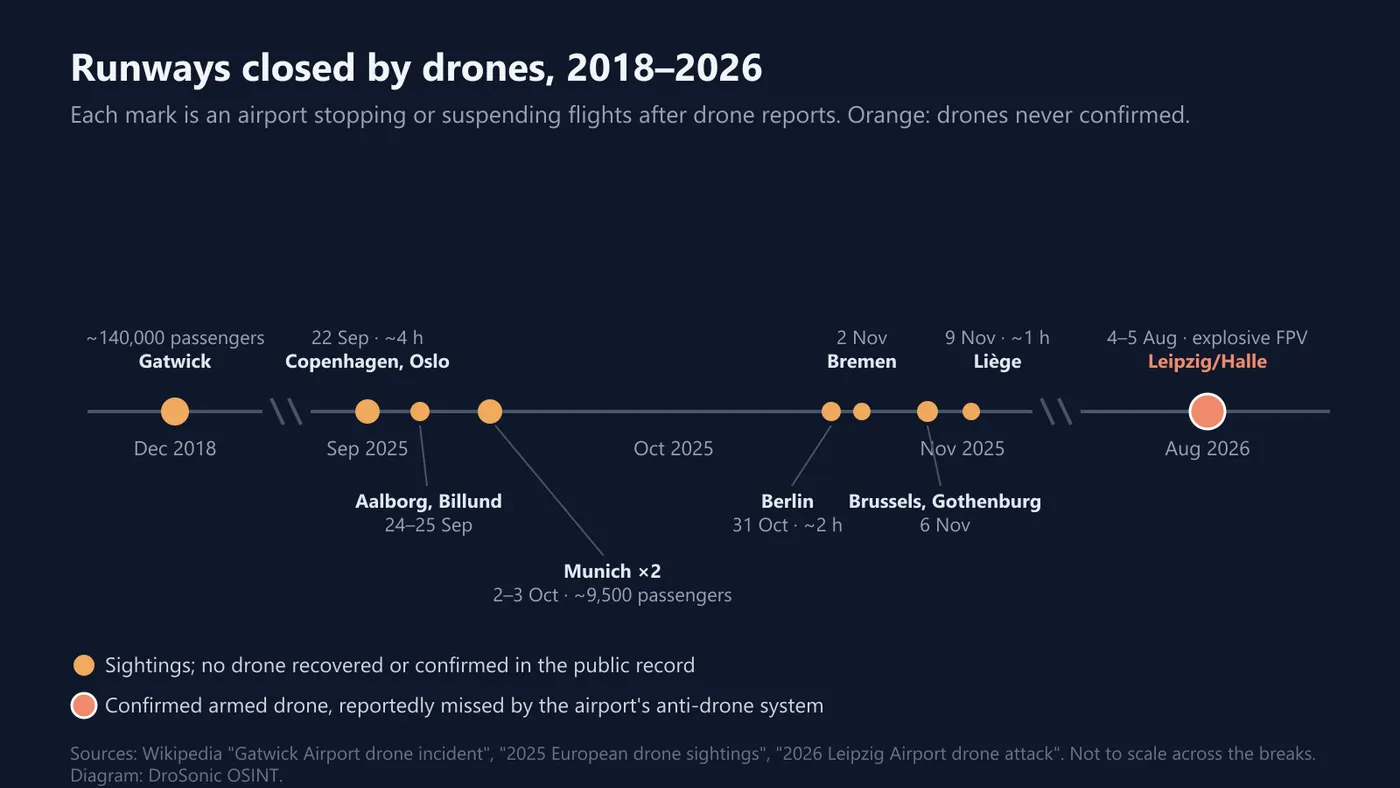
Runways closed by drones — eleven airports, one confirmed attack
Every orange mark is a disruption where, in the public record, no drone was recovered or confirmed. Leipzig/Halle is the exception.
Diagram: DroSonic OSINT · original · from the incident records cited below
Field 01 — The pattern
Sightings without confirmation
The template was set at Gatwick. Between 19 and 21 December 2018, reported drone sightings closed the runway repeatedly, affecting about 1,000 flights and 140,000 passengers. The reports were visual, from security staff and police. No photographs or video of a drone emerged, and the investigation closed without identifying anyone responsible.Wikipedia Gatwick then spent about £5 million on counter-drone equipment.
Autumn 2025 repeated the pattern across northern Europe. Copenhagen suspended flights for nearly four hours on 22 September after reports of large drones; Oslo closed the same night; Aalborg and Billund followed within days. Munich stopped flights twice in 24 hours on 2 and 3 October, affecting about 3,000 and then 6,500 passengers. Berlin, Bremen, Brussels and Liège were disrupted in October and November.Wikipedia Danish authorities called the activity a likely hybrid operation. Yet in June 2026 Copenhagen police said they had been unable either to prove or to deny that drones were over the airport on 22 September.Wikipedia
Each closure was the safe call. Each one also showed an airport that could not see what it was closing for.
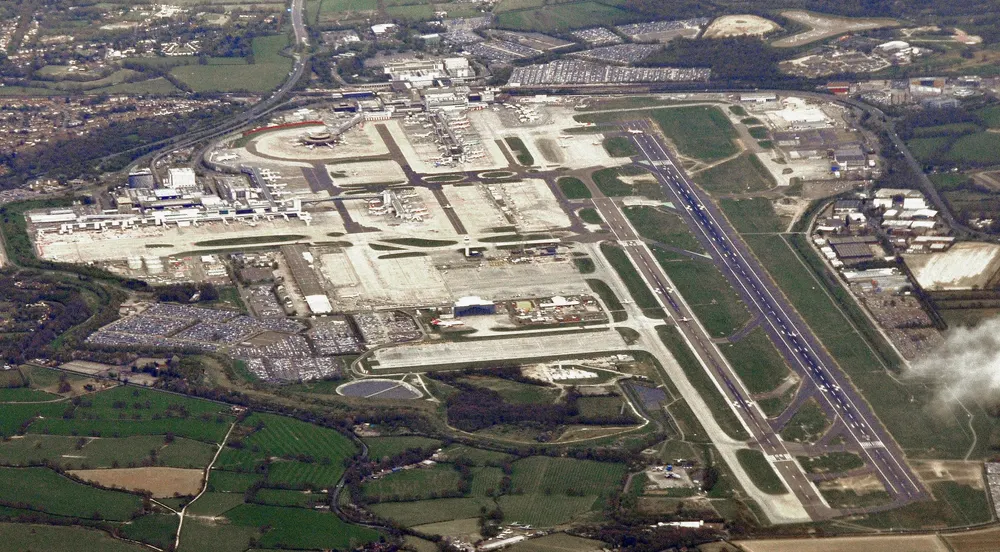
Gatwick — closed for three days in 2018
Britain's second-busiest airport, then the world's busiest single-runway airport.
Footage published under the title "Airport drone flight at Melbourne Airport in restricted airspace", filmed in April 2020 when the airport was nearly empty. It shows how close a small consumer drone can get to parked airliners. We show it as an illustration of the risk, not an endorsement.
On the night of 4–5 August 2026, a quadcopter FPV drone carrying explosives was found on the grounds of Leipzig/Halle Airport near an empty Ukrainian An-124 cargo aircraft. A second object struck a freighter that had aborted its landing because the runway was closed. Germany's interior minister called it a "new quality of danger".Al Jazeera On 1 September Germany formally blamed Russia, saying investigators had proof the operators worked on behalf of Russian state entities. Moscow rejected the accusation.Al Jazeera
The detection detail matters most. According to reporting compiled on the incident, the drone was controlled over the mobile network through a SIM card, which made it look like an ordinary phone to the airport's anti-drone system, and the system reportedly failed to detect it.Wikipedia A sensor that looks for drone radio links is blind to a drone that doesn't use them, the same gap fibre-optic drones exploit on the battlefield.
Munich Airport — two closures in 24 hours
In October 2025 drone sightings stopped flights twice in two days, affecting about 9,500 passengers in total.
An airport is close to the worst place to find a small drone:
Radar is tuned for aircraft. Airport surveillance radars track large, cooperative aircraft; a bird-sized drone below a few hundred metres is exactly what they filter out (see Parts 2–5 of our radar series).
RF detection depends on the drone transmitting. It catches consumer drones on standard links. It misses drones using mobile networks, fibre-optic cable or pre-programmed routes. Leipzig showed the first; the war in Ukraine shows the others.
Witnesses disagree. Lights, aircraft, stars and other drones produce credible-sounding reports that cannot be checked in the dark.
The perimeter is huge. Approach and departure paths extend kilometres beyond the fence, over land the airport does not control.
In the United States, the FAA has been testing drone-detection systems at airports, including Atlantic City, JFK, Denver and Dallas/Fort Worth, with the aim of setting minimum performance standards for any system used in or around U.S. airports.Vertical Magazine Since July 2026, trained U.S. state and local police can also be certified to detect, and in some cases disable, drones under the SAFER SKIES Act, passed with the FY2026 defence bill.Crowell & Moring
Field 04 — What an airport needs
The first five minutes
Our assessment of what an airport needs when a drone is reported:
Confirmation. Is there a drone? A second, independent sensor turns a sighting into a fact, or rules it out, and keeps runways open on false alarms.
Location and track. Where is it, how high, and where is it heading? That decides whether approaches must stop or just one runway.
Classification. Is it a small hobby quadcopter, a fixed-wing, something heavier?
Sensors that don't need the drone's cooperation. Detection that works whether the drone uses standard radio, a mobile network, fibre or autopilot. That means radar tuned for small targets, optical/infrared and acoustic sensing.
A record. Data that investigators can use afterwards, so the next Copenhagen does not end with "neither proved nor denied".
Confidence
How sure we are, and what would change it
High confidence in the incident record (dates, closures, passenger numbers) from multiple press and official sources.
Moderate confidence in the Leipzig detection details: reporting says the airport's anti-drone system missed the SIM-controlled drone, but the official investigation has not published its findings, and accounts differ on some details.
Our assessment is that confirmation and location, not interception, is the main capability gap at airports.
Close — what it means
Keep the runway open by knowing
Every closure in this record was a reasonable decision made in the dark. The cost of that darkness is counted in diverted flights and stranded passengers, and at Leipzig it came close to being counted in aircraft. What an airport needs first is not a weapon but certainty: a way to confirm, locate and classify a drone within minutes, whatever its control link.
Passive acoustic sensors are part of that picture. They hear drones that transmit nothing, emit nothing that could interfere with airport systems, and can ring a perimeter or an approach path cheaply. Our explainer What a Microphone Can Hear covers their range and limits. At DroSonic we build them for exactly this kind of critical-infrastructure perimeter.