Radar is the backbone of air defence, and the obvious first answer to drones. This series explains, from first principles, why small drones are such a hard radar target and what that means for anyone defending against them. Part 1 starts with the basic trade that sets everything else, how far a radar can see as the target shrinks.
Published
August 2026
Subject
How radar detects targets, and how target size limits range
Source base
Open radar references, peer-reviewed drone RCS measurements, U.S. military imagery
Method
First-principles explainer; worked numbers labelled as our arithmetic
Verdict
Range scales with RCS^¼, so small drones shrink a radar's useful reach to a few kilometres
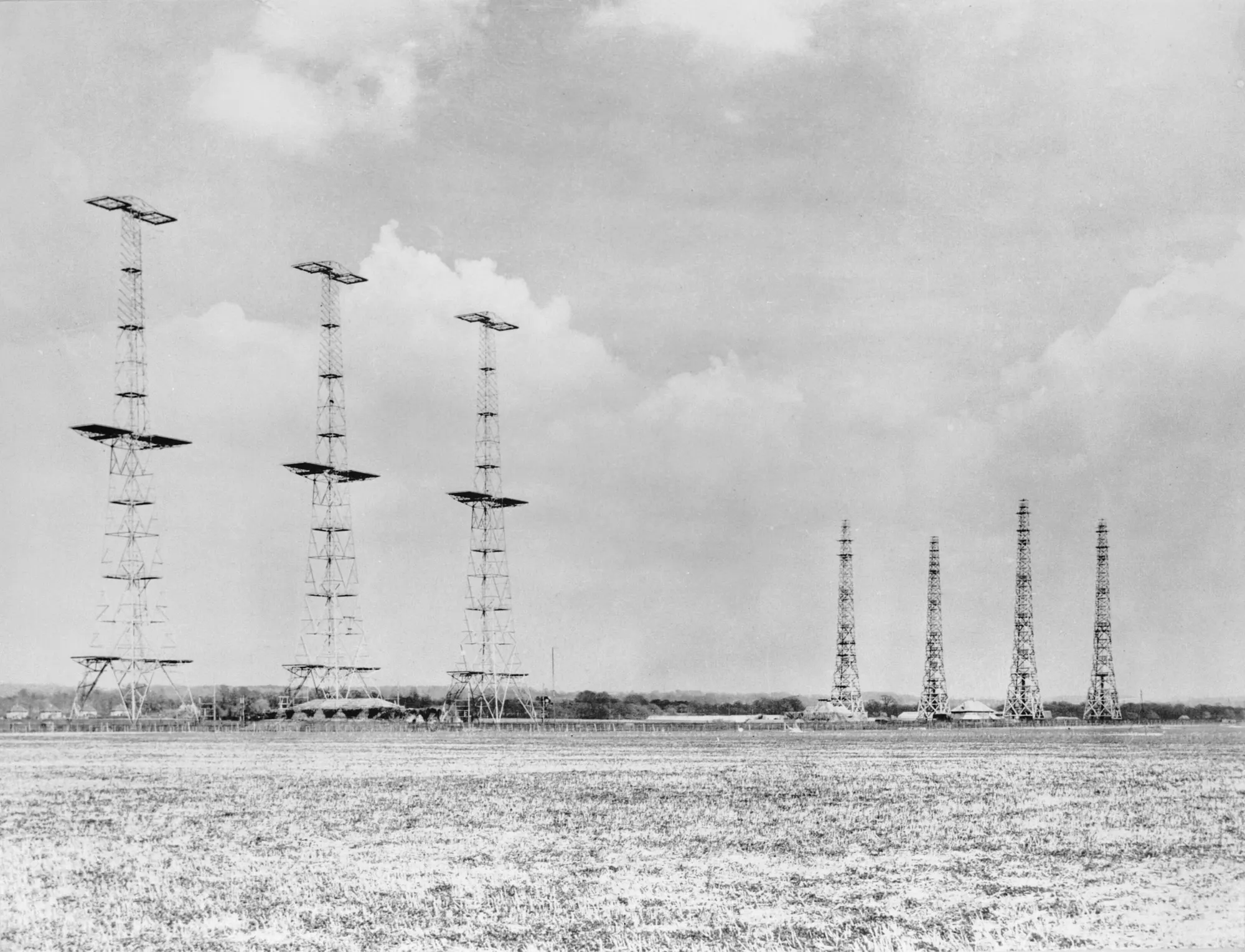
Photo: Chain Home radar station, Poling, 1945 · Royal Air Force official photographer · Public domain · Wikimedia Commons
Bottom line
A radar's reach against a target depends on the fourth root of how big an echo that target returns, and a small drone returns an echo the size of a bird's. Radar works by sending out radio energy and listening for the faint reflection. The reflection weakens with the fourth power of distance, so doubling detection range takes sixteen times the power, or a sixteen-fold bigger echo. Turn that around and the problem with drones becomes clear. A small quadcopter's echo is about a hundredth of a person's, so a radar that sees a person at 10 km sees the drone at only about 3 km. This first part explains that trade. The rest of the series covers the effects that make it worse: echo size, terrain, Doppler, and false alarms from birds.
R⁴
how fast a radar echo fades with distance◆ out and back, each spreading with distance squared
16×
power needed to double detection range◆ 2⁴ = 16
≈ ⅓
of the range against a person, against a small drone◆ 0.01 m² vs 1 m², so (0.01)^¼ ≈ 0.32
Key questions
Can radar detect small drones?
Yes, but at much shorter range than aircraft. Small drones have a radar cross section of about 0.01–0.03 m², like a bird, and detection range grows only with the fourth root of that echo: a radar that sees a person at 10 km sees a small drone at roughly 3–4 km.
Why does radar range drop so sharply for small targets?
The echo weakens with the fourth power of distance, because the energy spreads out on the way to the target and again on the way back. Doubling detection range takes 16 times the power, or a 16 times larger echo.
The Ruler — the whole series
Five reasons small drones are hard for radar
Part
The problem
What it costs the defender
1The fourth-root problem
Echo strength falls with the fourth power of range
Range collapses as targets shrink
2Radar cross section
Plastic airframes and small size give a bird-sized echo
Little signal to work with
3Under the horizon
Low drones hide below the radar horizon, behind terrain and in clutter
Short or no warning
4Doppler and micro-Doppler
Slow or hovering drones look like the ground
Clutter filters can delete them
5Is it a bird?
Thresholds trade missed drones against false alarms
Operators drown in birds, or miss drones
One part a week · each takes one problem from first principles to what it means for counter-drone defence
Field 01 — The idea
An echo you can time
Radar was built before the Second World War to do what Britain's concrete sound mirrors could not: see aircraft early, in any weather, far beyond hearing range. (Our report Listening to the Sky covers the mirrors it replaced.) The idea fits in one sentence. Send out a pulse of radio energy, listen for the echo, and time it.
Distance comes from the round-trip time. Radio travels at the speed of light, so every microsecond of delay means about 150 m of range.
Direction comes from where the antenna was pointing, or from comparing signals across the antenna.
Speed comes from the Doppler shift of the echo's frequency. That is the subject of Part 4.
Britain's Chain Home network, pictured above, did this with huge fixed towers: 360 ft steel masts for transmitting and 240 ft wooden towers for receiving.Wikimedia Commons Modern counter-drone radars are the same principle in a box on a truck.
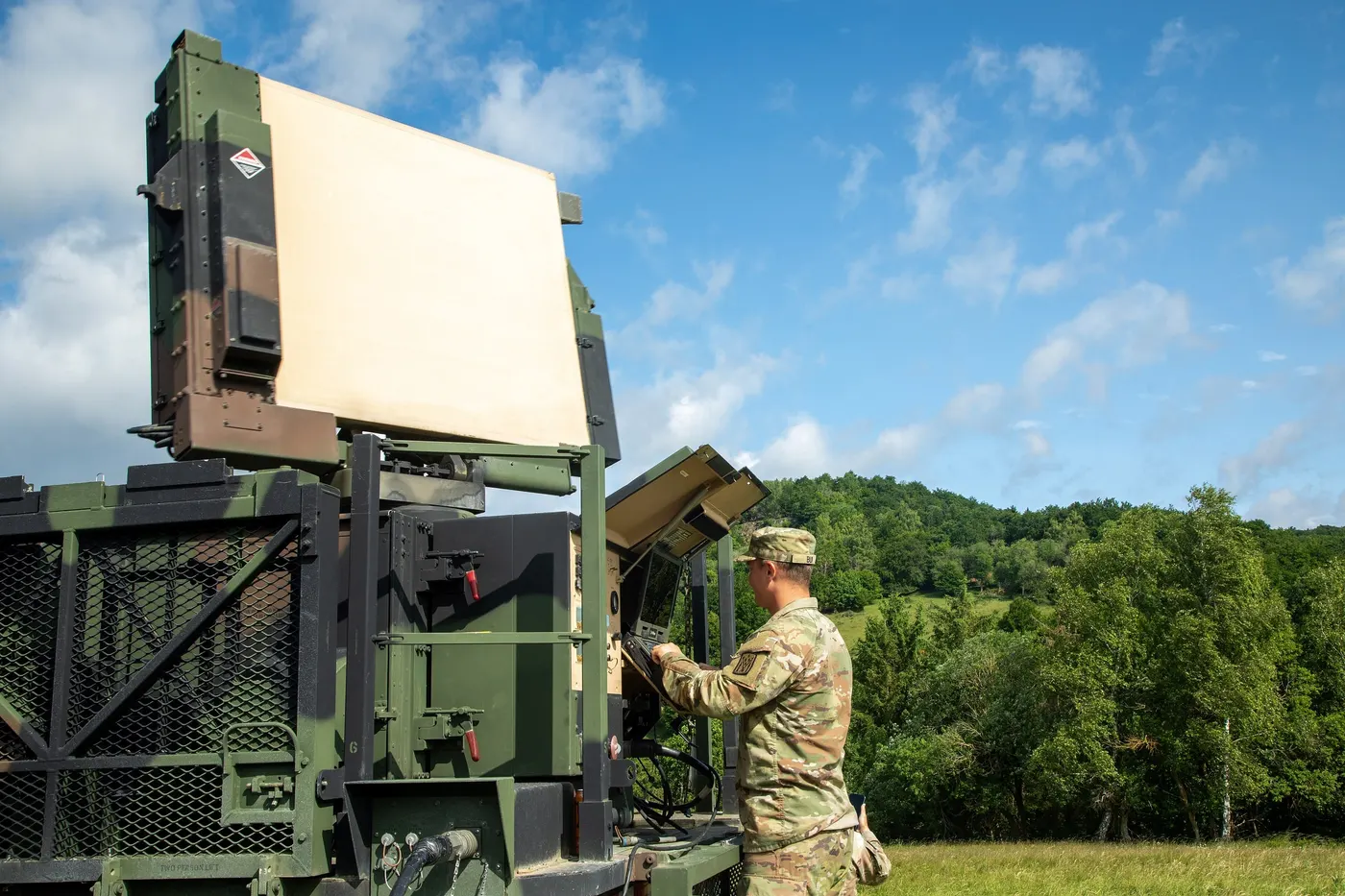
Sentinel radar, Project Flytrap 2025 — the same idea, eighty years on
A U.S. Army AN/MPQ-64 Sentinel at Hohenfels, Germany, during counter-drone trials of low-cost, portable systems.
Photo: U.S. Army, Pfc. Brent Lee · Public domain · Wikimedia Commons
Field 02 — The catch
Out and back, the energy spreads twice
A radar pulse spreads out as it travels, like ripples on a pond. At twice the distance, the same energy is spread over four times the area, so the target is lit by a quarter of the power. The target reflects some of that energy back, and the reflection spreads out on the return journey too, losing another factor of four. Out and back, the echo weakens with the fourth power of range: twice as far means one-sixteenth of the echo.
This is the core of the radar range equation. In plain terms, the echo a radar receives depends on:
Transmitter power: more power, more echo.
Antenna size and gain: a bigger antenna focuses the beam and collects more of the return.
Wavelength: it affects antenna gain and how targets reflect.
The target's radar cross section (RCS): how much energy it sends back towards the radar. This is the subject of Part 2.
Range, to the fourth power, working against all of the above.
A radar "detects" a target when the echo stands clearly above the receiver's own electrical noise. Part 5 covers what "clearly" means and why it matters.
Out and back, the energy spreads twice. Twice as far means a sixteenth of the echo.
Field 03 — The consequence
Why range collapses as targets shrink
Solve the range equation for distance and the fourth power becomes a fourth root. For a given radar, maximum detection range grows with the fourth root of the target's RCS.Wikipedia That works in both directions:
A target 16 times bigger is seen only twice as far away.
A target 100 times smaller is seen at about one-third of the range.
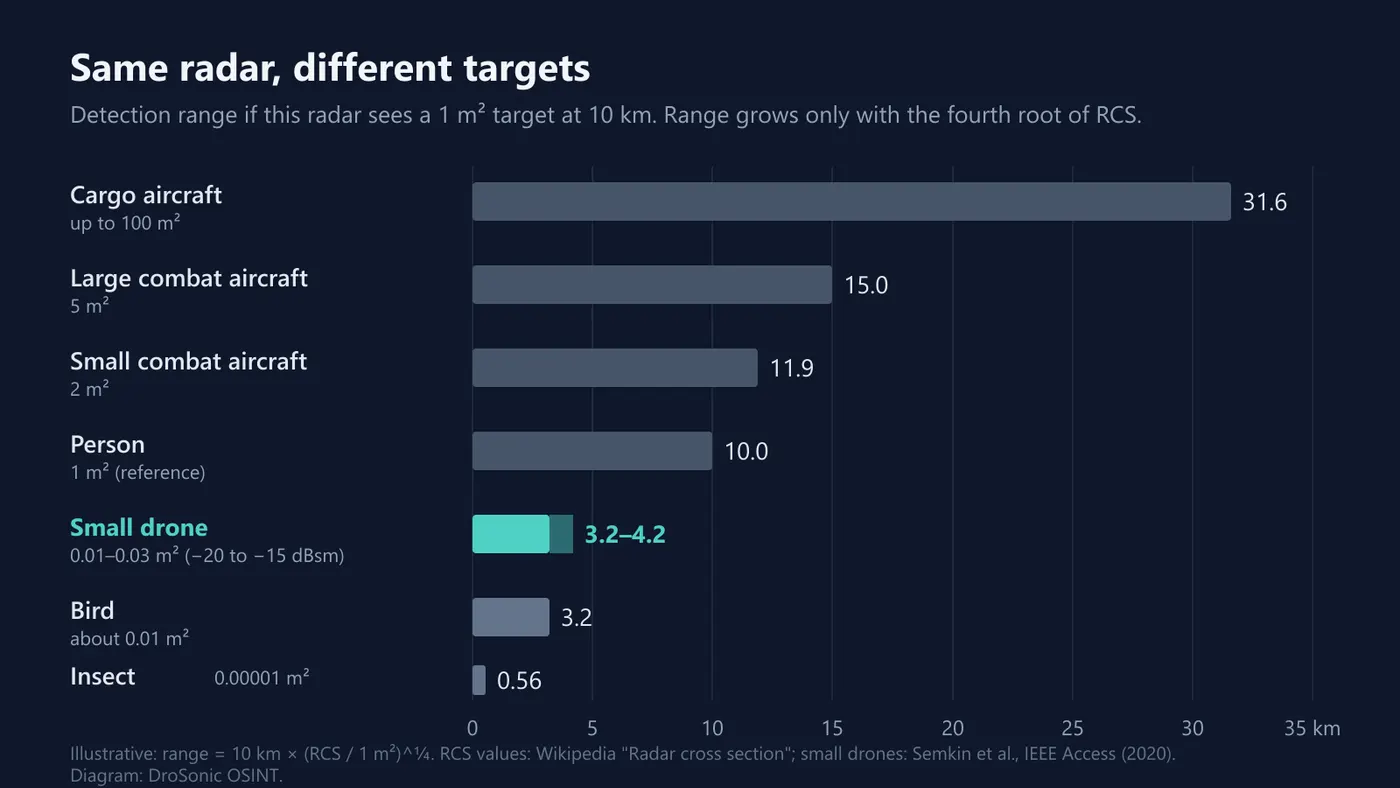
Typical radar cross sections in the open literature give a sense of scale: about 1 m² for a person, 2–3 m² for a small combat aircraft, up to 100 m² for a cargo aircraft, and about 0.01 m² for a bird.Wikipedia Measurements of small drones at X-band (a common radar band, around 10 GHz) typically fall between −20 and −15 dBsm, that is 0.01–0.03 m², in the same class as the bird.Semkin et al.
One radar, seven targets — the fourth root at work
If a radar sees a person at 10 km, the same radar sees a small drone at only 3–4 km. That is our arithmetic, using the fourth-root rule and typical RCS values.
Diagram: DroSonic OSINT · original · values from Wikipedia and Semkin et al. (2020)
In practice the gap is wider. A radar designed to spot aircraft tens of kilometres away also needs filters and thresholds tuned so that birds, rain and ground echoes don't swamp the screen. A target the size of a bird, flying low and slow, runs straight into every one of those filters. Parts 3 to 5 cover them.
Field 04 — The trade-offs
You can buy range back, at a price
There are only a few ways to recover the range that small targets take away, and each one has a cost.
More power. Doubling range takes 16 times the power. That means bigger power supplies, more heat and a stronger, easier-to-find emission.
A bigger antenna. More gain and finer beams, but a heavier, costlier system that is harder to move and hide.
Longer looks. Collecting more pulses on each target (integration) raises sensitivity. The price is a slower scan, so a fast drone can cross a gap between looks.
Shorter wavelengths. Higher frequencies give finer beams from smaller antennas and pick up small details such as rotor blades better. In exchange, rain and the atmosphere absorb them more.
Every radar is a compromise between these. That is why counter-drone radars are usually short-range, specialised sensors, not general air-surveillance radars with the gain turned up. It is also why they are rarely used alone.
Field 05 — The real world
Gatwick, and the limits of seeing
The best-known drone disruption of a major airport shows how hard the problem is. Between 19 and 21 December 2018, reported drone sightings closed Gatwick's runway and disrupted about 1,000 flights and roughly 140,000 passengers. Every report was a visual sighting by staff or police. No photographs or video of a drone were ever produced, and the police investigation closed without identifying a culprit.Wikipedia Gatwick then spent about £5 million on counter-drone equipment.
Whatever flew, or did not fly, over Gatwick, the episode shows the gap. Airport radars are built to track aircraft, not to confirm or rule out a bird-sized object at low altitude. Without a sensor that could do that, a major airport could neither confirm the threat nor rule it out for three days.
Confidence
How sure we are, and what would change it
High confidence in the physics: the fourth-power fall-off and fourth-root range scaling are standard radar theory. High confidence that small drones' X-band RCS sits in the 0.01–0.03 m² class, from peer-reviewed measurements.
Note: the ranges in the chart are our illustrative arithmetic for one hypothetical radar, not the performance of any real system. Real ranges depend on the radar, the drone's angle to the beam, terrain, weather and settings.
Close — what it means
Small targets change the sensor mix
The fourth-root rule cannot be engineered away; it can only be paid for. For a defender, that means radar alone becomes expensive just as targets become cheap. A radar that covers a city against aircraft covers only a neighbourhood against small drones.
That is the opening argument for layered detection: radar where its range still counts, alongside sensors that don't depend on a target's echo at all. Passive acoustic sensing listens for the sound a drone cannot help making, however small its echo. Our report Every Drone Has a Voice describes what each drone class sounds like. Next in this series, Part 2 looks at why a drone's echo is so small in the first place.