The final part of the series brings Parts 1 to 4 together at the point where radar turns signal into decisions. Every echo is compared against a threshold. Where that threshold sits decides whether operators drown in false alarms or miss real drones. Against small drones among birds, no setting wins outright, which is why modern counter-drone defence stacks several kinds of sensor.
Published
September 2026
Subject
Why radar false alarms and missed drones trade against each other, and how layering helps
Source base
Open radar references, U.S. national-laboratory and conference research, U.S. military imagery, Ukrainian reporting
Method
First-principles explainer; layered-sensing comparison is our assessment
Verdict
Thresholds cannot solve bird-sized targets; fusing radar, RF, optical and acoustic sensors can
A radar never "sees a drone". It sees echoes, and has to decide which ones are worth reporting. Every echo is compared with a threshold. Set it low and the radar catches faint, distant drones, but also every bird, rain cell and patch of ground clutter. Set it high and the screen is clean, but bird-sized drones fall below the line. Adaptive thresholds, track filtering and machine-learning classifiers move that trade-off but cannot remove it. Against targets as small and low as consumer drones, among thousands of birds of the same echo size, there is no single setting that works. The practical answer is layering: radar combined with RF, optical and acoustic sensors that each catch what the others miss.
1 flock
can hold hundreds of drone-sized radar echoes◆ each bird about 0.01 m²
> 90%
drone-vs-bird accuracy from track behaviour◆ machine learning on radar tracks (SPIE 2023)
≈ 20%
of targets entering Ukraine tracked by acoustics alone◆ per United24
Key questions
Why do birds cause false alarms on drone radar?
Birds return about the same radar echo as small drones (around 0.01 m²) and fly at the same heights. A threshold low enough to catch drones also catches birds; Sandia National Laboratories describes bird false alarms as not yet adequately dealt with.
What is layered drone detection?
Combining sensors that fail in different ways: radar for range and tracking, RF detection for control links, cameras for confirmation, and acoustic sensors for drones that are small, low, hovering or radio-silent.
The Ruler — the whole series
Five problems, one conclusion
Part
The problem for radar
What another sensor adds
1The fourth-root problem
Range collapses as targets shrink
Dense, cheap sensors close to the threat
2Radar cross section
Plastic, bird-sized echoes
Sensing that doesn't rely on reflection: sound, RF
3Under the horizon
Low drones hide behind Earth, terrain and clutter
Distributed sensors that don't need line of sight from afar
4Doppler and micro-Doppler
Hovering drones vanish into clutter filters
Sensors that hear rotors whether the drone moves or not
5Is it a bird?
Thresholds trade missed drones for false alarms
A second, independent signature to confirm or reject
Layering does not make radar obsolete: it makes each radar detection worth more
Field 01 — The threshold
Where do you draw the line?
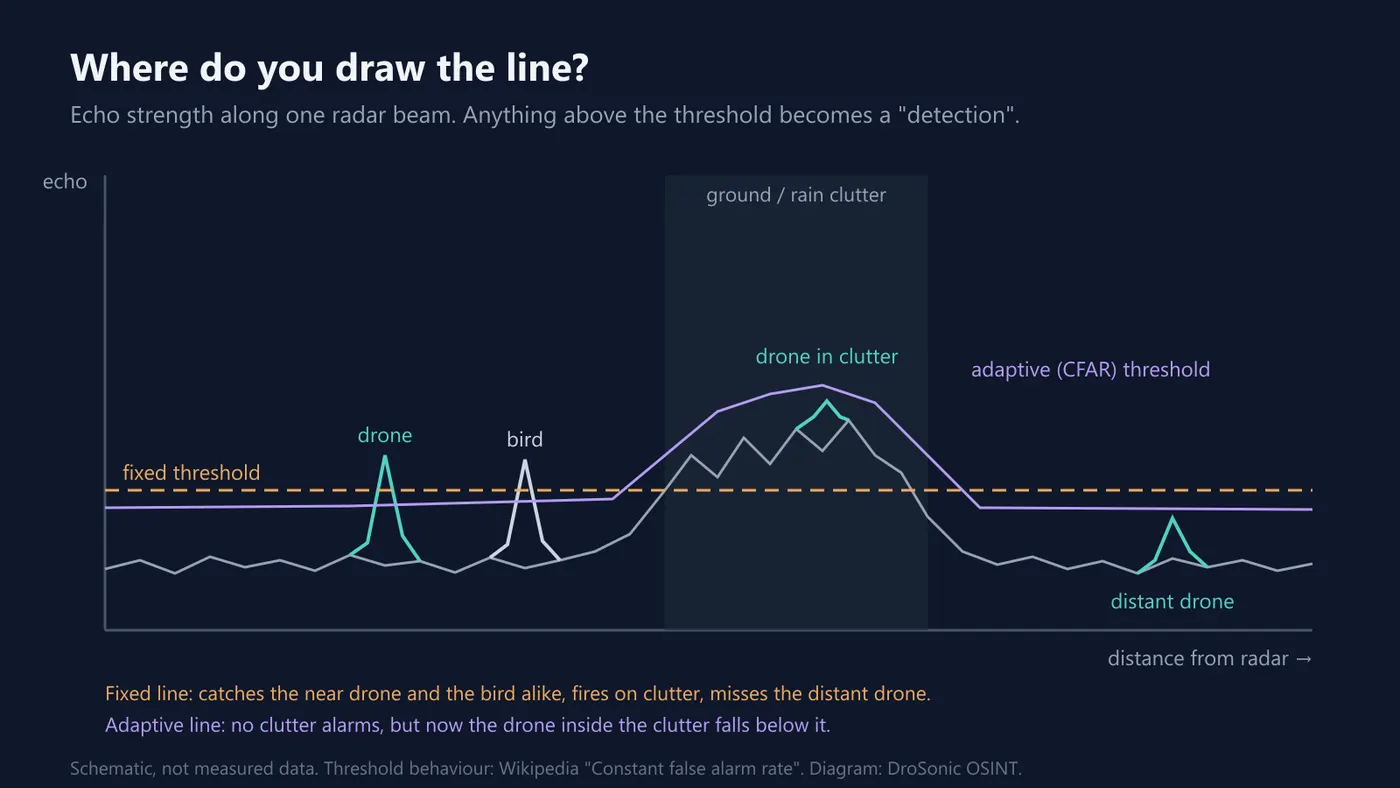
A radar receiver always hears something: its own electrical noise, plus echoes from the ground, weather and wildlife. Detection means deciding that a particular echo is strong enough to be a real target. That threshold sets the trade-off. Set it too low and "more real targets will be detected, but at the expense of increased numbers of false alarms." Set it high and you get the opposite.Wikipedia
Because the background changes from place to place, over hills, in rain or near a town, a fixed threshold produces too many alarms in some areas and misses targets in others. Most modern radars therefore use a constant false alarm rate (CFAR) detector. It estimates the local background from the cells around each one under test and sets the threshold just above it. Guard cells next to the test cell are left out, so a target's own energy does not raise its own bar.Wikipedia
CFAR keeps the alarm rate steady, but it does so by raising the bar wherever the background is busy. A small drone flying through clutter, exactly where Part 3 says it will be, faces the highest bar of all.
Where to draw the line — fixed versus adaptive thresholds
Schematic, not measured data. A fixed line fires on clutter and treats the bird and drone alike. An adaptive line quietens the clutter but raises the bar over it, hiding a drone inside.
Diagram: DroSonic OSINT · original · threshold behaviour from Wikipedia "Constant false alarm rate"
Field 02 — The birds
The false alarm that flies
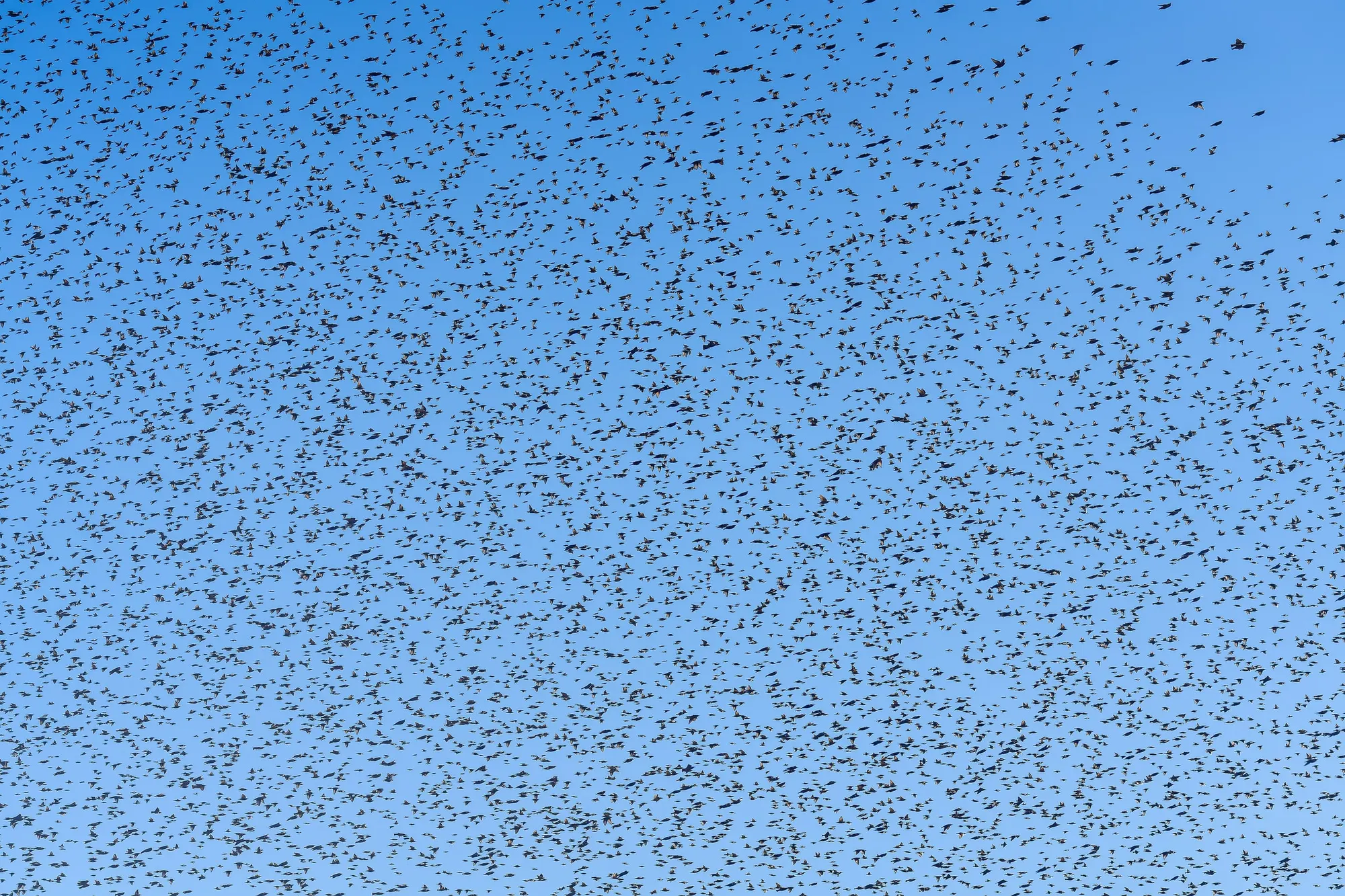
Clutter can be mapped and filtered because it mostly stays put. Birds don't. They move, they fly at drone heights, and each one returns about as much energy as a small drone (Part 2). A single flock can put hundreds of drone-sized echoes in front of a radar at once.
That is a known, under-solved problem. A Sandia National Laboratories publication notes that radar can detect drones at more than 1 km, but that nuisance and false alarms from natural sources, birds in particular, have not been adequately dealt with.Sandia National Laboratories Research presented at SPIE in 2023 describes counter-drone radars being swamped by bird tracks. It reports that machine learning on track behaviour (how a target moves over time) can recognise target drones with better than 90% sensitivity and specificity.SPIE
Better than 90% is impressive in a trial, but a sensor that misjudges one target in ten will still miss drones and raise false alarms when hundreds of birds pass by. Classification helps, and it works best with a second, independent piece of evidence.
Every bird is a test the radar has to pass. Over a flock, thousands of tests a minute.
Field 03 — The answer
Layering sensors that fail differently
Each sensor family fails in a different way, which is exactly why they work together:
Sensor
Finds drones by
Blind to
Radarreflection
Its echo, at kilometres, in any light
Low or hovering drones in clutter; telling drones from birds
RF detectionemissions
The control and video links
Fibre-optic and autonomous drones that do not transmit
Electro-optical / infraredsight
A picture an operator can confirm
Bad weather, darkness without thermal, narrow field of view
Acousticsound
Propellers, motors and engines
Long range, loud environments, strong wind
Our assessment · each row's blind spots are covered by at least one other row
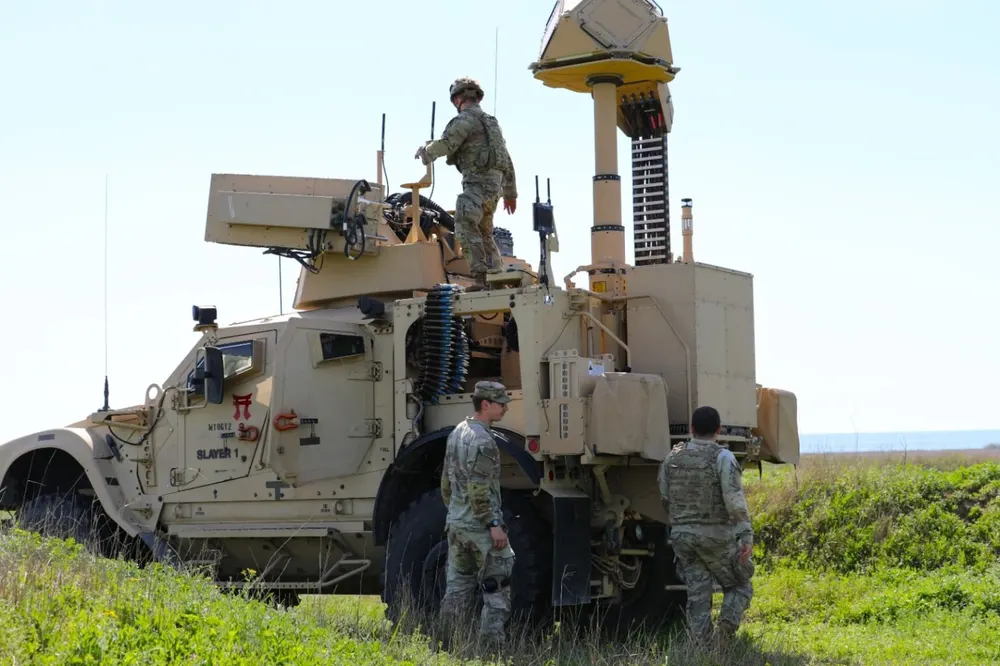
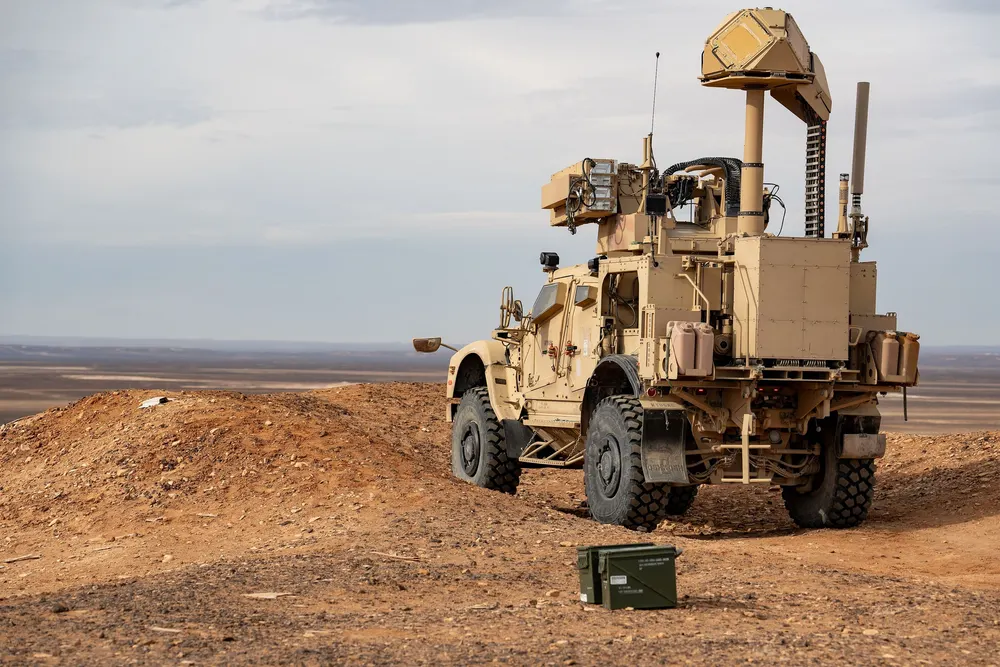
The U.S. military's own counter-drone vehicles are built this way. The M-LIDS system pairs a Ku-band radar with a 30 mm gun and Coyote interceptor drones on one vehicle.Wikimedia Commons The U.S. Defense Innovation Unit's 2025 low-cost counter-drone sensing challenge named acoustic, passive RF, radar, optical, infrared and multi-sensor technologies together, with a target of cutting ownership costs by 50–80%.The Defense Post
Ukraine's air defence shows the payoff at national scale. Its passive acoustic networks are fused with radar data. According to United24, about 20% of targets entering Ukrainian airspace are tracked by acoustic data alone, which is coverage radar was not providing.United24 Media
M-LIDS in Romania, 2024 — radar, optics and weapons on one vehicle
The U.S. Army's counter-drone vehicle during a live-fire exercise at Capu Midia.
Counter-drone training, 2025 — several sensors, one decision
A U.S. Air Force M-LIDS on a live-fire range during counter-small-drone training in the CENTCOM area.
Photo: U.S. Air Force, Master Sgt. Luke Olson · Public domain · Wikimedia Commons
Field 04 — Series summary
What five weeks of radar physics add up to
Across the five parts, the same conclusion keeps returning:
Small targets shrink radar range with the fourth root of echo size (Part 1).
Small drones are bird-sized echoes, and plastic or foam makes them smaller still (Part 2).
Flying low hides them behind the Earth, terrain and ground clutter (Part 3).
Hovering can defeat Doppler filtering, leaving only a faint rotor signature (Part 4).
Thresholds cannot separate them from birds without another source of evidence (Part 5).
None of this makes radar obsolete. It remains the best sensor for range, speed and all-weather tracking, and nothing else gives the same air picture. But against small, cheap, low drones, radar is one layer of a stack, not the whole defence.
Confidence
How sure we are, and what would change it
High confidence in the threshold trade-off and CFAR behaviour, which are standard radar theory. High confidence that birds are a major false-alarm source for counter-drone radar, from national-laboratory and conference research.
Moderate confidence in the layered-sensing comparison, which is our assessment. Real performance depends on specific products, sites and integration. The United24 acoustic figure is reported, not independently verified.
Close — what it means
The layer that listens
Five weeks of radar physics end in one place. The targets that matter most now, small, cheap, low drones, are the ones radar handles worst, and a growing share of them emit no radio signal for RF detectors to find. A defence built only on radar is short of range, short of height and buried in birds. A defence that adds independent sensors gets a second opinion on every echo.
Acoustic sensing is the natural partner. It is cheap enough to deploy densely, passive so it reveals nothing, unaffected by a target's echo size or material, and sensitive to exactly the rotors and engines that radar strains to classify. A bird's wings and a drone's propellers make very different sounds. At DroSonic we build passive acoustic drone detection to be that layer. If this series was useful, the reports Listening to the Sky and When the Detector Stays Silent show acoustic detection at work in Ukraine today.