Parts 1 to 3 showed why a small, low drone is hard to see. Part 4 covers radar's main tool against that problem, motion. Doppler processing separates a moving echo from stationary ground. The rotor blades' own fast motion, called micro-Doppler, gives a drone a fingerprint that birds don't share. Both tools weaken when the drone stops moving.
Published
September 2026
Subject
How radar uses motion to find and classify drones
Source base
Peer-reviewed radar measurements of drones and birds, open radar references, vendor material (flagged)
Method
First-principles explainer; worked numbers labelled as our arithmetic
Verdict
Micro-Doppler is radar's best drone-vs-bird test, and its weakest point is a hovering drone
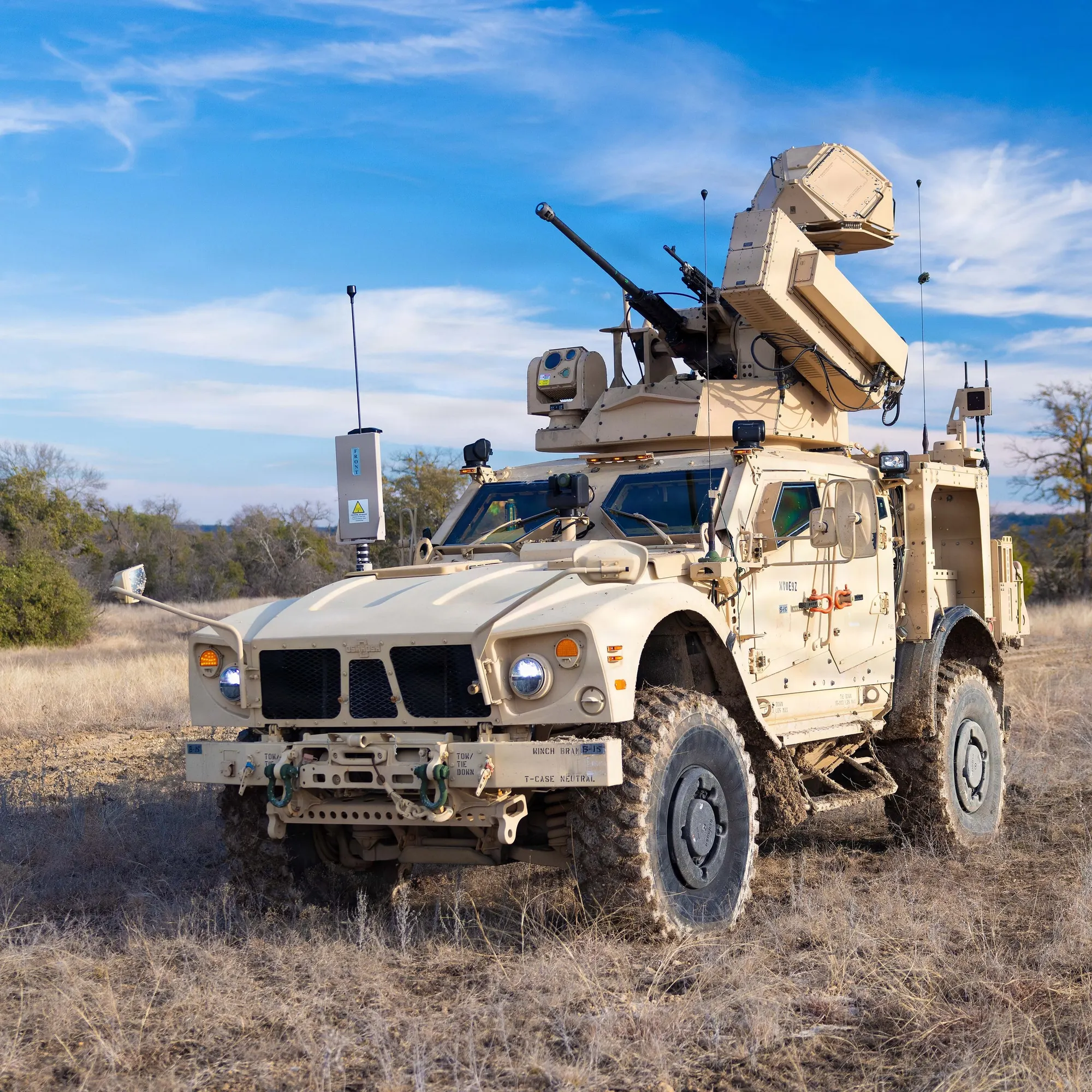
Photo: M-LIDS with KuRFS radar, Fort Hood, 2026 · U.S. Army, Capt. Russell Shirley-Jones · Public domain · Wikimedia Commons
Bottom line
A radar can separate a drone from the ground by its motion, and from a bird by the motion of its rotors. Both depend on the drone moving, and on a very faint signal. Doppler processing removes stationary echoes such as hills and buildings, which is how radar finds small targets in clutter. Spinning rotor blades add a wide spread of Doppler, micro-Doppler, that birds don't produce: a radar study found drone propellers turning at around 100 times a second against birds' 4–6 wingbeats. But the blade echoes are 20–40 dB weaker than the drone's body, so they need a capable radar at close range. A drone hovering in place has almost no body Doppler and can be removed along with the ground clutter.
≈ 100 Hz
typical drone propeller rotation rate◆ per St Andrews radar study
4–6 Hz
wingbeat rate of the birds measured◆ owls, hawk and eagle
20–40 dB
how much weaker blade echoes are than the body's◆ 100 to 10,000 times weaker
Key questions
How does radar tell a drone from a bird?
By micro-Doppler. Rotor blades turning around 100 times a second spread the echo across a wide band of speeds, while a bird's wings beat 4–6 times a second and stay close to its body signal. The blade signal is 20–40 dB weaker than the body's, so it takes a capable radar at close range.
Why are hovering drones hard for radar to detect?
A hovering drone has almost no Doppler shift, so the filters that remove stationary ground clutter can remove it too. Only its faint rotor signature is left.
The Ruler — the whole argument
What motion tells a radar
Signature
What causes it
What it tells the radar
Body Dopplerbulk motion
The whole target moving towards or away from the radar
Separates moving targets from stationary ground; gives speed
Rotor micro-Dopplerblade spread
Blades spinning around 100 times a second
"Rotorcraft": a wide, symmetric spread birds don't produce
Blade flashesperiodic peaks
A blade briefly side-on to the radar
Rotation rate and blade count, a model fingerprint
Wingbeatslow modulation
Wings flapping 4–6 times a second
"Bird": strong, close-in, slow
The hovering drone: no body Doppler, only the faint blade spread · Sources: Rahman & Robertson, Scientific Reports (2018)
Field 01 — Doppler
Hearing speed in the echo's pitch
When a target moves towards a radar, the echo returns at a slightly higher frequency. When it moves away, slightly lower. It is the same effect as a passing siren changing pitch. The shift is twice the target's speed divided by the wavelength. At X-band (about 3 cm), a drone closing at 10 m/s shifts the echo by roughly 670 Hz (our arithmetic). That is tiny next to the 10 GHz carrier, but easy for a coherent radar to measure across a series of pulses.
The ground does not move, so its echo has almost no Doppler shift. Moving target indication (MTI) exploits that, filtering out unmoving returns such as hills and trees.Wikipedia Pulse-Doppler processing goes further and sorts every echo into speed bins, so a small moving target can be pulled out of clutter far stronger than it is. This is how counter-drone radars such as the Ku-band KuRFS on the U.S. Army's M-LIDS vehicle, pictured above, find drones over cluttered ground.Wikimedia Commons
M-LIDS on the range — radar aimed skyward
U.S. Air Force defenders train with the M-LIDS counter-drone vehicle during a live-fire exercise in the CENTCOM area, January 2025. Its Ku-band radar finds the target that its gun engages.
Video: U.S. Air Force, Master Sgt. Luke Olson · Public domain · Wikimedia Commons
Field 02 — Micro-Doppler
The rotor's fingerprint
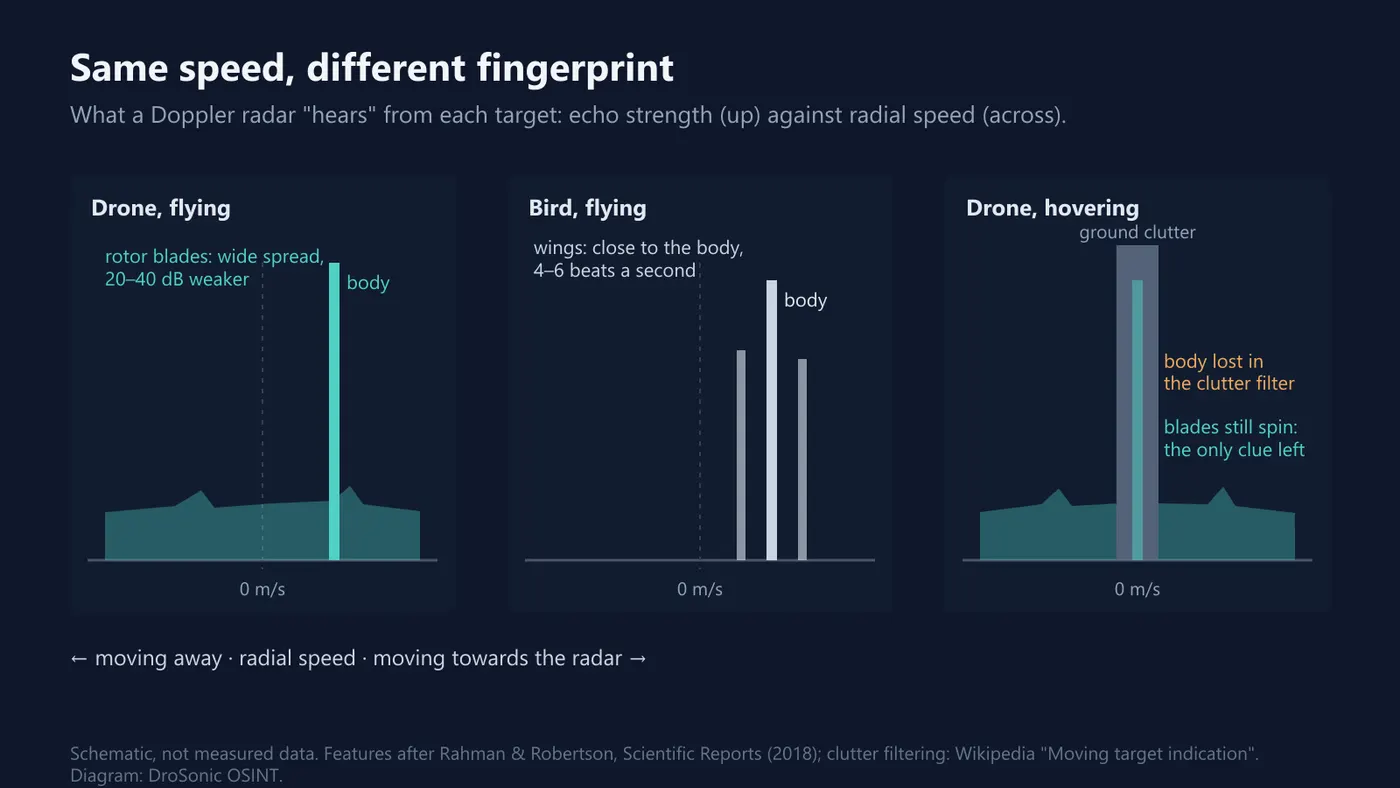
A drone is not one moving point. Its body moves at one speed, but its rotor blades spin far faster, with the advancing side of each blade rushing towards the radar and the retreating side moving away. Each blade spreads part of the echo across a wide band of Doppler on both sides of the body's line. That spread is the micro-Doppler signature.
Researchers at the University of St Andrews measured three DJI drones (Phantom 3, Inspire 1 and S900) and four birds of prey with 24 GHz and 94 GHz radars. Their findings set out the fingerprint clearly:Rahman & Robertson
Drone propellers turn at "of order 100 Hz", and the signature is "the wide signal spread over both sidebands" around the body's Doppler, with blade flashes and rotor modulation lines.
Birds show "no such wide micro-Doppler spread". Their wings modulate the echo slowly: the measured wingbeat frequencies of all four birds were 4–6 Hz.
The drone's blade echoes were 20–40 dB below the body's, while the birds' wing modulation was only 0–10 dB below their body echo.
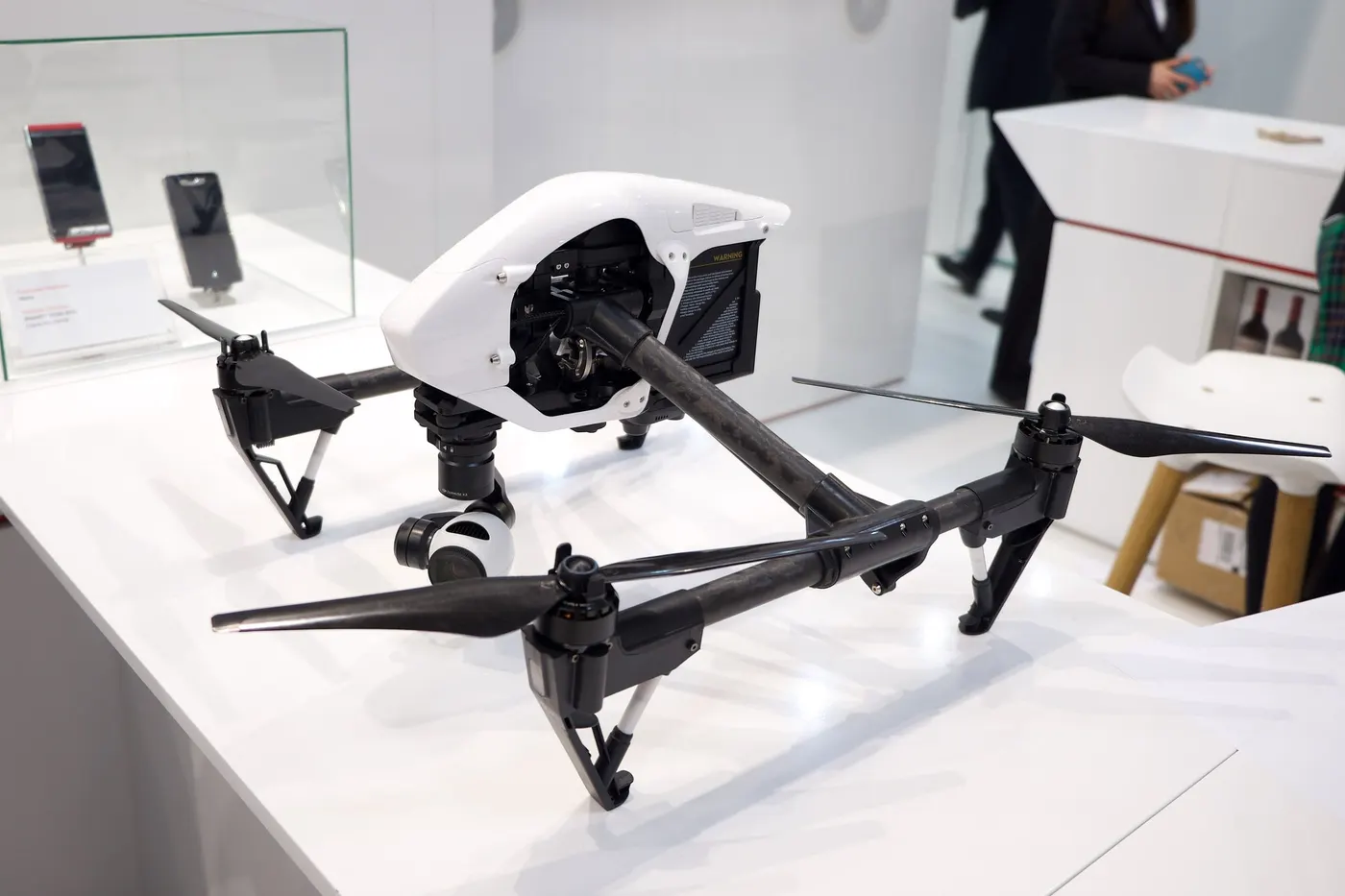
DJI Inspire 1 — one of the drones measured
One of the three DJI models in the St Andrews radar study. Its spinning blades produced micro-Doppler about 20 dB below its body echo.
The authors conclude that a high-fidelity drone-detection radar "is possible in the millimetre-wave band or in K-band." The catch sits in the third finding. The feature that best separates a drone from a bird is also its faintest, 100 to 10,000 times weaker than the drone's already bird-sized body echo. A radar has to be close, sensitive and sampling fast to see it. A blade tip on a Phantom-sized drone turning 100 times a second moves at roughly 80 m/s (our arithmetic), so the radar must sample fast enough to capture Doppler shifts many kilohertz wide.
Same speed, different fingerprint — and what hovering does to it
Schematic, not measured data. A drone's rotors spread a faint signature wide; a bird's wings stay close in. A hovering drone's body sits in the clutter filter, leaving only the faint rotors.
Diagram: DroSonic OSINT · original · after Rahman & Robertson (2018)
Field 03 — The weak spot
When the drone stops moving
Doppler processing works because targets move and the ground does not. A drone that hovers, as quadcopters do when observing, waiting to drop a munition or sitting in ambush, takes that advantage away. Its body echo sits at zero Doppler, alongside the ground.
Radar engineers call the problem minimum detectable velocity. Any target slower than the radar's MDV "cannot be detected" because its Doppler cannot be separated from the clutter.Wikipedia Recent research on hovering-drone detection describes conventional range-Doppler and MTI methods degrading badly in this case, because the hovering drone's return overlaps the clutter spectrum.Electronics (MDPI)
The rotors still spin, so their micro-Doppler is still there. That faint spread on either side of zero is the only evidence left. Radar makers say their systems use it to hold hovering drones. Weibel, for example, says its XENTA-C radar detects rotor micro-Doppler to separate hovering drones from ground clutter "even at zero speed".Weibel That is a vendor claim; we found no independent test results. It works only if the blade signal, 20–40 dB below an already weak body echo, rises above the noise.
Doppler finds drones because they move. A drone that waits in place leaves only the faint whisper of its blades.
Field 04 — In practice
Fingerprints, false friends and fixed wings
Micro-Doppler is powerful, but in the field it has limits:
Fixed-wing drones have no rotors to fingerprint. A Shahed-type drone, or its Gerbera decoy, is driven by a single pusher propeller at the rear,Wikipedia hidden by the airframe from many angles. Its signature looks more like a small aircraft's, or at worst a bird's.
Range eats the signal. The fourth-root rule from Part 1 applies doubly: the blade signal is far weaker than the body's, so radars can usually classify a drone only well inside the range at which they first detect it.
Vendors differ. Radar maker Robin Radar describes drone rotor modulation at roughly 50–100 Hz against bird wingbeats at about 4–10 Hz as the basis for its classifier.Robin Radar How well this works for a given product at a given range is rarely published.
Bird-like drones exist. Researchers working on drone-versus-bird classification note that the arrival of bird-like drones makes the problem harder still.Mississippi State University
Confidence
How sure we are, and what would change it
High confidence in the physics of Doppler, MTI and micro-Doppler, and in the drone-versus-bird differences, which rest on a peer-reviewed measurement study.
Moderate confidence in how well fielded radars handle hovering drones. The research describes the problem; vendors claim solutions; independent test results are scarce.
Close — what it means
The rotor talks to the microphone too
Micro-Doppler is the radar's way of hearing a drone's rotors. It picks up the same spinning blades that make the sound a drone cannot hide. The difference is the medium. The radar has to light up the blades and catch a reflection 20–40 dB below an already weak echo. A microphone hears the blades directly, because they push on the air whether the drone is moving or hovering. A hovering drone, radar's hardest case, makes the same acoustic signature as a moving one.
That is why acoustic detection pairs so well with radar. Each fills the other's weak spot, and the blade signature that radar strains to see is the one sound sensors are built around. Every Drone Has a Voice explains how that signature varies across drone types. Next, the final part of the series asks what happens when a radar has to decide, thousands of times a second, whether an echo is a drone at all.
Weibel — Vendor brochure: hovering-drone detection via rotor micro-Doppler
Wikipedia — Gerbera: pusher propeller; shaped like the Shahed-136
Robin Radar — Vendor: rotor modulation vs wingbeat frequency
Mississippi State University — Thesis (2025): radar micro-Doppler and camera fusion for drone/bird classification; bird-like drones exacerbate the problem