Part 1 showed that a radar's reach shrinks with the fourth root of a target's echo. Part 2 asks why a drone's echo is so small. Radar cross section depends on size compared with wavelength, on material and on shape. Small commercial drones lose on all three, while the parts that do reflect are not always the ones you would expect.
Published
September 2026
Subject
What sets a drone's radar cross section, and how small it is
Source base
Peer-reviewed RCS measurements (IEEE Access, Scientific Reports), open radar references
Method
First-principles explainer, checked against published measurements
Verdict
Drones are bird-sized radar targets; materials and angle make their echo erratic
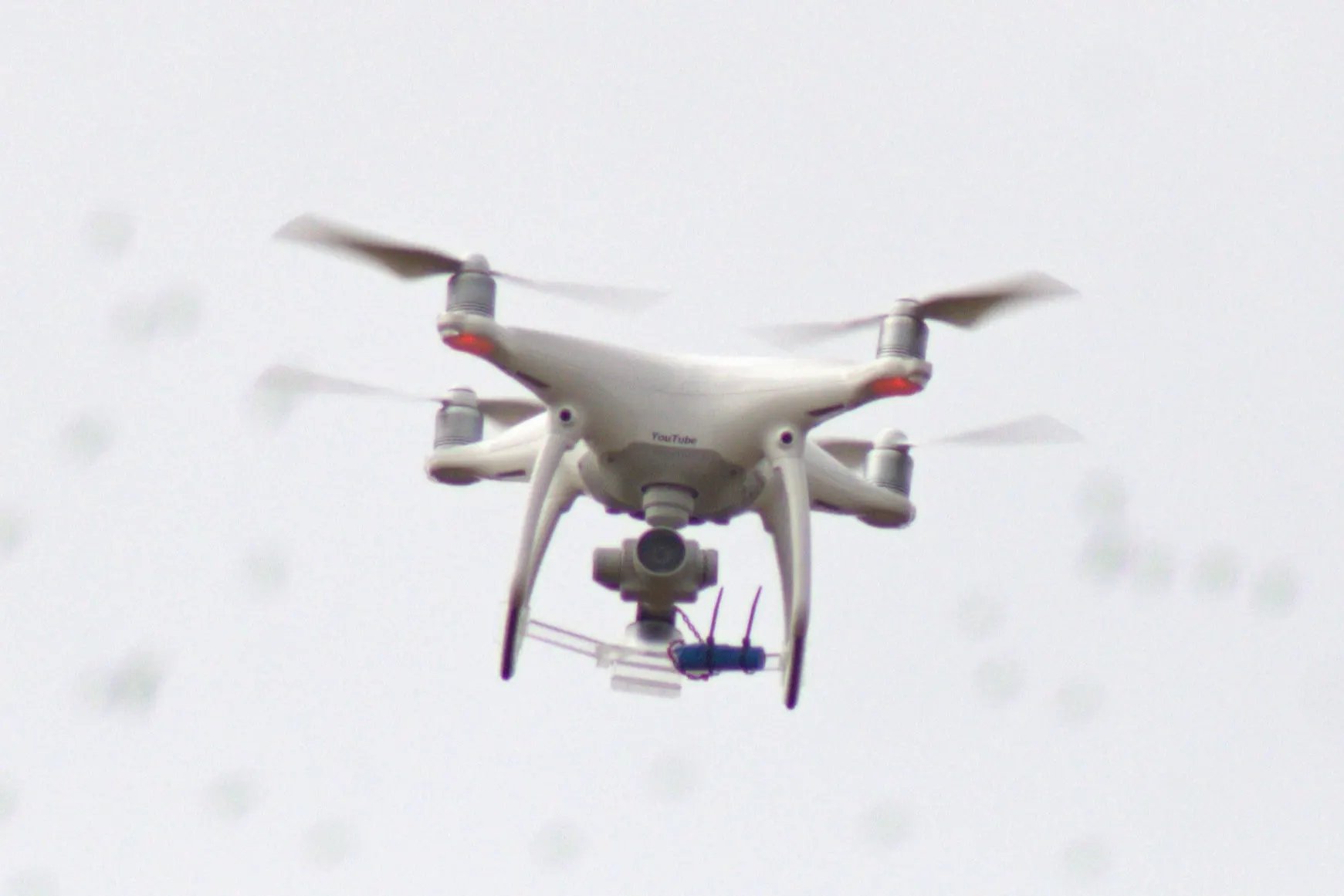
To a radar, a small drone looks like a bird, and the brightest part of it is often the battery. Radar cross section (RCS) is the size of the perfect reflector that would send back the same echo as the target. It depends far less on how big an object looks than on its size compared with the radar's wavelength, what it is made of, and which way it faces. Small commercial drones lose on all three. Published measurements put them at about 0.01–0.03 m² at X-band, the same class as a bird and roughly two thousand times smaller than a car. Plastic and foam airframes are close to transparent to radar, so a dense metal part such as the battery can dominate the echo. Their RCS also swings widely as the drone turns, which makes detection and tracking unreliable.
0.01–0.03 m²
typical small-drone RCS at X-band◆ −20 to −15 dBsm, per published measurements
≈ 0.01 m²
a bird◆ same class as the drone
≈ 63 m²
a car at 24 GHz◆ +18 dBsm, about two thousand times larger
≈ 7 dB
carbon-fibre drones over plastic ones◆ mean RCS at 26–40 GHz
Key questions
What is the radar cross section of a drone?
Small commercial drones typically measure −20 to −15 dBsm at X-band, about 0.01–0.03 m²: the same class as a bird and roughly two thousand times smaller than a car.
Why are plastic drones hard for radar to see?
Radar reflects strongly from metal and passes largely through plastic and foam. Measurements show carbon-fibre drones about 7 dB brighter than plastic ones, and the battery can be the strongest reflector on a small drone.
The Ruler — the whole argument
What sets a drone's echo
Factor
What it does
Why drones lose
Size vs wavelengththe scattering regime
Objects much smaller than the wavelength reflect very weakly
Rotor arms and frames are centimetres across
Materialconductor or not
Metal reflects strongly; plastic and foam barely at all
Commercial and many military drones are mostly plastic or foam
Shape and angleaspect
Flat plates and corners flash; curves scatter energy away
The echo flickers as the drone turns and the rotors spin
Hidden metalbattery, motors, wiring
Dense metal parts dominate the return
The battery can be the brightest part of the drone
Sources: Semkin et al., IEEE Access (2020); Wikipedia "Radar cross section"
Field 01 — The definition
Not how big it is, how big it looks to radar
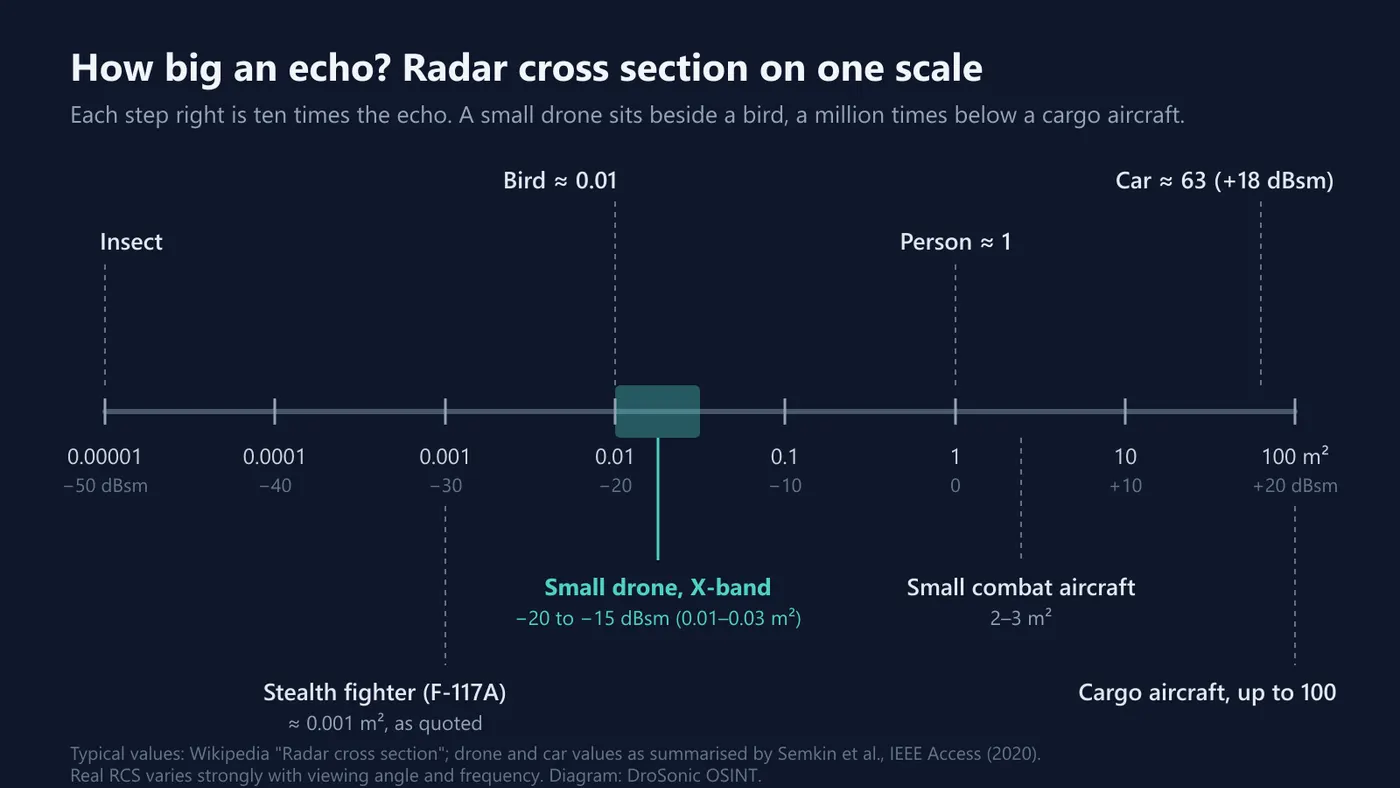
RCS is a measure of reflectivity, expressed as an area. It is the cross-section of an idealised object that would scatter the same power back to the radar. It is quoted in square metres or in dBsm (decibels relative to 1 m²): 0 dBsm is 1 m², −10 dBsm is 0.1 m² and −20 dBsm is 0.01 m². Every 10 dB is a factor of ten.
RCS often bears little relation to physical size. Reference values in the open literature run from about 0.00001 m² for an insect and 0.01 m² for a bird, through 1 m² for a person, to up to 100 m² for a cargo aircraft. A stealth aircraft such as the F-117A is quoted at about 0.001 m², a full-size combat aircraft with a smaller echo than a bird.Wikipedia
One scale, ten million to one — the drone sits with the bird
Each step is a factor of ten. On radar, a small drone sits next to a bird and far below anything radar was originally built to find.
Diagram: DroSonic OSINT · original · values from Wikipedia and Semkin et al. (2020)
Field 02 — Size and wavelength
Three regimes of scattering
How strongly an object reflects depends on its size compared with the radar's wavelength. X-band radars work at about 3 cm, and drone-detection radars often go higher, to Ku-band (about 2 cm) and above.
Much smaller than the wavelength. Reflection is weak and climbs steeply with frequency. For a small sphere it rises with the fourth power of frequency.Wikipedia A thin rotor arm or a few centimetres of wire at long wavelengths falls here.
Comparable to the wavelength. Reflection rises and falls erratically with size and frequency, the resonance region. Many drone parts at X-band sit in this zone.
Much larger than the wavelength. Reflection settles towards the object's geometric cross-section, and shape takes over. A sphere many wavelengths across reflects roughly its physical cross-section.Wikipedia
This is one reason counter-drone radars favour higher frequencies. At shorter wavelengths, more of a drone's small parts become large enough to reflect well, and rotor blades start to show up. Part 4 explains why that matters.
Field 03 — Material
What a radar sees through
Radar waves reflect strongly from conductors and pass largely through good insulators. A metal airframe is a mirror. A plastic or foam one is closer to a window.
Researchers at Aalto University, UCLouvain and NYU Wireless measured nine multi-rotor drones and a single lithium-polymer battery at 26–40 GHz, and published the data openly. Their summary is blunt. Larger drones made of carbon fibre are easier to detect, while "drones made from plastic and styrofoam materials are less visible to the radar systems." Mean RCS for the carbon-fibre group was roughly 7 dB higher, about five times larger, than for the plastic group. Battery packs contribute significantly: on a small, non-reflective drone, the battery might be detected even when the airframe is not.Semkin et al.
The same study gives the comparison that matters for detection. Typical RCS for drones is −15 to −20 dBsm at X-band, against about +18 dBsm for a car at 23–27 GHz.Semkin et al. That is a gap of 33 dB or more, a factor of about two thousand or more.
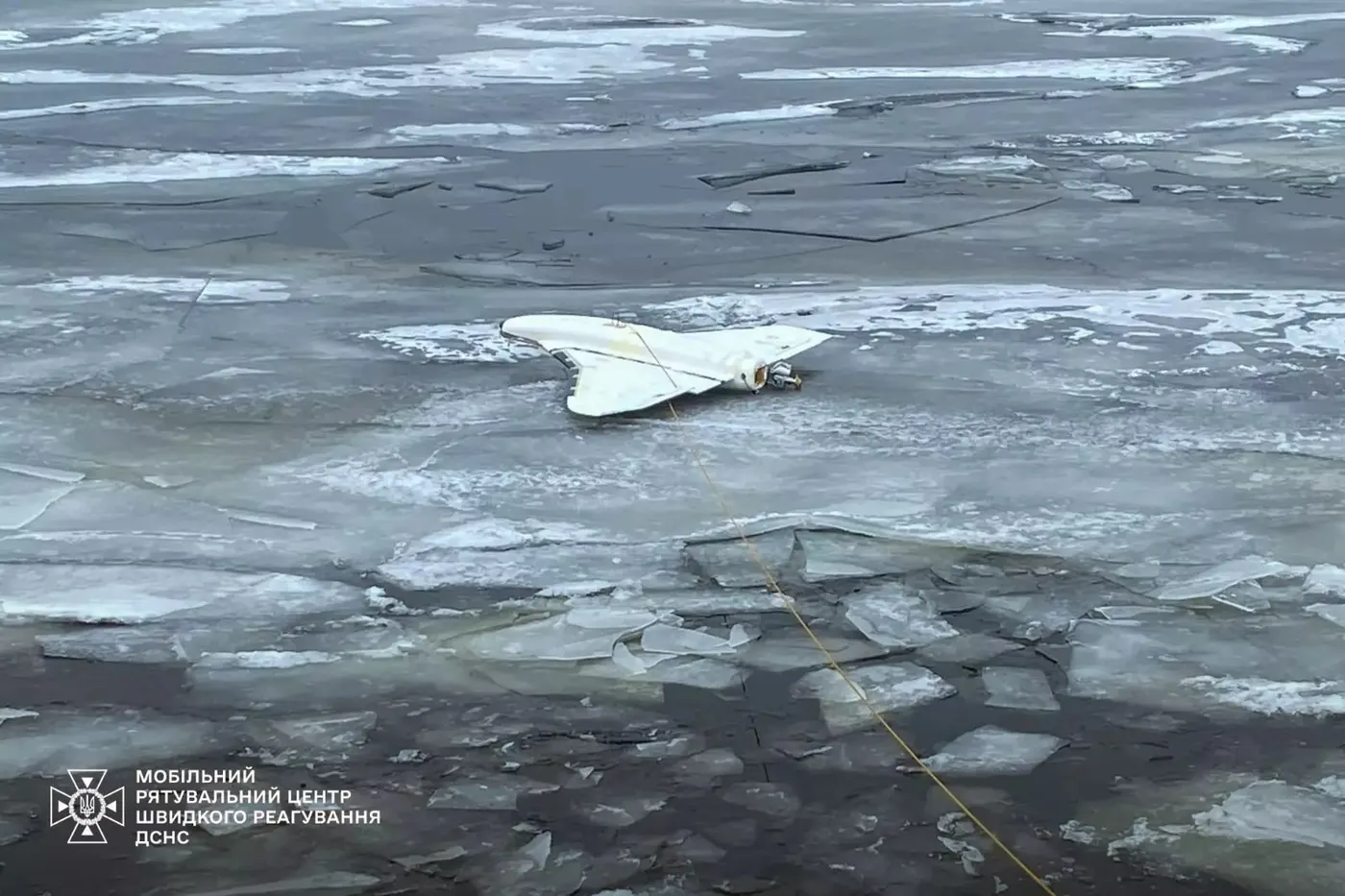
Military designers use the same physics on purpose. Russia's Gerbera decoys are built from a plywood frame under a polystyrene foam body.Wikipedia The Molniya strike drone is a cheap plywood aircraft.RSF guide Neither was necessarily built for stealth, but wood and foam give a radar very little to work with. The engine, battery and payload are left to carry the echo.
Gerbera decoy — foam over plywood
Shaped like a Shahed, but built largely of materials radar sees poorly. Its small engine, wiring and any payload carry most of the echo.
Photo: State Emergency Service of Ukraine · CC BY 4.0 · Wikimedia Commons
To a radar, a plastic quadcopter is mostly empty space. The part it sees best may be the battery.
Field 04 — Angle
An echo that flickers
RCS is not one number. It changes, often by orders of magnitude, with the angle from which the radar sees the target. A flat surface facing the radar flashes brightly; a few degrees off, its energy goes elsewhere. Drone measurements show the same pattern. In the study above, both the drones' and the standalone battery's echoes changed markedly with the angle they were lit from.Semkin et al.
For a radar this matters in two ways. A drone that is detectable on one pass can disappear on the next as it turns, so a tracker loses it. And because the published averages hide wide swings, any single RCS figure is a rough guide, not a guarantee. Spinning rotors add a further flicker, which Part 4 shows can be turned to the radar's advantage.
Field 05 — The comparison
Why "bird-sized" is the real problem
A small echo would be manageable if nothing else in the sky had one. But the sky is full of birds with echoes of about 0.01 m², the same as the drone.Wikipedia Researchers at St Andrews who measured drones and birds with K-band (24 GHz) and W-band (94 GHz) radars used −20 dBsm, 0.01 m², as their working figure for a drone.Rahman & Robertson
So a radar sensitive enough to see a drone will also see every bird around it, and echo size alone cannot separate the two. Part 4 explains how motion can, and Part 5 what happens when it cannot.
Confidence
How sure we are, and what would change it
High confidence that small drones have RCS in the 0.01–0.03 m² class at X-band, and that material, size relative to wavelength, and angle drive it. These rest on peer-reviewed measurements and standard theory.
Moderate confidence in exact figures for any one drone: RCS varies by model, frequency, angle and payload, and published averages hide large swings. Large military drones with metal engines and warheads, such as the Shahed, reflect much more and are a different problem.
Close — what it means
When the echo is the weak link, add a different signature
The physics of RCS works against the defender at every step. Small size puts drones in the weak or erratic scattering regimes. Plastic and foam let radar energy through. Shape and angle make what echo remains flicker. Cheap drones are not small radar targets because anyone designed them that way. They are small by nature, and they come in their thousands.
That argues for sensors that don't rely on reflected energy at all. A drone's motors, propellers and engine produce sound however little they reflect, and their sound depends on propulsion, not material. Acoustic detection picks up exactly the class of target that radar struggles with. Our report When the Detector Stays Silent shows the same gap for radio-silent drones. Next in the series, Part 3 asks what happens when that small echo also flies low.