Parts 1 and 2 dealt with a drone's small echo. Part 3 adds geometry. A radar sees in straight lines, so the curve of the Earth, terrain and buildings hide anything flying low enough. Close to the ground, the radar also has to pick a faint echo out of the strong reflections from the ground itself. Low flight is the cheapest stealth there is.
Published
September 2026
Subject
Why low altitude hides drones from radar
Source base
Open radar references, Ukrainian air-defence reporting, U.S. military imagery
Method
First-principles explainer; horizon distances calculated with the standard 4/3-Earth formula
Verdict
Low flight defeats radar through geometry and clutter, whatever the radar's power
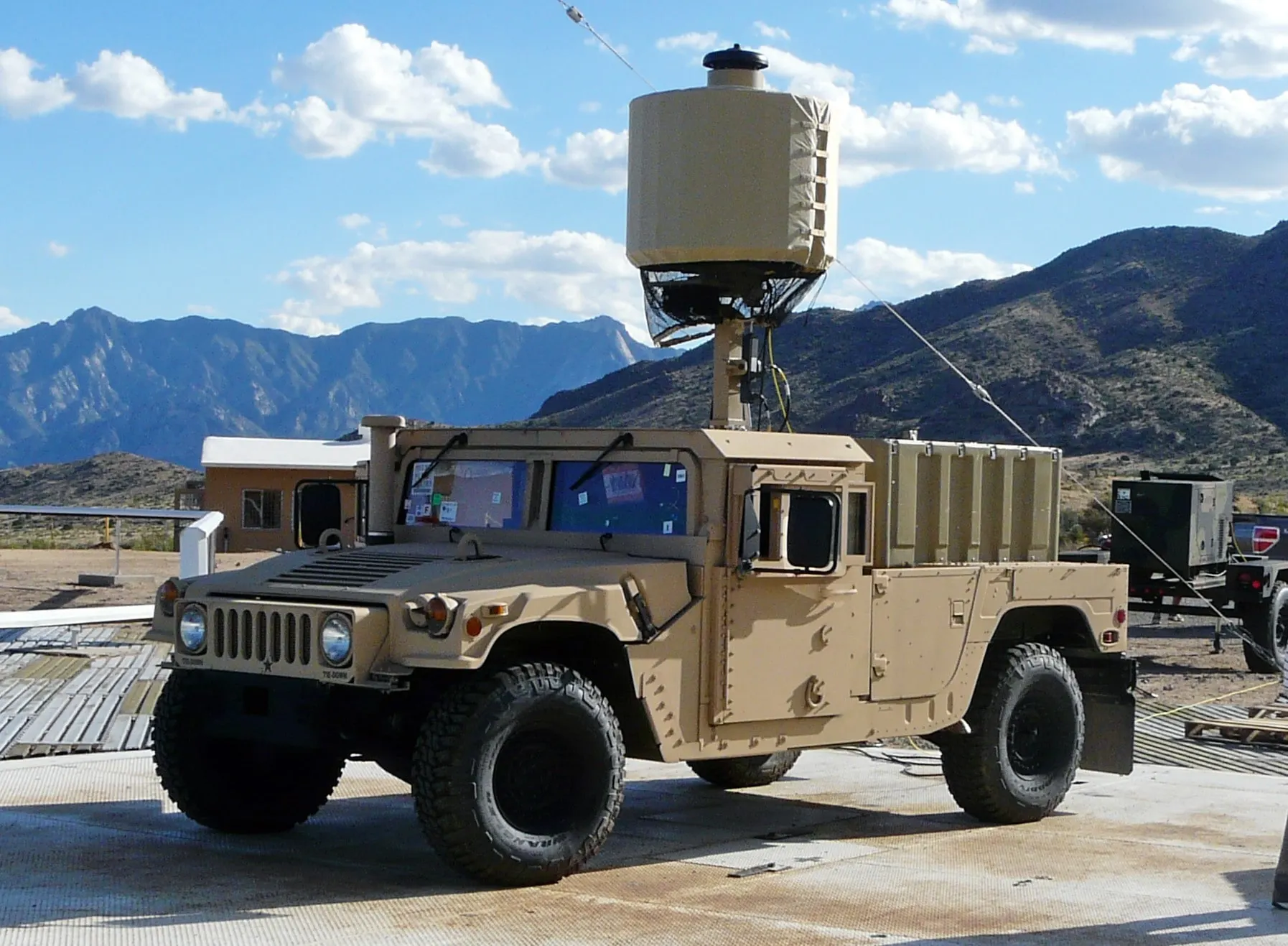
Photo: AN/TPQ-50 Lightweight Counter Mortar Radar · U.S. Army · Public domain · Wikimedia Commons
Bottom line
A radar cannot see around the curve of the Earth or through a hill, and close to the ground it struggles to see past the ground's own echo. That makes low altitude the cheapest form of stealth. A radar on a 10 m mast loses a drone flying at 10 m beyond about 26 km, even over perfectly flat ground. Hills, trees and buildings cast shadows much closer than that. Even inside line of sight, a low drone's faint echo competes with strong reflections from the terrain behind it, and with copies of itself bounced off the ground. Ukraine's war shows attackers using the trade both ways: flying low to hide from radar, or high to escape guns.
≈ 26 km
furthest a 10 m-mast radar sees a drone at 10 m◆ smooth Earth, standard atmosphere
≈ 54 km
the same radar, drone at 100 m◆ height buys line of sight
1.5–2 km
altitude Russian Shaheds moved up to◆ out of reach of guns, but into radar view
Key questions
How low does a drone have to fly to avoid radar?
Low enough to stay below the radar's line of sight. Over flat ground, a radar on a 10 m mast cannot see a drone flying at 10 m beyond about 26 km; hills, trees and buildings hide low drones at far shorter ranges.
What is radar clutter?
Unwanted echoes from the ground, sea, rain and wildlife. Near the ground a small drone's echo competes with much stronger clutter, and reflections off the ground can make it fade in and out.
The Ruler — the whole argument
Three ways the ground hides a drone
Effect
What happens
What it means for drones
Radar horizonthe curve
The Earth curves away below the radar's line of sight
Low targets are hidden beyond a few tens of km
Terrain maskingthe shadow
Hills, trees and buildings block the beam
Low targets can be hidden at a few hundred metres
Clutter and multipaththe noise
The ground echoes strongly, and reflections create ghost paths
Faint low echoes are buried or fade in and out
All three get worse the lower the drone flies, and none is fixed by adding power
Field 01 — The curve
How far a radar can see over a round Earth
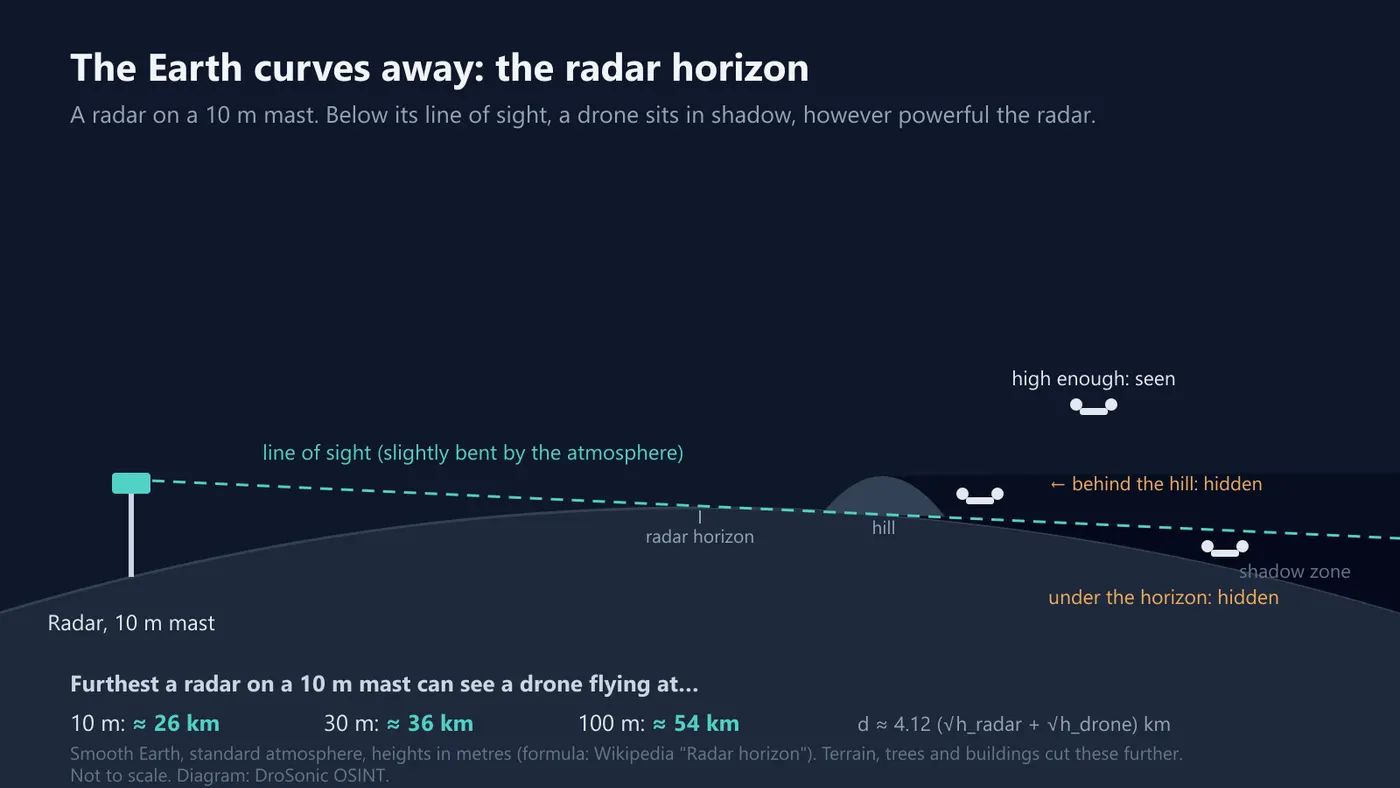
Radar travels in nearly straight lines. In a normal atmosphere the beam bends slightly downward, which radar engineers model by treating the Earth as if its radius were four-thirds of its true value.Wikipedia With that model, the distance to the radar horizon works out to roughly:
d ≈ 4.12 × (√h_radar + √h_target) km, with both heights in metres.
That gives these limits (our arithmetic, smooth Earth):
Radar on a 10 m mast, drone at 10 m: about 26 km.
Same radar, drone at 30 m: about 36 km.
Same radar, drone at 100 m: about 54 km.
Beyond those distances the drone is in the Earth's shadow, however powerful the radar. Raising the radar helps, which is why air-defence radars sit on masts, hills and aircraft. But the target's own height counts just as much, and the attacker decides that.
The radar horizon — height buys sight
Above the line of sight, a drone is visible. Below it, behind the horizon or behind a hill, it is invisible to this radar at any power.
Diagram: DroSonic OSINT · original · formula from Wikipedia "Radar horizon"
Field 02 — The shadow
Hills, trees and buildings
The horizon figures assume a billiard-ball Earth. Real ground is not like that. Every ridge, tree line, building and embankment casts a radar shadow behind it, and a drone flying a few tens of metres up can stay inside those shadows for most of its route. Shadows in the open may be kilometres long. In a town or a forest the radar's view of low targets can shrink to a few hundred metres.
Siting therefore matters as much as performance. A radar on a hilltop sees further but looks down on more ground and more clutter. A radar in a valley is shielded from clutter but blind beyond the next ridge. The Humvee-mounted counter-mortar radar in the photo above, built to detect mortar and rocket fire from 500 m to 10 km, shows the compromise: a compact sensor on a mast that can be moved to the best vantage point.Wikimedia Commons
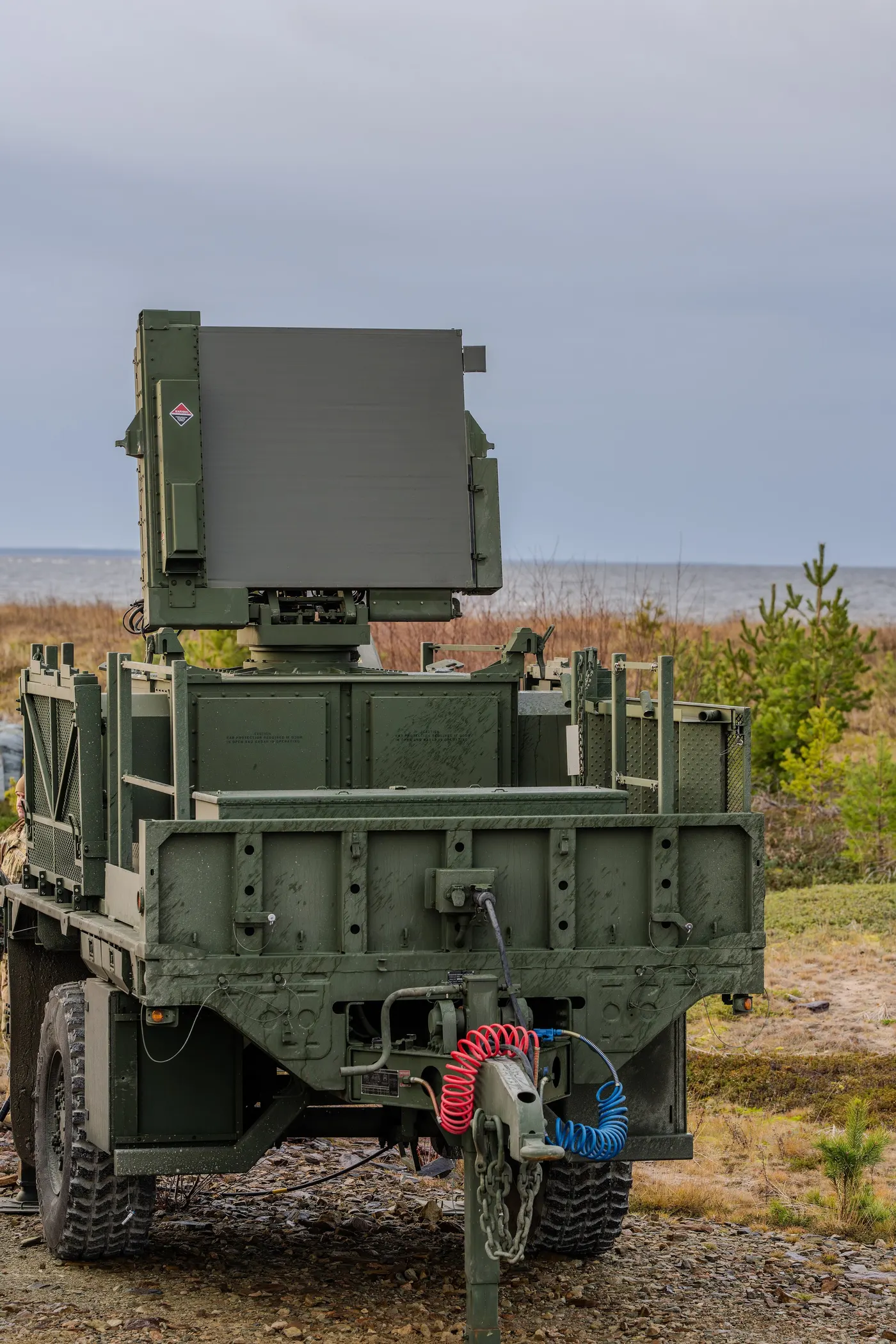
Sentinel radar, Mallet Strike 2024 — siting is half the battle
A U.S. Army Sentinel radiating during a NATO air-defence exercise in Lohtaja, Finland. Where a radar stands decides what it can see below a few hundred metres.
Photo: U.S. Army, Capt. Alexander Watkins · Public domain · Wikimedia Commons
Field 03 — The noise
Clutter and ghost reflections
Even inside line of sight, a low drone is hard to see. When the radar beam points low, it hits the ground as well as the target. Unwanted echoes are called clutter: from ground, sea, rain, animals and insects. How strong surface clutter is depends on the grazing angle of the beam, the frequency and the polarisation.Wikipedia A hillside or a town at the same range as a 0.01 m² drone returns a far larger echo, which can bury the drone completely unless the radar can separate the two by motion, the subject of Part 4.
The ground also acts as a mirror. Energy can reach a low target directly and also by bouncing off the surface. The two paths interfere, so the echo can strengthen or almost cancel as the drone changes height or range. Ground-reflected multipath echoes are especially troublesome because they appear to move like real targets.Wikipedia A low drone can therefore fade in and out of view, and generate ghosts, even in clear line of sight.
Low flight needs no special technology. It turns the planet, the hills and the ground's own echo into the drone's camouflage.
Field 04 — The war
High or low, the attacker chooses
Ukraine's air war shows the trade playing out. Low flight hides drones from radar but brings them within range of guns. Ukraine's mobile fire groups, gun crews on pickup trucks, were built to exploit exactly that. In 2025 Russian forces began launching Shahed-type drones at 1.5–2 km altitude, high enough that "ground-based interception efforts" became "far less effective", according to an analysis by the Ukrainian outlet Texty.Euromaidan Press At that height the drones are easier for radar to see but out of reach of machine guns. The same analysis reports Russian decoys carrying devices that make them look like much larger aircraft on radar.
The pattern is the point. An attacker can pick the altitude that beats the defender's sensors and weapons, high against guns and low against radar. A defence that relies on one band of altitude will be flown around.
Field 05 — The fixes
What radar can and cannot do about it
Radar designers have several answers, all partial:
Height. Masts, towers, aerostats and airborne radars push the horizon back. They cost money and are visible targets themselves.
More radars. A dense net of short-range radars fills shadows that one long-range radar cannot. The cost multiplies with the number of sites.
Doppler processing. Separating moving targets from stationary ground clutter by their motion is the main tool. It has its own blind spot for slow and hovering targets, the subject of Part 4.
Higher frequencies and finer beams. These reduce the patch of ground competing with the target, at the cost of range in bad weather.
None changes the basic geometry. Below the line of sight a radar sees nothing, and close to the ground it sees a great deal it does not want.
Confidence
How sure we are, and what would change it
High confidence in the physics of radar horizon, terrain masking, clutter and multipath. These are standard radar theory, and the horizon distances are our arithmetic from the standard 4/3-Earth formula.
Moderate confidence in the specific Ukrainian altitude figures, which come from a single Ukrainian analysis (Texty), reported by Euromaidan Press. Tactics change month to month.
Close — what it means
The ground hides drones from radar, not from microphones
Low altitude defeats radar through geometry, and geometry does not care how good the radar is. To see low drones over real terrain, a defender needs many sensors close to where the drones fly, not one powerful sensor far away.
That is where cheap, passive sensors come in. Sound bends around obstacles to a degree that radar waves do not, and a microphone a few hundred metres from a drone's path is not limited by a horizon tens of kilometres away. Ukraine's acoustic networks, described in Listening to the Sky, were built to listen in exactly the low-altitude band that radar covers worst. At DroSonic we build distributed acoustic detection on the same idea. Next week, Part 4 looks at how radar uses motion to find drones in clutter, and why a hovering drone defeats it.