Acoustic drone detection went from a Ukrainian improvisation to a national air-defence layer in under three years. It is also widely misunderstood, oversold by some and dismissed by others. This report sets out plainly what passive acoustic detection does, the physics that limits it, and where it fits alongside radar, RF and optical sensors.
Published
October 2026
Subject
Passive acoustic detection of drones
Source base
Acoustics research, Ukrainian systems reporting, U.S. federal guidance, manufacturer claims (flagged)
Method
Explain the physics; compare claims with independent figures
Verdict
Strong against small, low, radio-silent drones close in; weak at range and in noise
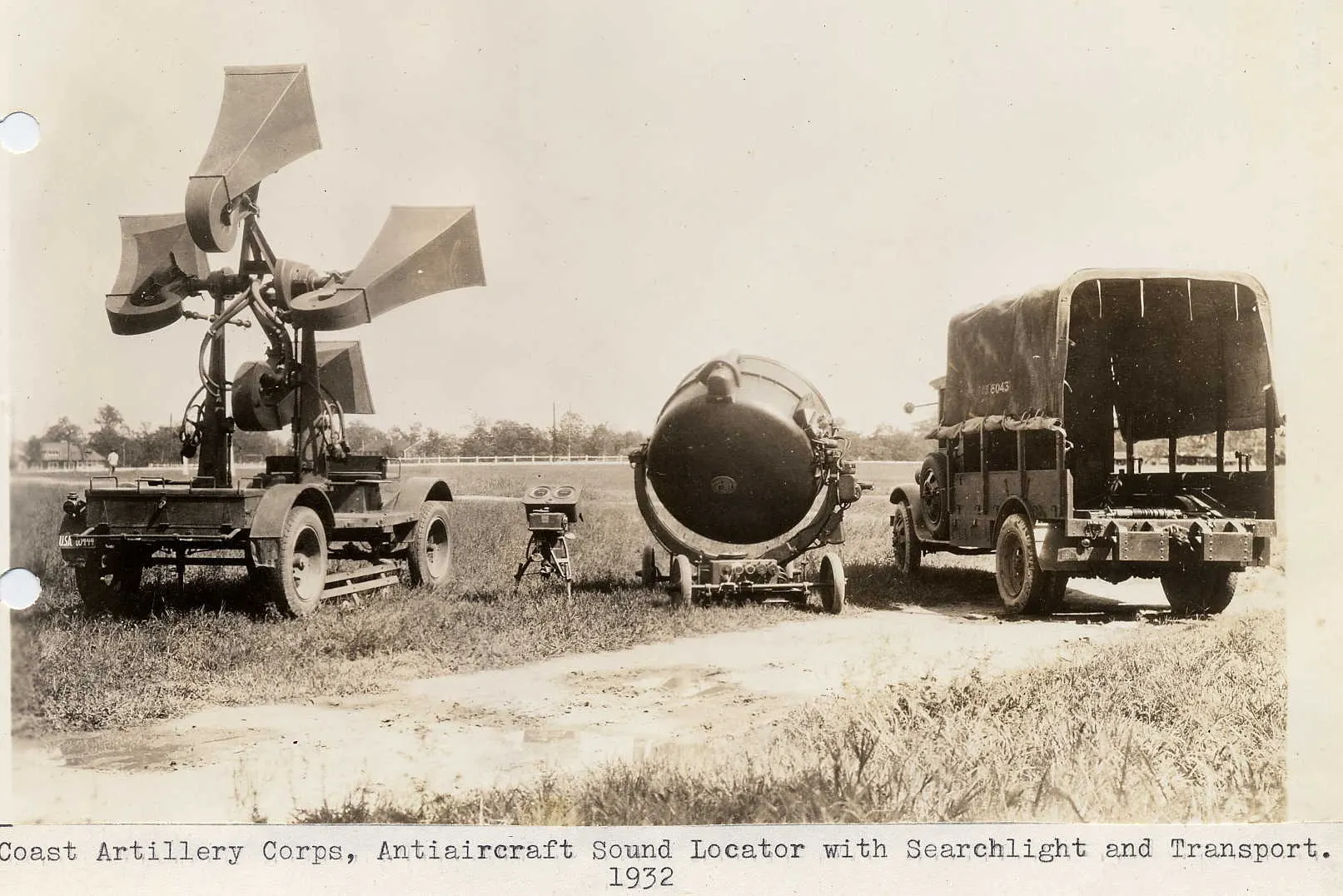
Photo: U.S. Army Coast Artillery Corps sound locator, 1932 · Public domain · Wikimedia Commons
Bottom line
Acoustic detection finds drones by the one signature they cannot switch off: the sound of their propellers and engines. A passive microphone emits nothing, needs no line of sight over the horizon and does not care whether a drone uses radio, fibre-optic cable or full autonomy. That makes it the natural answer to the drones radar and RF detection handle worst: small, low, slow and radio-silent. Its limits are equally physical. Sound fades and scatters over hundreds of metres, not kilometres; wind and city noise mask it; and range claims are mostly from manufacturers. Acoustic sensing is not a replacement for radar. It is a dense, cheap, passive layer that fills radar's blind spots, as Ukraine has shown at national scale.
0
signals an acoustic sensor emits◆ nothing to jam, locate or license
150–450 m
claimed range against FPV drones◆ Zvook NW0, manufacturer figure
≈ 5 dB/km
air absorption at 1 kHz◆ rising to ≈ 77 dB/km at 8 kHz
$400–1,000
cost of a Ukrainian acoustic node◆ as reported
Key questions
How does acoustic drone detection work?
Microphones listen for the tones a drone's propellers and engine make. Software on each sensor recognises the drone's sound pattern, and several networked sensors compare arrival times to work out where it is. The sensors emit nothing.
How far away can an acoustic sensor hear a drone?
It depends on the drone and the environment: claims for small FPV drones are a few hundred metres (Zvook's NW0: 150–450 m), while loud piston-engined drones are reported at up to about 5 km. Wind and background noise shorten every figure.
Can acoustic sensors detect fibre-optic drones?
Yes. A fibre-optic drone sends no radio signal, so RF detectors miss it, but its propellers still make sound. Ukraine's newest acoustic sensors are marketed specifically for fibre-optic FPVs.
The Ruler — the whole argument
Where acoustic detection fits
Sensor
How it finds a drone
Where acoustics adds what it lacks
Radarreflection
Echo of its own transmission
Low, small or hovering drones in clutter (see our radar series)
RF detectionemissions
Control and video radio links
Fibre-optic, autonomous or radio-silent drones [new]
Optical / infraredsight
Camera image
Night, cloud, smoke and narrow fields of view
Acousticsound
Propeller, motor and engine noise
Range: acoustics is the shortest-reaching of the four
The gap acoustic sensing fills most clearly · our assessment
Field 01 — The signal
What a drone sounds like
Every propeller produces a tone at its blade-pass frequency (the number of blades multiplied by the rotation rate) plus a series of harmonics. In drone recordings these tonal peaks stand roughly 10–20 dB above the surrounding broadband noise.USPTO Research on drone acoustics finds the strongest peaks between about 100 Hz and 10 kHz, and judges acoustic detection best suited to small, low-flying drones at short to medium range.Acta Acustica
Those tones form a signature. A quadcopter's whine, a hexacopter bomber's deeper hum and a Shahed's two-stroke rattle are different enough to classify, as our report Every Drone Has a Voice sets out family by family. A drone can go radio-silent, fly at night or hide in clutter, but it cannot fly without moving air.
Field 02 — The sensor
From microphone to alert
A modern acoustic node does three things in a few hundred milliseconds:
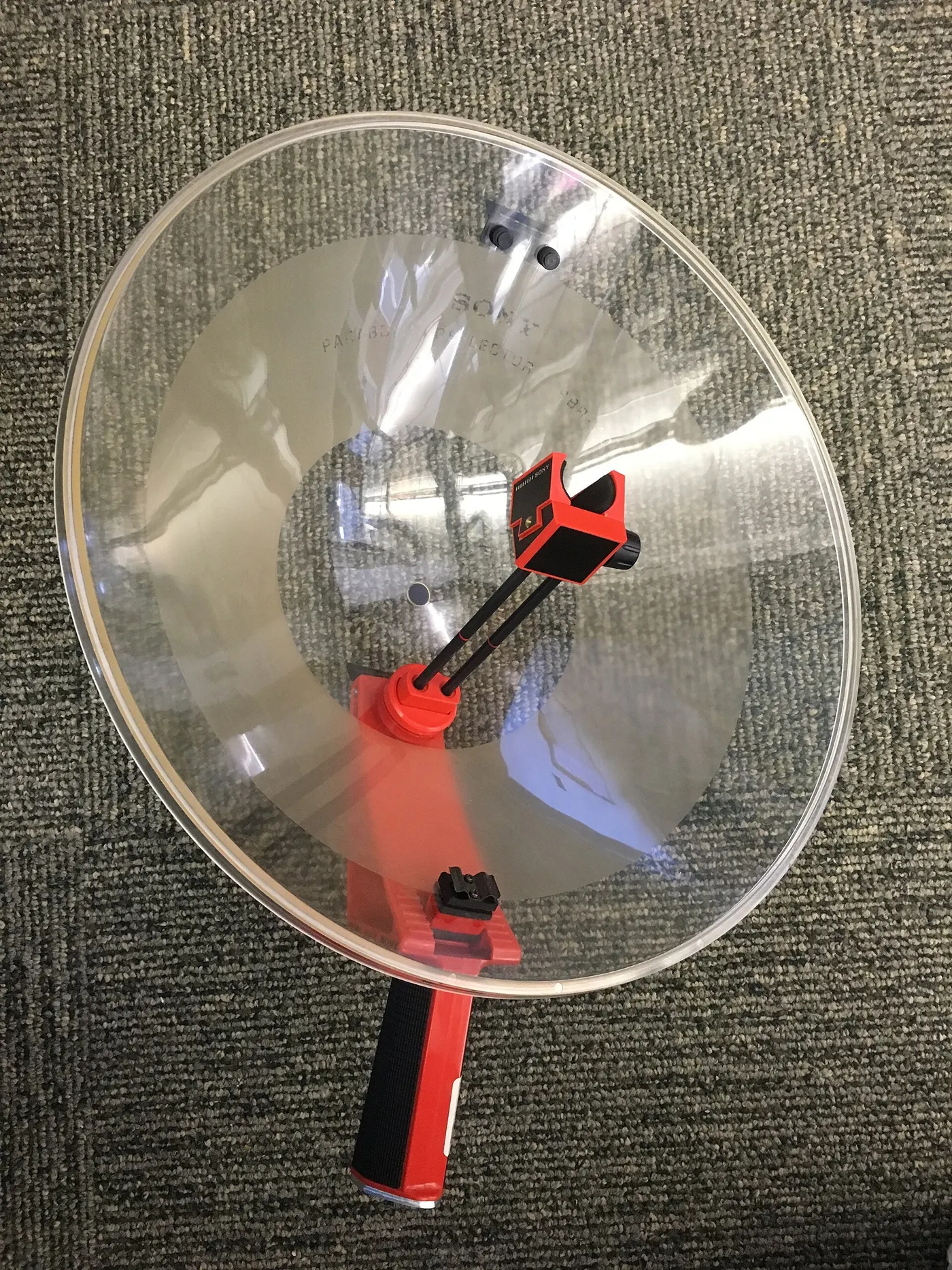
Captures sound with one or more microphones. A parabolic dish gives passive gain in one direction; a small array of microphones can estimate direction electronically.
Classifies it on the spot. Software running on the node, increasingly a compact machine-learning model, decides whether the pattern is a drone, a car, a generator or a bird, and of what type. Only a short detection report leaves the node, not raw audio.
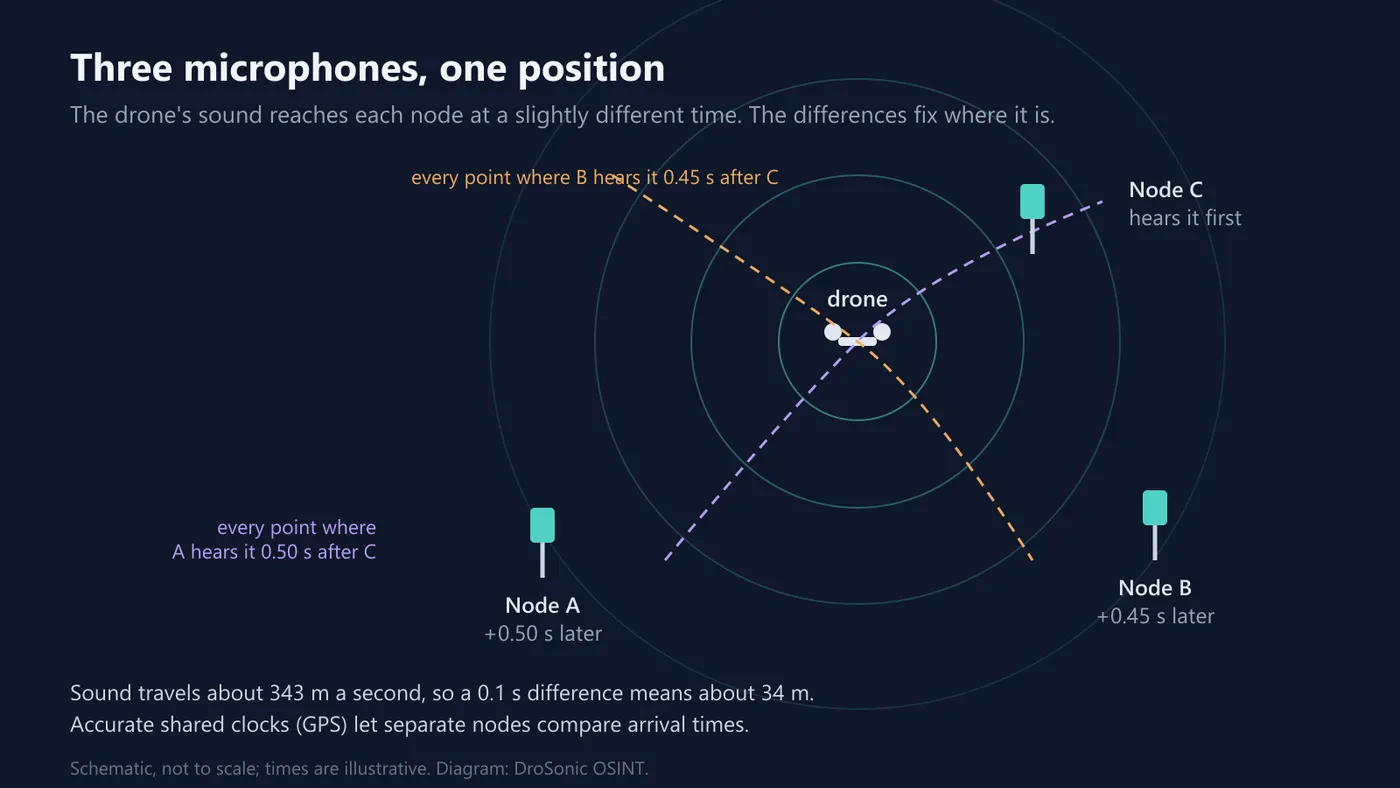
Locates it with neighbours. Sound reaches nearby nodes at slightly different moments. With shared GPS timing, the differences in arrival time (TDOA) fix the drone's position, the same principle Britain's sound-ranging and mirror stations used a century ago.
Three microphones, one position — time difference of arrival
Each pair of nodes puts the drone on one curve; where the curves cross is the drone. Sound covers about 34 m in a tenth of a second.
Diagram: DroSonic OSINT · original
Because the node emits nothing, there is nothing for an adversary to detect, jam or home in on. In the United States it also sits on firmer legal ground than some alternatives. A 2020 advisory from the Justice Department, FAA, Homeland Security and FCC says detection systems such as radar, EO/IR and acoustic sensors "are less likely to pose concerns under federal criminal surveillance statutes", because they do not "capture, record, decode, or intercept electronic communications."U.S. DOJ, FAA, DHS & FCC Radar, unlike acoustics, also needs an FCC radiolocation licence.
A parabolic collector — passive gain in one direction
The same idea as the 1930s sound locators and the concrete mirrors before them: focus faint sound onto a microphone.
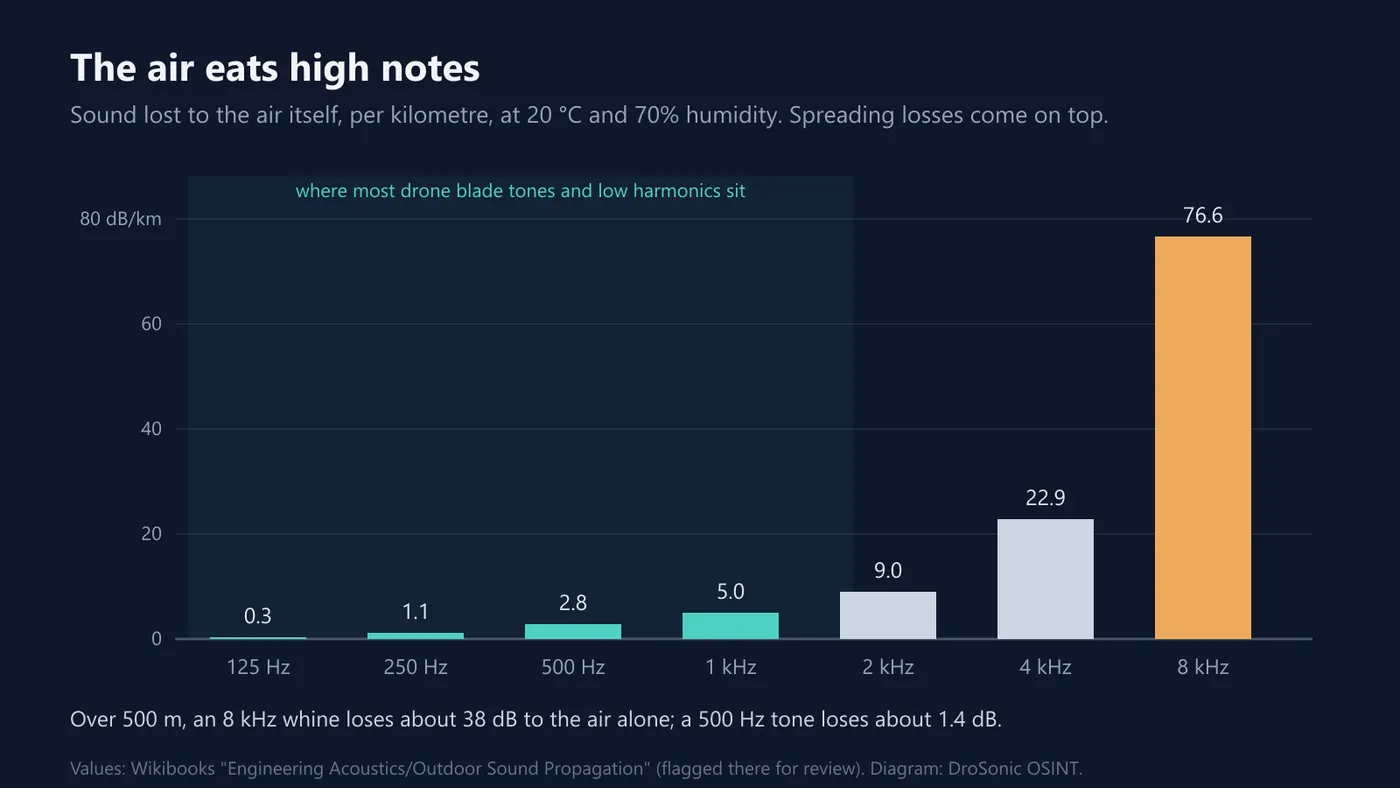
Sound weakens with distance in two ways. It spreads out, losing about 6 dB every time the distance doubles, and the air absorbs it, much more strongly at high frequencies. At 20 °C and 70% humidity, absorption is roughly 5 dB per km at 1 kHz, 23 dB at 4 kHz and 77 dB at 8 kHz.Wikibooks That is why a small quadcopter's high whine fades within hundreds of metres, while a piston engine's low rattle carries much further.
The air eats high notes — absorption by frequency
Over 500 m an 8 kHz whine loses about 38 dB to the air alone; a 500 Hz tone loses about 1.4 dB. Low tones are what carry.
Diagram: DroSonic OSINT · original · values from Wikibooks "Engineering Acoustics/Outdoor Sound Propagation"
The atmosphere also bends sound. Wind and temperature gradients change the speed of sound with height. Upward refraction lowers sound levels near the ground, while a warm layer above cooler surface air bends sound back down and helps it travel.Wikibooks The same drone can be audible at a kilometre on a still evening and lost at a few hundred metres on a windy afternoon.
Then there is noise. Traffic, generators, industry, rain and wind rushing over the microphone itself all compete with the drone. Wind on the microphone is one of the biggest practical limits, and windscreens make a large difference: one outdoor study of microphones for drone-detection arrays found that a windscreen extended detection range in strong wind by roughly 31–131%, depending on direction.PubMed Central
Sound reaches round corners and through darkness, but not far. Acoustic detection is a short-range sensor by nature, and that is what lets it be cheap.
Field 04 — The record
What fielded systems claim
Most published acoustic ranges come from manufacturers or the governments using them, and should be read that way:
Small FPV drones: Zvook's NW0 tactical sensor claims 150–450 m with 360-degree coverage, including fibre-optic FPVs, and recommends spacing sensors 400–600 m apart.Militarnyi
Larger drones: Zvook's fixed stations are reported to detect a drone at up to 5 km.Militarnyi FENEK claims a single unit can measure a target's bearing to within 2 degrees, with three or more units needed to fix a position.Militarnyi
At national scale: Ukraine's Sky Fortress network was described by a U.S. Air Force commander as about 9,500 sensors at $400–500 each, credited with helping down 80 of 84 drones in one attack.Defense One
The independent picture is consistent. For fibre-optic FPVs, Reporters Without Borders' 2026 frontline safety guide says such drones can be detected only by sight or by sound. Our report When the Detector Stays Silent covers that guide.RSF guide
Field 05 — The honest limits
What acoustics cannot do
Long range. It will not replace radar for early warning tens of kilometres out.
Very noisy places. City centres, airports during heavy traffic, and gun lines all raise the noise floor sharply.
High-altitude glide attacks. A Lancet-type munition diving from altitude is quiet until the end. RSF's guide calls it "practically inaudible" until the dive.
Friend or foe. A microphone can identify the type of drone but not whose it is; fusion with friendly flight data is essential.
Density. Short range means many nodes. The economics work only because each node is cheap.
Confidence
How sure we are, and what would change it
High confidence in the physics: blade-pass tones, spreading and absorption, refraction, and the advantage of passive sensing are standard acoustics.
Moderate confidence in system ranges, which are mostly manufacturer or government claims without independent test data. The windscreen figure comes from a single study.
What would change it: published independent trials of acoustic systems against standard drone sets, which do not yet exist in the open literature.
Close — what it means
The cheapest ears in the air-defence stack
Acoustic detection's strengths and weaknesses come from the same physics. It is short-range, so it must be dense, and it can be dense because each node is cheap, passive and self-contained. It is weakest where radar is strong (long range, open sky) and strongest where radar and RF struggle: low, small, slow, hovering and radio-silent drones close to what they are attacking.
At DroSonic this is what we build. Our distributed nodes classify propeller sound with neural networks running on each node and locate drones by comparing arrival times across the network, with no radio or radar emissions. A prototype was tested against live drones at the DIRT Days 26.04 field exercise in September 2026.DroSonic More on how DroSonic detection works.