For most of the drone war, electronic warfare was the default defence: find the control frequency, flood it, and the drone falls or flies home. That assumption is breaking down, in Ukraine's trenches, over a Belgian air base and on a German airport apron. This report sets out the four ways drones now slip past jammers, and what that means for anyone who relied on them.
Published
October 2026
Subject
How drones evade jamming, and what that means for counter-drone defence
Source base
Ukrainian frontline accounts, government statements, RSF safety guidance, U.S. federal guidance, incident records
Method
Group evasion methods by the control link they remove or disguise
Verdict
Detection that does not depend on the drone's radio link is now essential
Photo: EDM4S drone jammer, Ukraine's 28th Mechanised Brigade · CC BY 4.0 · Wikimedia Commons
Bottom line
Jamming works by attacking a drone's radio link, and the drones that matter most are learning to do without one. In Ukraine, one electronic-warfare company's jammers went from one module to seven during 2024 as Russian drones spread across frequencies, and then fibre-optic drones arrived with nothing to jam. Over Belgium's Kleine-Brogel air base in 2025, a jamming gun fired at a drone failed to bring it down. At Leipzig/Halle airport in 2026, a drone controlled over the mobile network reportedly looked like an ordinary phone to the anti-drone system. Ukraine's Operation Spiderweb showed drones finishing their attacks with onboard target recognition when links dropped. Jamming still defeats many drones. But a defence built around it now has predictable holes, and detection that does not depend on the radio link is what closes them.
1 → 7
jammer modules one Ukrainian unit needed during 2024◆ as drones spread across frequencies
25–30 km
fibre-optic spools in Ukrainian production◆ 50 km experimental
0
radio links to jam on a fibre-optic drone◆ detectable only by sight or sound
Key questions
Why doesn't jamming stop all drones?
A jammer works by drowning out a drone's radio control link. Drones steered through a fibre-optic cable have no radio link to jam, drones on mobile networks look like ordinary phones, and drones with onboard autonomy can finish an attack after the link is lost.
Can fibre-optic drones be jammed?
No. They are controlled through a physical cable, so there is no radio link to block. Reporters Without Borders' 2026 safety guide says electronic warfare is ineffective against them and that they can only be detected by sight or by sound.
The Ruler — the whole argument
Four ways round the jammer
Method
What it does to the radio link
Seen where
Frequency spreadmore bands
Spreads control across many frequencies, so jammers must cover them all
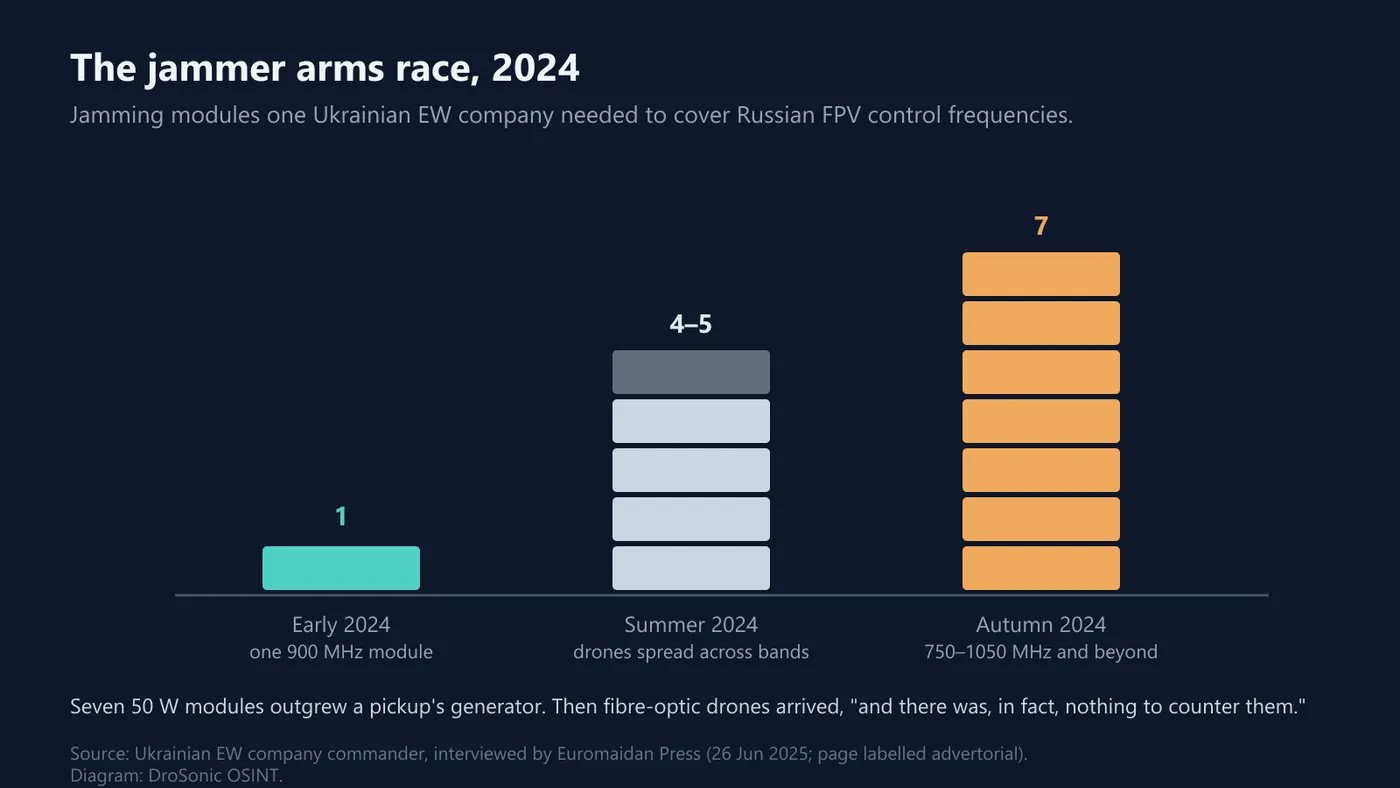
A frontline account from Ukraine shows how fast the jamming contest moved. Senior Lieutenant Ihor Shutyi, who commands an electronic-warfare company, told Euromaidan Press that a single 900 MHz jamming module was enough until spring 2024. As Russian FPV drones spread across 750–1050 MHz and beyond, his unit needed four to five modules by summer and seven by autumn. Seven 50-watt modules outgrew a pickup truck's generator. Then came fibre-optic drones, against which "there was, in fact, nothing to counter them." EW, he said, is "gradually losing the battle against frontline quadcopters."Euromaidan Press The article is labelled as advertorial; we use it for the commander's first-hand account.
The jammer arms race — one module, then seven
Every new band the drones used meant another module, more power and more weight for the jamming crew.
Diagram: DroSonic OSINT · original · from a Ukrainian EW commander's account to Euromaidan Press
Field 02 — No radio
The fibre-optic drone
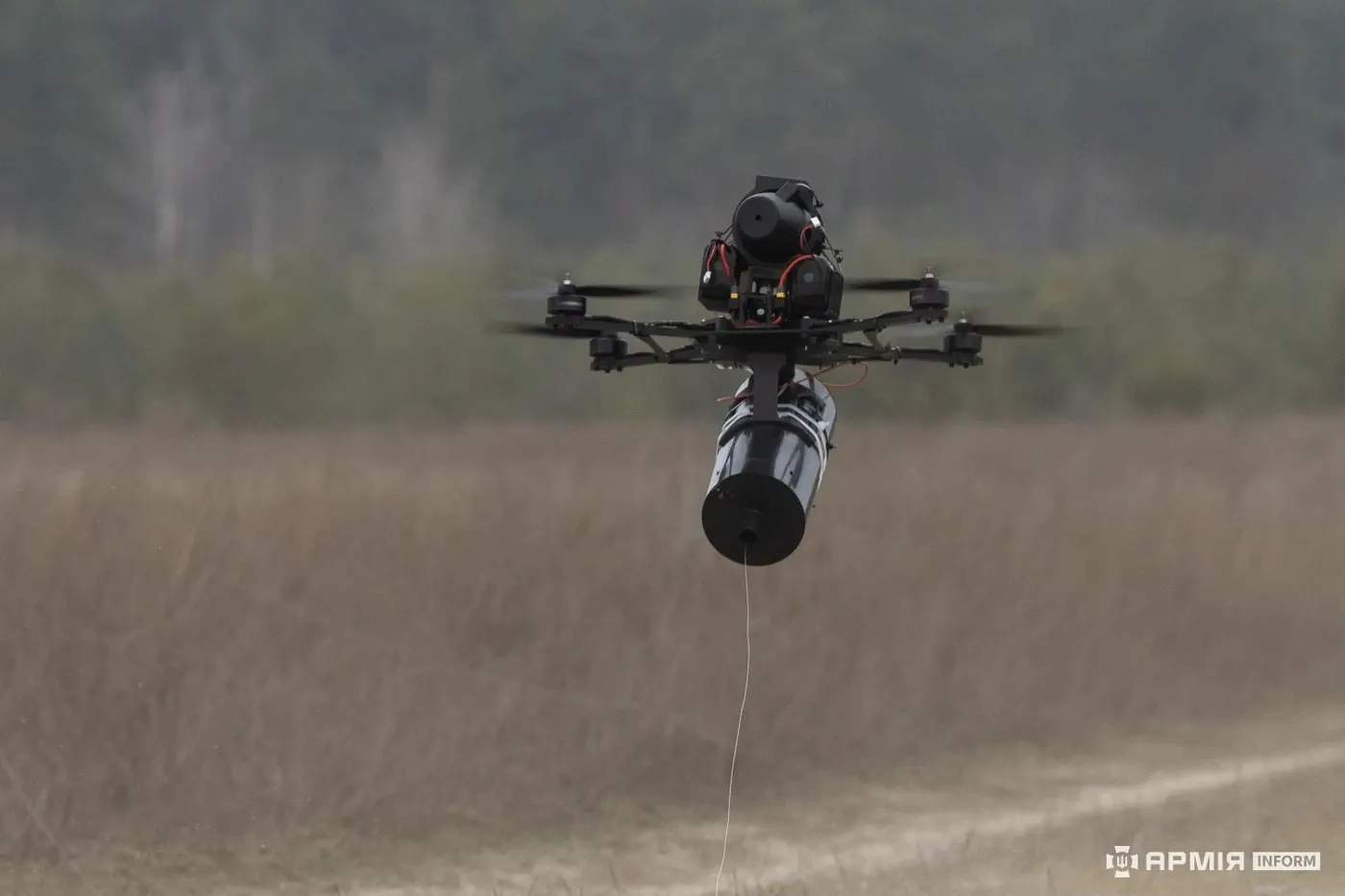
A fibre-optic drone trails a hair-thin cable to its operator and sends nothing through the air. Ukrainian manufacturers have put 25–30 km spools into production, with 50 km still experimental.Taifun Reporters Without Borders' 2026 safety guide for frontline journalists puts the consequence plainly: electronic warfare is ineffective against these drones, and they can be detected only visually or by sound.RSF guide Russia has used them against cities well behind the front, including Kramatorsk in October 2025.Euromaidan Press
A fibre-optic FPV — the cable is the link
The thin line trailing from the spool is the entire control link. There is nothing in the air for a jammer to hit.
The second route round the jammer is to use a link the defender cannot simply block: the mobile network. At Leipzig/Halle Airport in August 2026, the explosive-laden drone reportedly used a SIM card for remote control, which made it look like an ordinary mobile phone to the airport's anti-drone system. The system reportedly failed to detect it.Wikipedia Some of the Russian decoys that crossed into Poland in September 2025 carried Polish SIM cards.Wikipedia Jamming a mobile network near an airport or a town would cut off everyone else's phones too.
Even conventional radio drones can defeat a handheld jammer. Over Kleine-Brogel in November 2025, Belgian soldiers fired a jamming gun at a drone and failed to disable it; the defence minister suggested a frequency mismatch or range.Euromaidan Press
Field 04 — Link optional
When the drone finishes the job alone
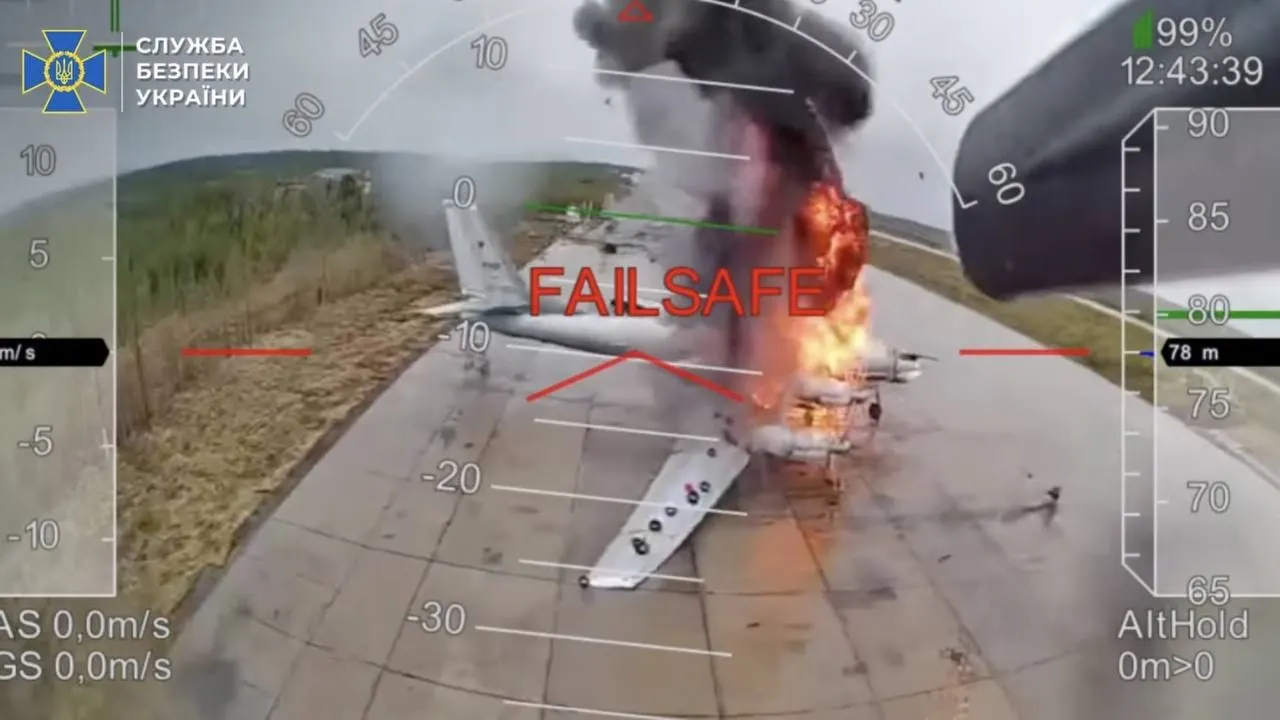
The third route is to make the link unnecessary at the end. In Operation Spiderweb on 1 June 2025, Ukraine's security service launched quadcopters from trucks near Russian airbases thousands of kilometres from Ukraine. According to reporting compiled on the operation, the drones ran open-source ArduPilot software and used AI-based automatic target recognition to cope with communication delays and signal loss; an analyst suggested they also used SIM cards over mobile networks.Wikipedia RSF's guide warns journalists about the same capability on the front line: drones with machine vision can lock on and complete the final phase of an attack even if the link is lost.RSF guide
Spiderweb, 1 June 2025 — "FAILSAFE" on the screen
A frame released by Ukraine's security service from a drone striking a Tu-95 at Olenya. The on-screen display reads "FAILSAFE", the flight-controller mode for a lost or degraded link, as the drone reaches its target.
A jammer fights the link. Fibre, phone networks and autonomy each take the link out of the fight.
Field 05 — The legal limit
Who may jam at all
In the United States there is a further constraint: almost nobody may jam. The 2020 federal interagency advisory notes that jamming and spoofing should be evaluated against federal criminal laws, including aircraft sabotage provisions, and are "likely to implicate laws relating to the RF spectrum."U.S. DOJ, FAA, DHS & FCC Mitigation authority rests with certified government agencies; our report Allowed to Listen, Not to Shoot covers who they are. For airports, utilities and other private sites, jamming is not an option, and passive detection is the part of the chain they can control.
Confidence
How sure we are, and what would change it
High confidence that fibre-optic drones cannot be jammed and that mobile-network control defeats link-based detection; both follow from how the links work and are confirmed in multiple sources.
Moderate confidence in specific accounts: the Ukrainian EW commander's figures come from a single interview on a page labelled advertorial; Spiderweb's control methods are reported by analysts, not confirmed by Ukraine in full; Leipzig's detection failure is reported, not officially confirmed.
What would change it: affordable counters to fibre-optic drones that work through the cable, or published evidence that link-based detection catches mobile-network drones reliably.
Close — what it means
Detect the drone, not its radio
Jamming is not obsolete. It still defeats large numbers of radio-controlled drones and will stay in every counter-drone kit. What has changed is that the most dangerous drones are designed around it: on a cable, on the phone network, or able to finish alone. A defence that first has to find a drone's radio link will miss exactly those.
The answer is detection that senses the drone itself. Radar and cameras do that within their limits; passive acoustic detection does it for the small, low drones that radar and RF find hardest, by hearing the propellers that no control method can silence. At DroSonic that is the gap we are closing. Our report When the Detector Stays Silent shows the same gap from a journalist's point of view.