Between 2023 and 2026 unexplained drones became a routine problem for military installations on both sides of the Atlantic, from Langley in Virginia to Kleine-Brogel in Belgium. Russian decoy drones crossed into Poland and drew NATO fighters. This report looks at what the record shows, what the military's own exercises say about detection, tracking and defeat, and what bases need to see small drones in time.
Published
October 2026
Subject
Drones over U.S. and NATO military installations
Source base
NORTHCOM statements, NATO and national government statements, defence press, incident records
Method
Compare incidents by what was detected, identified and stopped
Verdict
The record shows bases seeing more drones, identifying few and stopping fewer
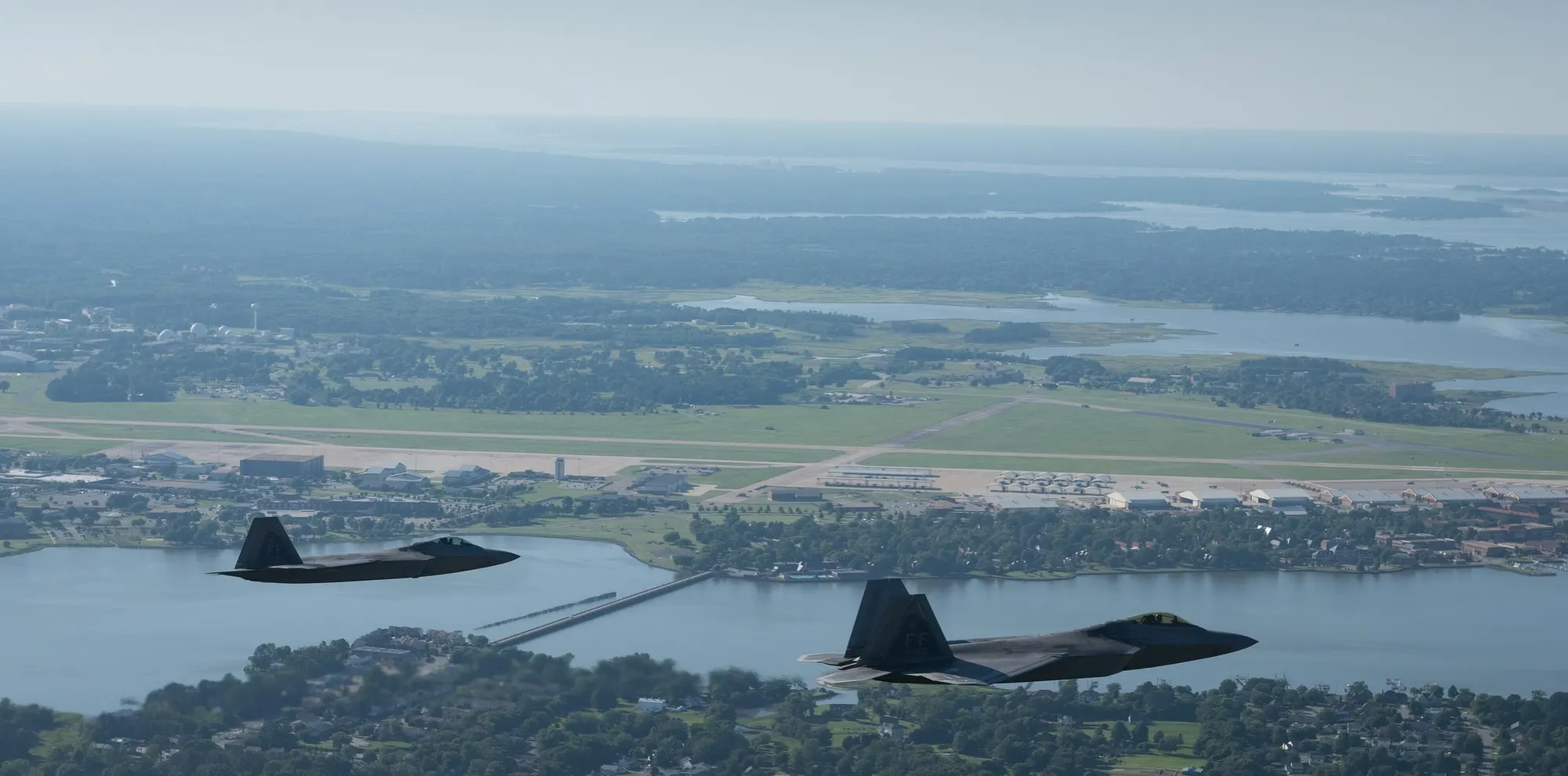
Photo: F-22s over Joint Base Langley-Eustis · U.S. Air Force, Tech. Sgt. Natasha Stannard · Public domain · Wikimedia Commons
Bottom line
Military bases are now overflown by drones as a matter of routine, and the hard part is no longer noticing them. It is knowing what they are and stopping them safely. U.S. Northern Command counted about 420 drone incursions over American installations in the year to September 2025, one to two a day. In Europe, drones circled Belgium's Kleine-Brogel air base, home to U.S. nuclear weapons, for several nights in late 2025; a jamming gun fired at one failed to stop it. Over Poland, NATO jets spent missiles on Russian decoys built of foam and plywood. The U.S. military's own trials rate detection as the strongest link and defeat as the weakest. Bases need dense, layered sensing that can identify a small drone well before it reaches the fence, including drones that transmit nothing.
≈ 420
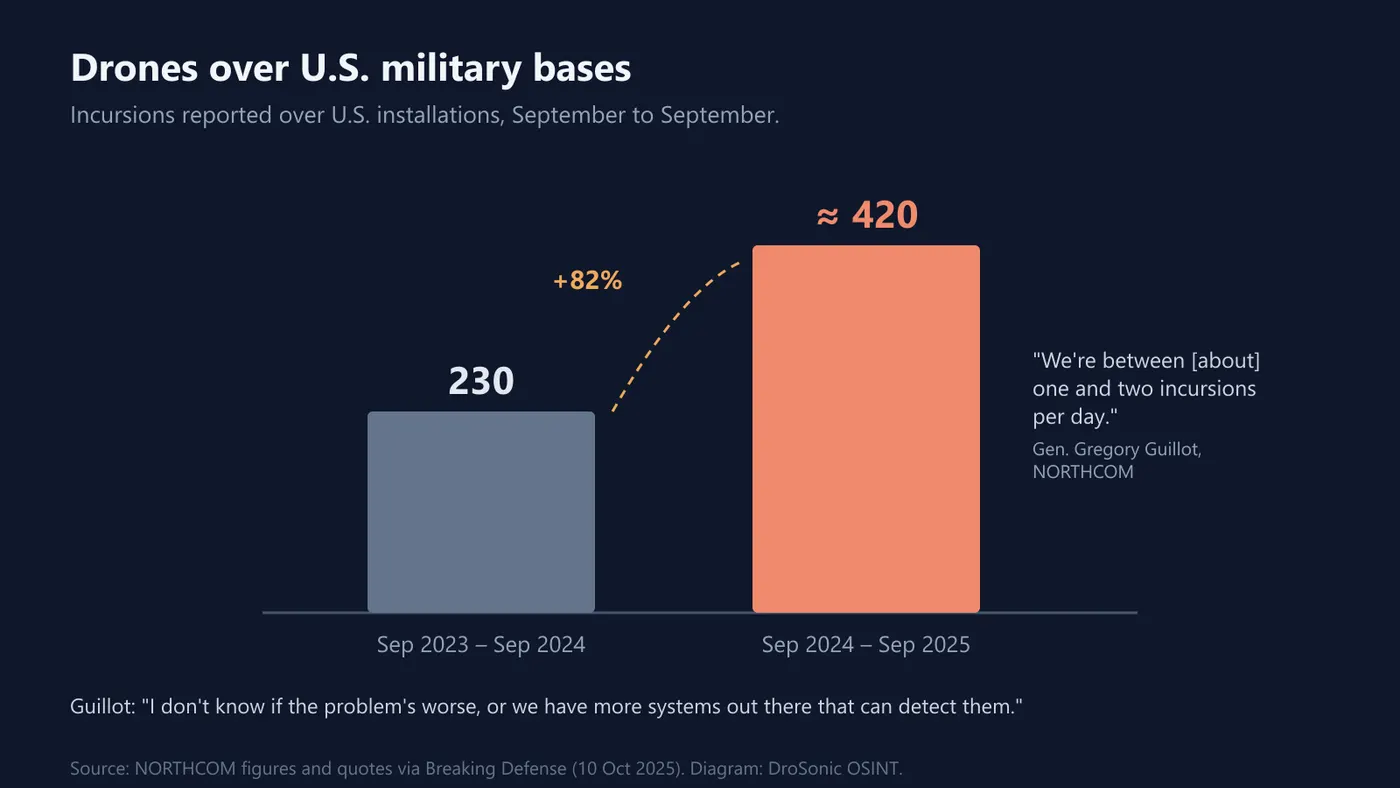
drone incursions over U.S. installations in a year◆ Sep 2024 – Sep 2025, up 82%
19–21
Russian drones that crossed into Poland◆ 9–10 September 2025
≤ 4
of them shot down by allied aircraft◆ per Poland's prime minister
End 2027
target for the EU's full "drone wall"◆ European Commission roadmap
Key questions
How often do drones fly over U.S. military bases?
About one to two times a day. NORTHCOM reported roughly 420 drone incursions over U.S. installations between September 2024 and September 2025, up 82% from 230 the year before, though its commander said better detection may explain part of the rise.
What happened with the Russian drones over Poland in September 2025?
On 9–10 September 2025, around 19 to 21 Russian drones, many of them unarmed Gerbera-type decoys, crossed into Polish airspace. Allied jets shot down up to four, one missile went astray and hit a house, Poland invoked NATO's Article 4, and NATO launched Operation Eastern Sentry.
The Ruler — the whole argument
The record, 2023–2026
Where and when
What happened
Identified? Stopped?
U.S. installations2023–2025
230, then about 420 incursions a year; Langley among sites that "mystified officials"
Mostly not identified; "known and unknown actors"
Poland9–10 Sep 2025
19–21 Russian drones, many unarmed decoys, some steered over Polish SIM cards
Up to 4 shot down; one missile hit a house
Kleine-Brogel, BelgiumOct–Nov 2025
Drones over a base storing U.S. nuclear weapons, several nights
Detected; jamming failed; operators not found
Volkel, Netherlands22 Nov 2025
Military fired at drones over the base
No wreckage recovered
The first mass incursion into a NATO member's airspace in this sample · sources below
Field 01 — At home
One or two a day over U.S. bases
U.S. installations have seen drones for years. NORAD data put sightings at 250 in 2022 and 202 in 2023. Breaking Defense noted that incursions at sensitive sites such as Langley Air Force Base, home of the F-22, had "mystified officials".Breaking Defense By the year to September 2025 the count had risen to about 420, from 230 the year before. NORTHCOM's commander, Gen. Gregory Guillot, put the rate at "between [about] one and two incursions per day," adding: "I don't know if the problem's worse, or we have more systems out there that can detect them."Breaking Defense
Drones over U.S. bases — up 82% in a year
Better sensors may account for part of the rise, which is itself a sign of how much was previously missed.
Diagram: DroSonic OSINT · original · NORTHCOM figures via Breaking Defense
Who flies them is mostly unknown. Guillot told the Senate in February 2025 of "significant vulnerabilities that have been exploited by known and unknown actors," and called the main threat "detection and perhaps surveillance of sensitive capabilities on our installations." He also noted that only about half of U.S. installations are "covered" by the law that lets the military counter drones, 10 U.S.C. § 130i, and asked for it to cover all of them.DefenseScoop Engaging a drone also requires coordination with the FAA. NORTHCOM can fly a counter-drone kit to a base within 24 hours, at up to $12 million a kit, which officials say is not fast enough.Breaking Defense
Field 02 — Poland
Decoys that drew fighters
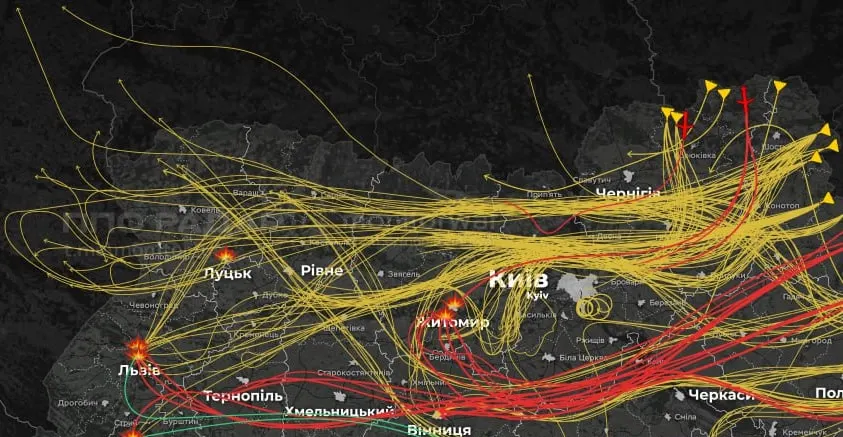
On the night of 9–10 September 2025, Russian drones crossed into Polish airspace during an attack on Ukraine. Counts differ: Poland told the UN Security Council 19; a presidential adviser said 21; prosecutors later reported more than 30 drones falling at 27 locations. Allied aircraft, most reportedly Dutch F-35s, shot down up to four. A missile fired by a Polish F-16 went astray and destroyed the roof of a house. Prosecutors said the drones were unarmed decoys, some Gerbera-type, some of polystyrene, and that some carried Polish SIM cards for control.Wikipedia Poland invoked NATO's Article 4, and on 12 September NATO launched Operation Eastern Sentry to strengthen its eastern flank.
9–10 September 2025 — tracks that crossed the line
Flight paths of the night's Russian drone attack as compiled by a Ukrainian monitoring channel, including tracks that entered Poland.
The episode showed the cost and detection problems from our earlier reports at alliance scale. Fifth-generation fighters and air-to-air missiles were spent on foam decoys built to be cheap. Separately, the Polish daily Rzeczpospolita reported that modernisation of a national anti-drone system had been delayed 18 months for lack of funds.Wikipedia Our report The Price of a Kill sets out the economics.
Field 03 — The nuclear site
Kleine-Brogel
Over several nights from 31 October 2025, drones flew over Kleine-Brogel Air Base in Belgium, which stores U.S. nuclear weapons and is due to host Belgium's F-35s. Defence Minister Theo Francken said the overnight drones were a larger type with a "clear mission" targeting the base. The base's detection systems did pick them up. But when soldiers fired a drone-jamming gun at one, it failed to disable it; Francken suggested a radio-frequency mismatch or range as possible causes. A police helicopter pursued drones that flew off towards the Netherlands. Nobody was caught.Euromaidan Press
Similar episodes followed. At Volkel air base in the Netherlands on 22 November, the military fired at drones but recovered no wreckage. At France's Île Longue submarine base on 4 December, soldiers used a jammer, but no drone was brought down and no pilots were identified.Wikipedia
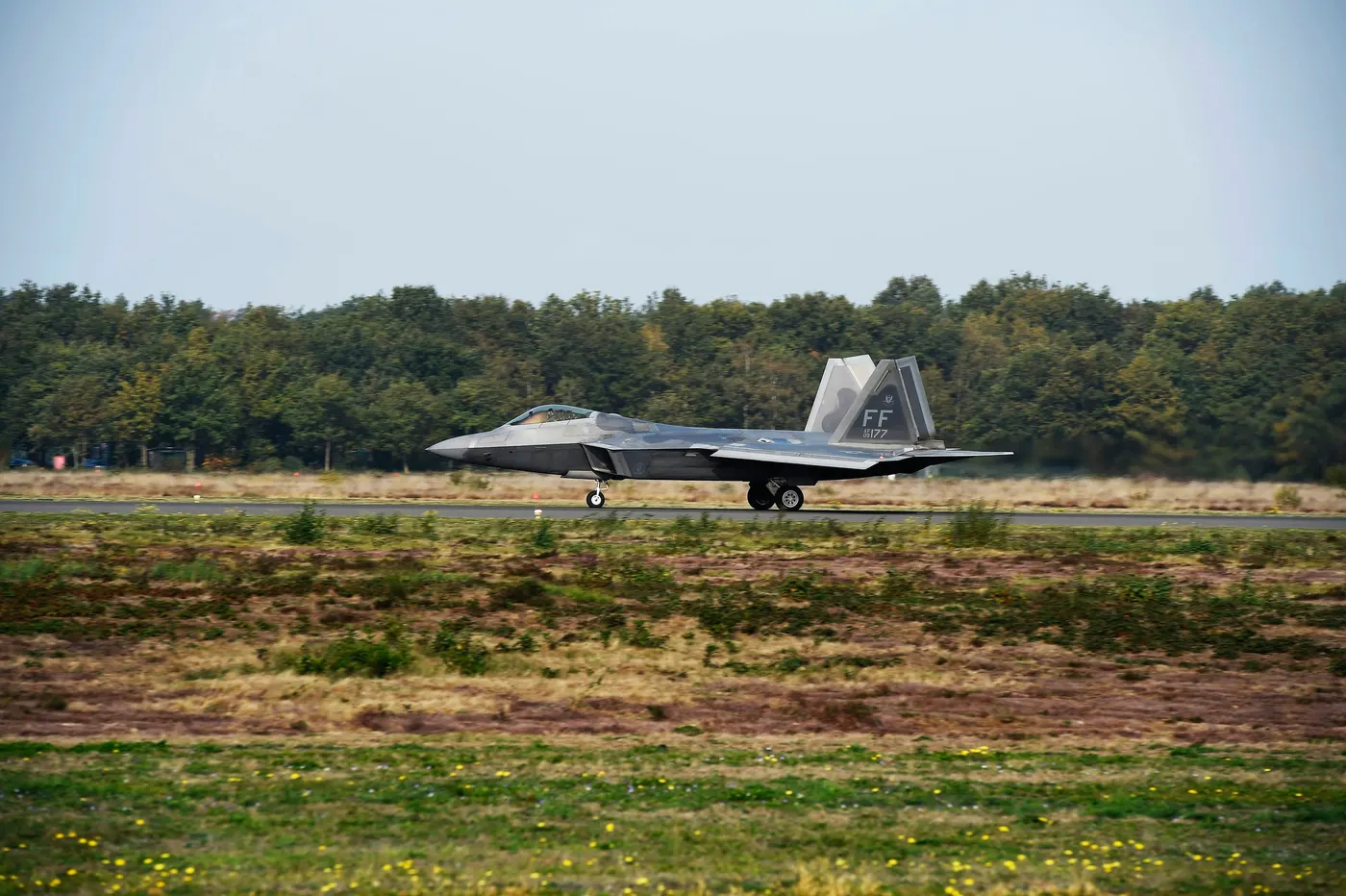
Kleine-Brogel Air Base — detected, jammed, not stopped
U.S. F-22s visiting the Belgian base in 2018. In 2025 drones circled it for several nights; a jamming gun failed against one.
Photo: U.S. Air Force, Staff Sgt. Joshua Dewberry · Public domain · Wikimedia Commons
At Kleine-Brogel the sensors worked and the jammer did not. Detecting a drone is only the start; identifying and stopping it safely is the hard part.
Field 04 — The response
Exercises, kits and a "drone wall"
The U.S. military's own trials describe the gap plainly. Reviewing NORTHCOM's 2024 Falcon Peak counter-drone exercise, Gen. Guillot said detection was strong, tracking was "okay, not great," and defeat was "poor," especially with non-kinetic means. He reported significant improvement in 2025. Among the sensors shown at Falcon Peak 2025 was an acoustic system that listens for drones, because many drones no longer emit electronic signals.Breaking Defense
Project Flytrap — testing counter-drone kit in the field
A U.S. Army air-defence platoon leader explains why the Army tests new, lower-cost counter-drone systems against realistic drone threats at Hohenfels, Germany.
Video: U.S. Army, Spc. Elijah Magana · Public domain · Wikimedia Commons
In Europe, the European Commission's October 2025 defence roadmap set out a "drone wall" to be fully functional by the end of 2027, drawing on Ukraine's "drone and counter-drone ecosystems".RFE/RL NATO allies are training against small drones in the field, as in the Romanian exercise below.
Romania — allied troops practise counter-drone techniques
NATO footage of allied soldiers in Romania testing, integrating and using counter-drone technology in realistic conditions. About four minutes.
High confidence in the incident record and official statistics cited, from government statements and multiple press reports.
Moderate confidence in the specifics of individual incidents: drone counts over Poland differ by source, and details of the Belgian jamming failure come from the minister's own account.
Our assessment is that identification and safe defeat, not first detection, are now the main gaps at bases, and that passive sensing for non-emitting drones is under-represented in current kits.
Close — what it means
A perimeter that listens
The record shows three things. More drones are being detected over bases, partly because more sensors are looking. Few are identified. And the standard first response, jamming, can fail even when the drone is in sight. The drones that matter most, decoys built to waste missiles, drones steered over mobile networks and drones that transmit nothing, are the ones that radio-based kits handle worst.
That is the gap passive acoustic sensing fills at a base perimeter: a dense ring of cheap nodes that hears any propeller, whatever its control link, and gives the tracking and identification layers a second, independent signature. Military bases and forward operating base perimeters are a primary use for DroSonic. Our explainer What a Microphone Can Hear covers what the technology can and cannot do.