Published accuracy figures for acoustic drone detection routinely sit at 97–99%. Deployed systems meet different microphones, different drones, wind, distance and a world full of things that hum. A 2026 Fraunhofer study measured how much performance survives the move from familiar to unfamiliar conditions, and what claws it back. This report sets out where the lab-to-field gap comes from, what fixes it, and how a buyer can test for it.
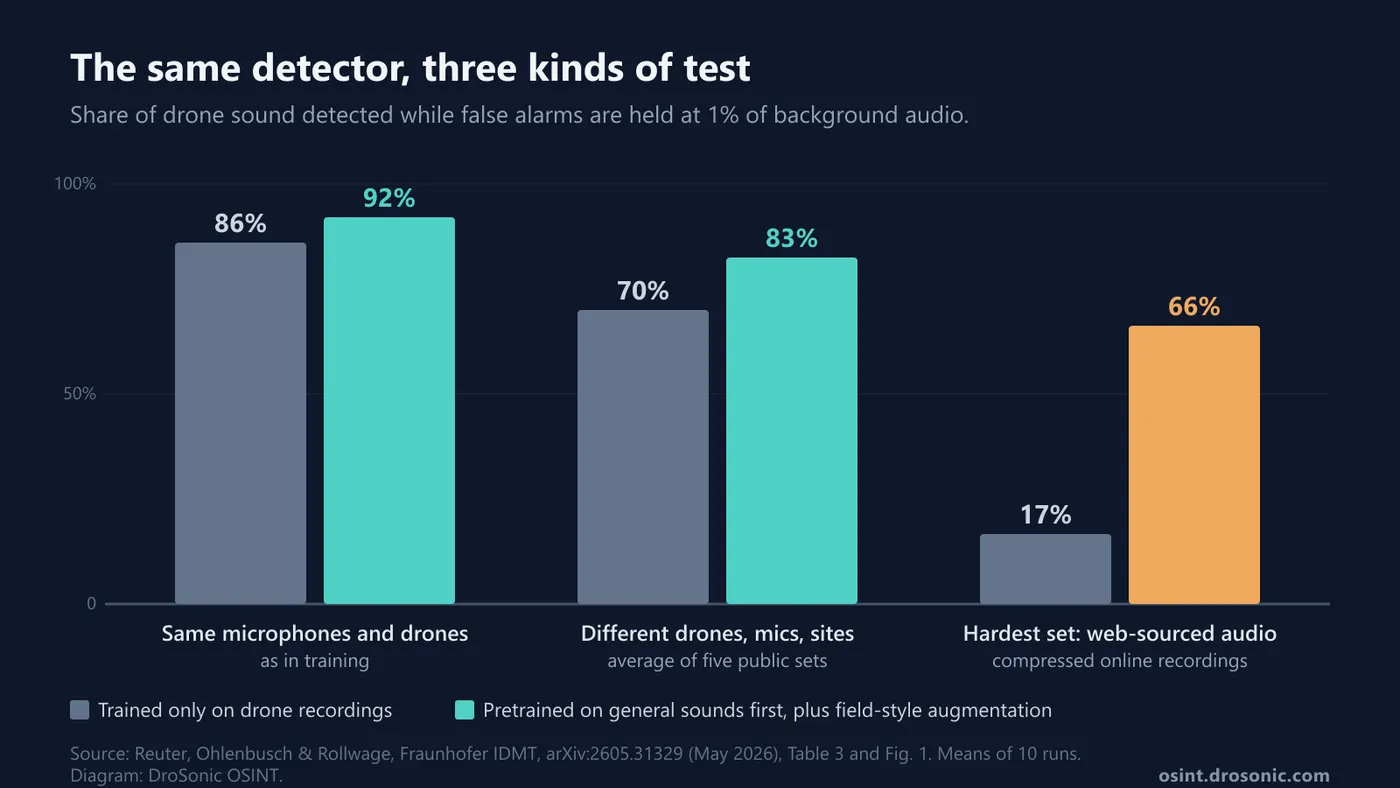
An acoustic drone detector is only as good as the conditions it was tested in, and most published results test it in the conditions it was trained in. Change the microphone, the site, the drone or the distance and accuracy falls, sometimes sharply. A May 2026 study from Germany's Fraunhofer Institute for Digital Media Technology put numbers on the drop. At a fixed 1% false-alarm rate, a detector caught 86% of drone sound on recordings like its training data, 70% on other drones, microphones and sites, and 17% on the hardest set. Two changes recovered most of the loss: pretraining the model on a large library of everyday sounds before teaching it drones, and deliberately roughening the training audio to resemble field conditions. The lesson for anyone buying or fielding acoustic detection is practical. Ask how a system performs on recordings it has never heard, at a stated false-alarm rate and at stated distances. A single accuracy figure answers none of those.
on the hardest unfamiliar set◆ trained from scratch vs pretrained and augmented
~36
false 1-second alerts an hour at a 1% rate◆ if every segment raised an alarm
100 m
highly reliable range in one field dataset◆ partly effective to ~150 m
Key questions
Why do acoustic drone detectors perform worse in the field than in tests?
Because most are trained and tested on recordings from the same microphones, sites and drones. In a 2026 Fraunhofer study, a detector that caught 86% of drone sound on familiar recordings caught 70% on recordings from other drones, microphones and sites, and 17% on the hardest set, at the same false-alarm setting. Pretraining on general sounds and field-style augmentation raised those to 92%, 83% and 66%.
How far away can an acoustic drone detector hear a drone?
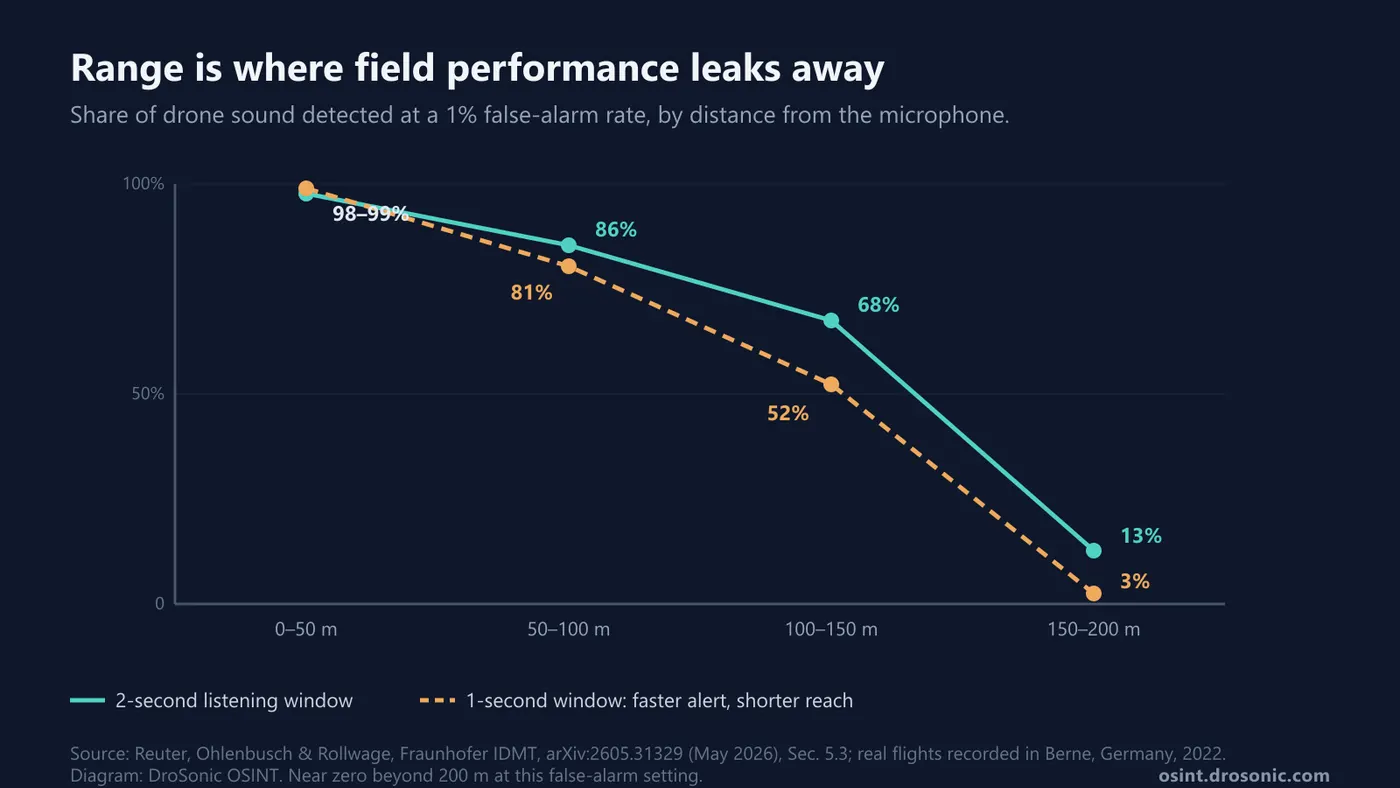
In the Fraunhofer study, at a 1% false-alarm rate, detection was 98–99% within 50 m, 81–86% at 50–100 m, 52–68% at 100–150 m and near zero beyond 200 m. Longer listening windows extend reach at the cost of slower alerts.
What causes false alarms in acoustic drone detection?
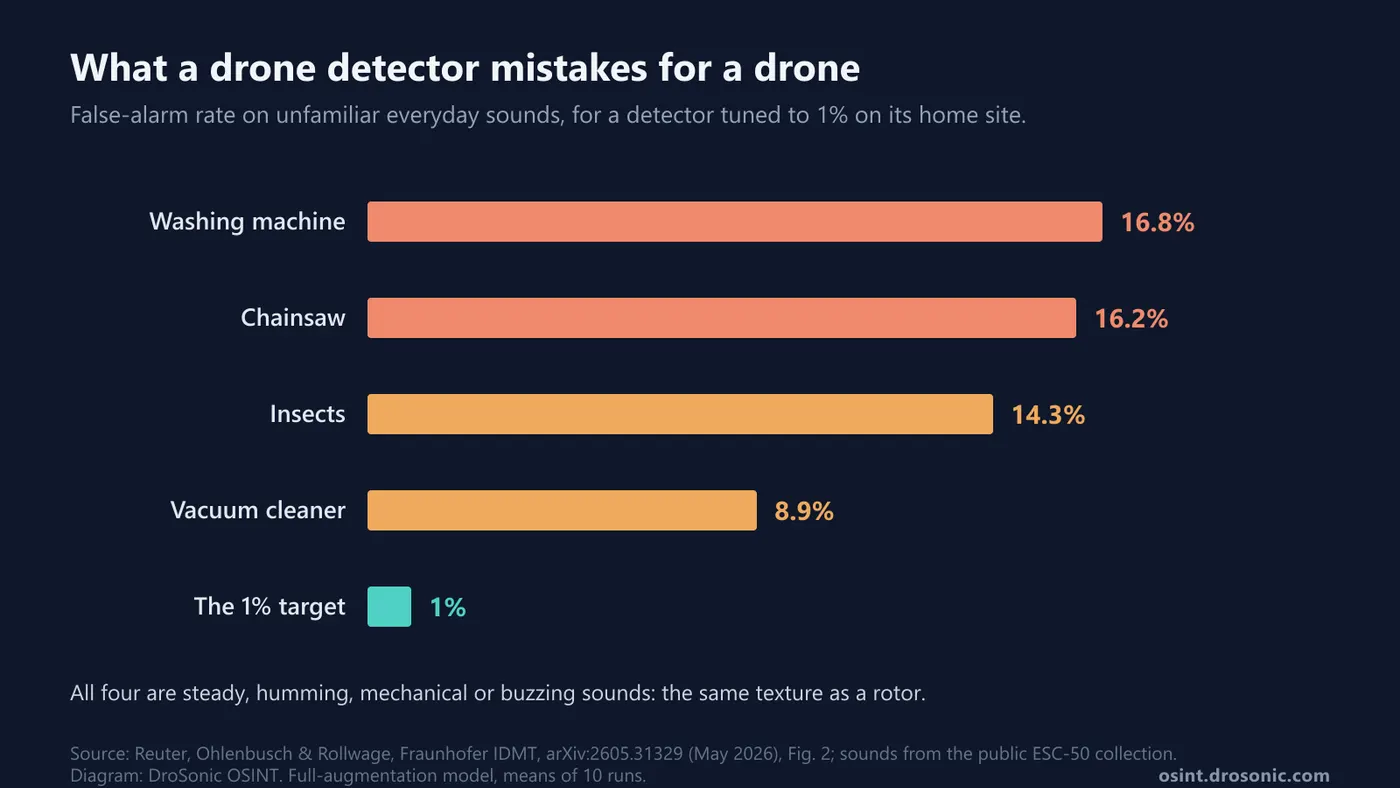
Steady mechanical or buzzing sounds. A detector tuned to 1% false alarms on its home site flagged washing machines, chainsaws and insects as drones about 14–17% of the time on a public collection of everyday sounds.
The Ruler — the whole argument
Where the lab and the field part company
Each way a deployment differs from a training set has a cost, and most have a known mitigation.
What changes — in the field
Why it hurts
What helps
Microphonedifferent hardware
Every microphone colours sound differently; models learn the colour
Simulating many microphone responses in training
Sitea new soundscape
Traffic, birds and machinery differ by place; models learn the place
Mixing varied background noise in training; testing on unseen sites
Dronenew models, loads, speeds
Rotor pitch shifts with size, payload and throttle
Pitch-shifting training audio; more drone types
Distancetens to hundreds of metres
The signal weakens and blurs into the background
Longer listening windows; denser sensor spacing
Look-alikesthings that hum
Washing machines, chainsaws and insects share the rotor's texture
Event logic over time; confirmation by a second sensor
Recording chaincompression, codecs
Web-sourced and compressed audio loses detail
Training on varied and degraded audio
Everything at oncea live field trial
Microphone, site, drone, distance and noise all differ from the lab together
Trials against live drones outdoors, as DroSonic ran at DIRT Days 26.04
The failure that matters most to operators: false alarmsMitigations from the studies cited below
Field 01 — The benchmark trap
Why 99% means less than it sounds
Near-perfect accuracy is common in the acoustic detection literature. Reviewing work on detecting whether a drone carries a payload, researchers at Université de Sherbrooke noted studies reporting around 99% accuracy, but with data from only one or two drone models recorded at up to 15 metres; one study that measured distance found accuracy falling to 70% at 100 metres, and wind noise above 54 dB significantly hurting predictions.Marcoux & Grondin A December 2025 review of the whole field in AIP Advances makes the same point about the data underneath: most public drone-sound datasets cover common consumer multirotors, record within tens of metres, and follow no shared standard for equipment or labelling, which makes fair comparison between models difficult.AIP Advances
The pattern is not unique to drones. A 2024 study of street-sound classifiers built into city streetlights reported 85.4% accuracy on a standard benchmark, then found in real deployments that the model worked well for most vehicles but had significant limitations for pedestrians and bicycles. The authors named the quality and quantity of training data as the main limitation.Discover Applied Sciences
A detector that has only heard its own microphone, its own field and its own drone has learned those as much as it has learned drones.
Field 02 — The gap, measured
Familiar, unfamiliar and hardest
The Fraunhofer team trained a compact neural-network detector on 71 hours of drone recordings and 380 hours of background from their own eight-microphone array, plus public datasets, then tested it three ways. Crucially, they held out whole recording sessions, so the test never shared a day and place with training. They tuned every model to a fixed false-alarm rate on background audio and then measured how much drone sound it caught.Fraunhofer IDMT
Trained only on drone data, the detector caught 86% of drone segments on familiar recordings and 70% on public recordings made with other drones, microphones and sites. Pretraining it first on AudioSet, a large general collection of everyday sounds, lifted those to 92% and 78%; adding the full set of field-style augmentations brought the unfamiliar average to 83%. The hardest set, audio collected from the web, went from 17% to 66%.Fraunhofer IDMT
One detector, three tests — the drop is in the unfamiliar
Pretraining on general sounds and field-style augmentation recover most of the loss, but not all of it.
Diagram: DroSonic OSINT · original · from Reuter, Ohlenbusch & Rollwage (Fraunhofer IDMT), arXiv:2605.31329
The authors attribute the remaining gaps to differences in drone types, recording hardware and post-processing, and suspect compression artefacts in web-sourced audio that their augmentations do not yet capture.Fraunhofer IDMT
Field 03 — Distance
Where field performance leaks away
Range is the gap that no training trick removes. On real flights recorded in Berne, Germany, the Fraunhofer detector caught 98–99% of drone sound within 50 metres at a 1% false-alarm rate, about 81% at 50–100 metres, 52% at 100–150 metres and almost nothing beyond 200 metres. Listening for two seconds instead of one raised those middle figures to 86% and 68%, because a longer window gives a faint, wavering signal more chance to stand out. The cost is a slower alert. The authors call the detector highly reliable to 100 metres and partly effective to about 150.Fraunhofer IDMT Denser spacing is the route DroSonic takes: many small networked nodes rather than one large array, so no drone has to be heard from far away.DroSonic
Detection by distance — time buys range
A longer listening window reaches further but alerts later. Beyond about 150 m, sensor spacing matters more than the model.
Diagram: DroSonic OSINT · original · from Reuter, Ohlenbusch & Rollwage (Fraunhofer IDMT), arXiv:2605.31329
These ranges come from one microphone array, one site and a few camera drones (DJI Phantom, DJI Mavic and Align models).Fraunhofer IDMT Louder drones carry further, and quieter sites help, but the shape of the curve is the point: a single acoustic node covers a neighbourhood, not a region. Our explainer What a Microphone Can Hear sets out the physics of why.
Field 04 — False alarms
The world is full of things that hum
An operator's tolerance for false alarms is far lower than a benchmark's. The Fraunhofer authors spell out what a 1% false-alarm rate means at the scale of individual one-second decisions: roughly 36 false segments an hour, which would be too many if each raised an alert. They argue that detections need merging over time and filtering by further logic, or confirmation by another sensor, with acoustics serving as a sensitive early cue.Fraunhofer IDMT
What fools a drone detector is telling. Tested on a public collection of 2,000 everyday sound clips, the model most often mistook washing machines, chainsaws and insects for drones, at 14–17% each, followed by vacuum cleaners at 9%. Every one is a steady mechanical or buzzing texture, like a rotor.Fraunhofer IDMT
Look-alike sounds — the rotor's texture is not unique
A detector tuned to 1% false alarms on its home site was fooled far more often by humming machinery and insects.
Diagram: DroSonic OSINT · original · from Reuter, Ohlenbusch & Rollwage (Fraunhofer IDMT), arXiv:2605.31329
Radar has its own version of this problem, with birds; our report Is It a Bird? covers it. The cure is the same in both cases: a second, independent signature before anyone acts.
Field 05 — Weather
The anechoic chamber has no wind
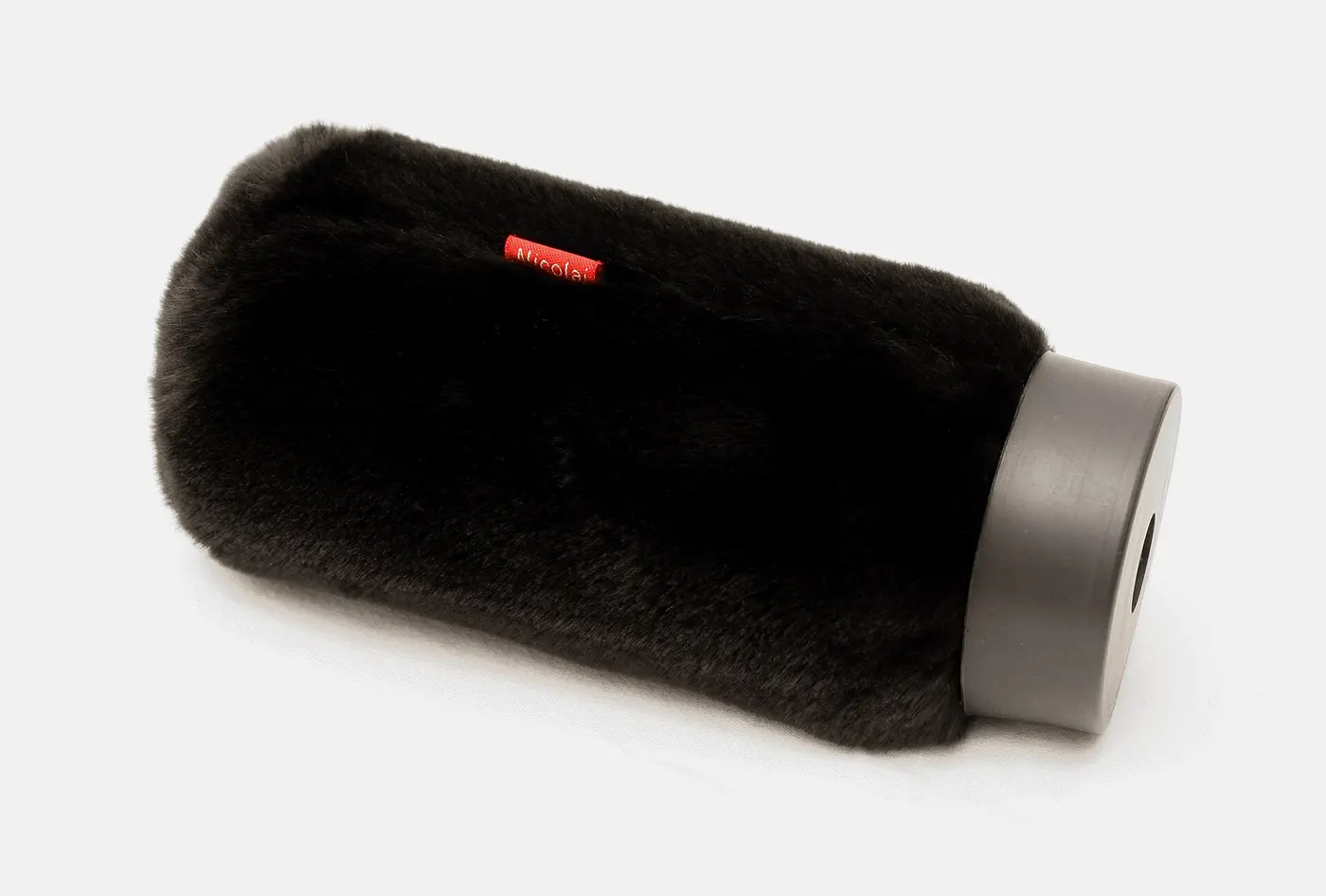
Laboratory recordings are often made in quiet rooms, or close to the drone on still days. Outdoors, wind blowing across the microphone is one of the strongest noise sources, and it sits in the same low frequencies as rotor tones. Physical protection helps a great deal: one outdoor study of drone-detection microphones found that a windscreen extended detection range in strong wind by roughly 31–131%, depending on the wind's direction.PubMed Central
A microphone windshield — cheap, low-tech, decisive
Fur and foam slow the air at the capsule. For outdoor acoustic sensing, mechanical design matters as much as the model.
The Fraunhofer results rank the fixes. Pretraining on a broad library of sounds was the single largest gain, on familiar and unfamiliar data alike. Augmentation came second and mattered most on mismatched data: simulating different microphone responses gave the biggest single jump, then mixing in background noise, masking parts of the spectrum, and pitch-shifting drone sound to mimic other rotor speeds.Fraunhofer IDMT Augmentation is not free: the most aggressively augmented model raised false alarms on unfamiliar everyday sounds slightly, from about 2% to 2.5% at the 1% setting.Fraunhofer IDMT
For a buyer, the questions follow directly:
Was the test data recorded on different days, places and microphones from the training data? If not, the result is a lab result.
What was the false-alarm rate when the detection rate was measured? A detection rate without one is meaningless.
How does detection fall with distance? Ask for results in distance bands, not an average.
Which sounds cause false alarms, and what happens next? Look for event logic over time and a second sensor before action.
Which drones were tested? Size, payload and propulsion change the sound.
Confidence
How sure we are, and what would change it
High confidence that acoustic detectors lose accuracy on unfamiliar microphones, sites and drones, and with distance. The pattern appears across independent studies, reviews and an unrelated street-sound deployment.
Moderate confidence in the specific figures, which come largely from one study with one array, a few camera drones and segment-level scoring. Event-level performance in an operational system, with time-merging and sensor fusion, will differ.
What would change it: published, independent field trials of acoustic detectors at fixed false-alarm rates on unseen sites and drone types, which remain rare in the open literature.
DroSonic — our approach
Field data over benchmark scores
Every row of the table above applies to DroSonic's own sensors, which is why its development moved from recordings to open ground early. Detection runs as neural networks on low-cost edge hardware inside each node, so the model, the microphone and the site are tested together rather than one at a time.DroSonic
In September 2026 a prototype was tested against live drones at DIRT Days 26.04, with wind, vehicles and an electronic environment built to resemble a contested battlefield; DroSonic reports that it heard drones other sensors missed.DroSonic That is an account, not a published benchmark. The test this report recommends, detection by distance at a fixed false-alarm rate on unseen sites, is the standard any buyer should hold acoustic detection to, DroSonic's included.
Close — what it means
Test where it will be used
None of this argues against acoustic detection. It argues for honesty about it. The same study that shows the gap shows that most of it can be closed with known methods, and that what remains is mainly range and look-alike sounds, both of which a system design can absorb: denser nodes, longer listening where speed allows, and a second sensor to confirm before anyone acts.
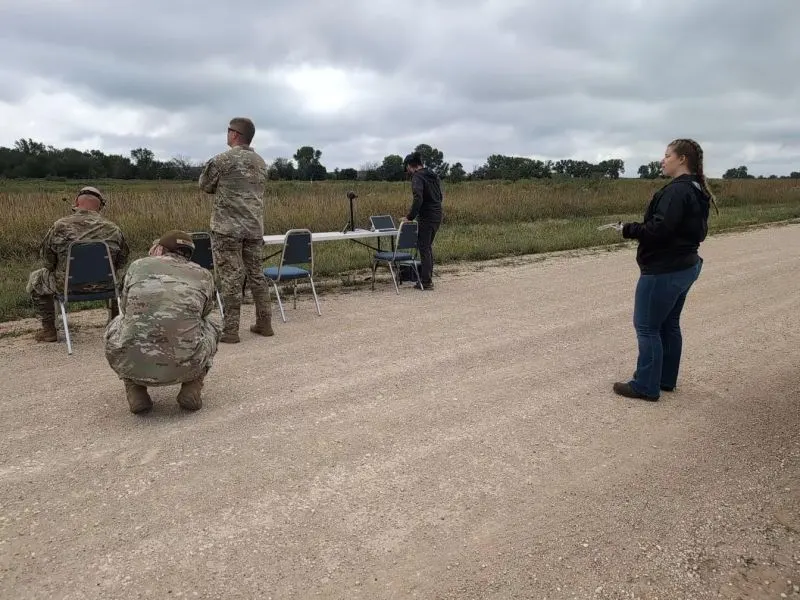
At DroSonic that is why we test outdoors, against live drones and in noise, not only on recordings. In September 2026 a DroSonic prototype was tested against live drones at the DIRT Days 26.04 field exercise.DroSonic
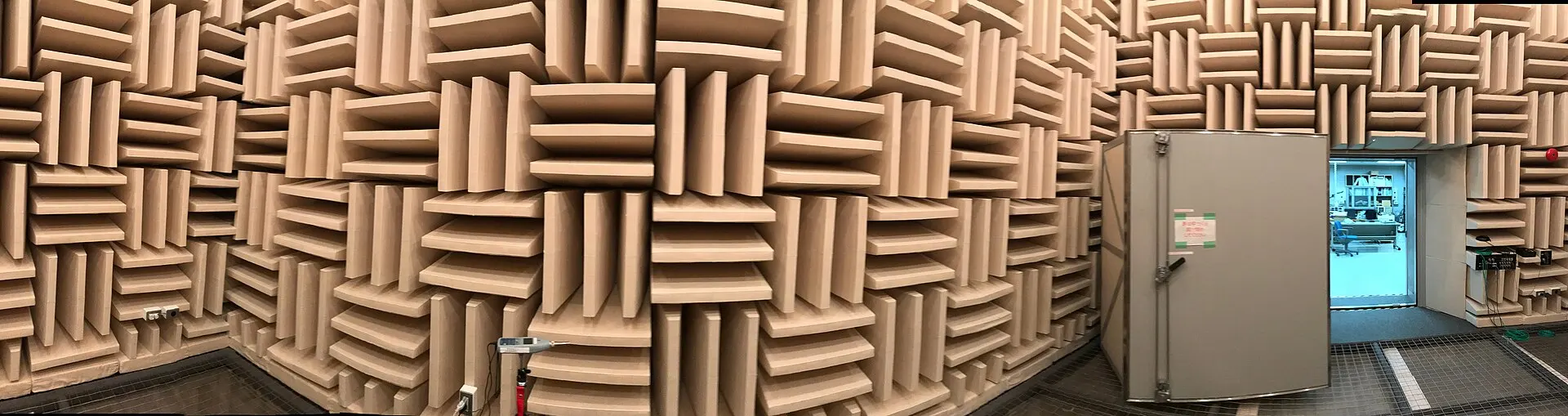
The other end of the scale — a field test, not a quiet room
DroSonic's test position at DIRT Days 26.04: open ground, wind, vehicles and live drones. Results from days like this, not from the lab, are what a buyer should ask for.
@misc{mujtaba2026acousticdetectionlabvsfield,
  author       = {Mujtaba, Ghulam},
  title        = {{From the Lab to the Field: Why Acoustic Drone Detectors Fail in the Field}},
  howpublished = {DroSonic OSINT situation assessment},
  publisher    = {DroSonic},
  year         = {2026},
  month        = oct,
  url          = {https://osint.drosonic.com/assessments/acoustic-detection-lab-vs-field.html},
  note         = {Open-source assessment, confidence: moderate}
}
RIS
TY  - ELEC
AU  - Mujtaba, Ghulam
TI  - From the Lab to the Field: Why Acoustic Drone Detectors Fail in the Field
T2  - DroSonic OSINT
PB  - DroSonic
PY  - 2026
DA  - 2026/10/30
UR  - https://osint.drosonic.com/assessments/acoustic-detection-lab-vs-field.html
AB  - Acoustic drone detectors score near-perfect in papers and stumble on new ground. New research shows where the gap opens and how to close it.
KW  - Acoustic Detection
KW  - Explainer
KW  - Counter-UAS
LA  - en
ER  -
Ghulam Mujtaba, Ph.D., is the founder and CEO of DroSonic and leads its work on passive acoustic drone detection. A computer engineer with 13 years of experience building machine-learning systems for edge hardware, he holds a Ph.D. in computer engineering from Gachon University in South Korea, was an NSF postdoctoral fellow at West Virginia University in the United States, and is an Assistant Professor of AI and Data Science at Regis University in Denver, Colorado. An IEEE Senior Member, he has published more than 20 papers on deep learning, computer vision and multimedia for edge devices.