Drones have become routine tools for the criminal organisations on the U.S.-Mexico border: scouting for agents, guiding crossings and carrying drugs. The numbers are now large enough to measure in tens of thousands of flights a year, and in February 2026 a reported "cartel drone incursion" closed the airspace over El Paso. This report sets out what is known, what is disputed, and why detection along a border more than 3,000 km long is the core problem.
Published
October 2026
Subject
Drone use by criminal organisations on the U.S.-Mexico border, and how it is detected
Source base
DHS Senate testimony, CBP figures as reported, local reporting, incident records
Method
Compare official counts; separate confirmed events from claims
Verdict
The volume is real and growing; detection coverage, not authority, is now the binding limit
Drones are now a daily feature of the U.S.-Mexico border, and the limiting factor for the United States is seeing them, not stopping them. CBP detected 34,682 drone flights within 500 metres of the southern border in fiscal year 2025, more than four times the number on the Canadian border. Most scout for agents, watch over people smugglers or carry drugs; across the line in Mexico, cartels already use drones armed with explosives. In February 2026 a reported cartel drone incursion closed the airspace over El Paso. Official accounts and press reports still disagree about what was shot at. Detection along a frontier of more than 3,000 km is the hard part: the drones are small, low, cheap and often operated at night.
34,682
drone flights within 500 m of the Mexico border◆ CBP, fiscal year 2025
7,678
on the Canadian border◆ same period, same measure
> 27,000
drones detected near the southern border◆ second half of 2024, DHS testimony
< 8 hours
El Paso's "ten-day" airspace closure◆ February 2026
Key questions
How many drones cross or approach the U.S.-Mexico border?
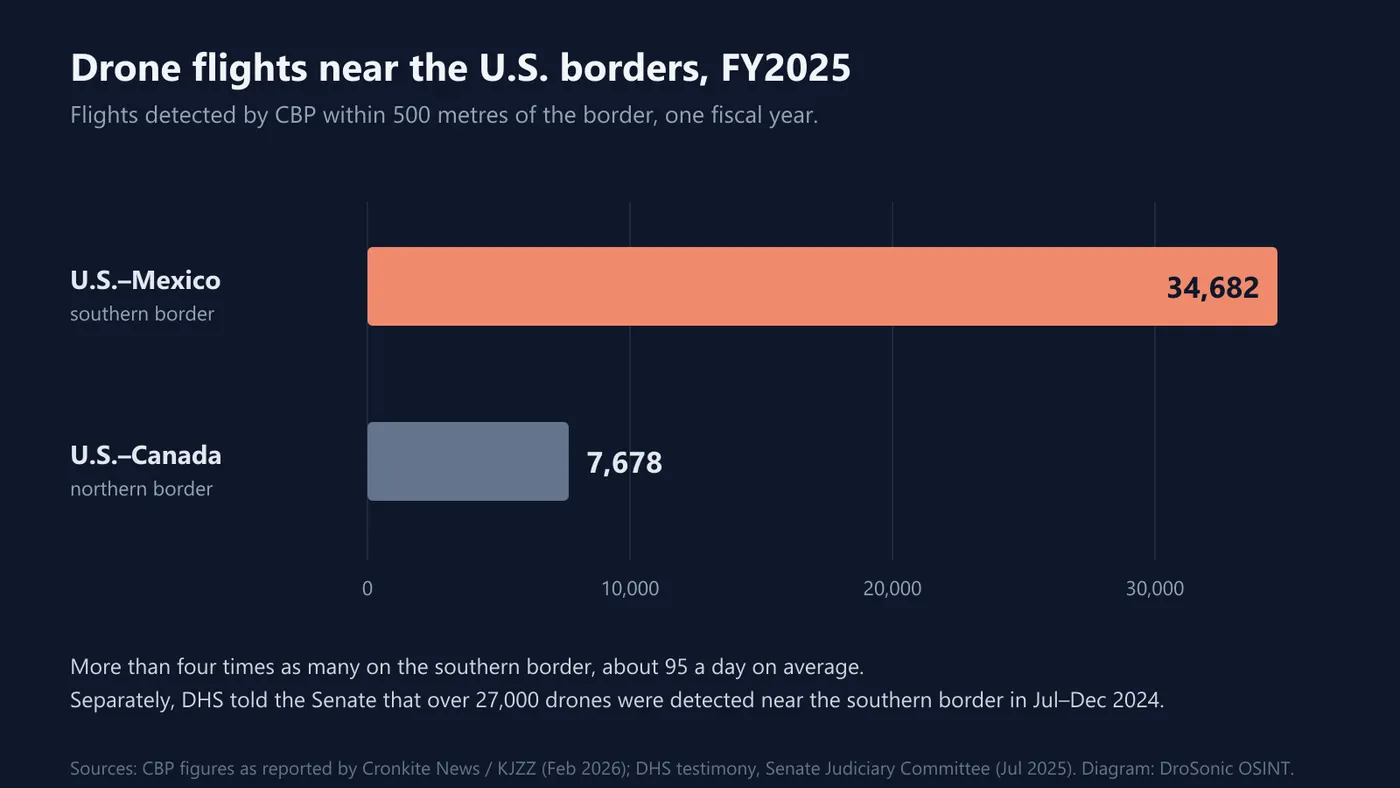
CBP detected 34,682 drone flights within 500 metres of the U.S.-Mexico border in fiscal year 2025, against 7,678 along the Canadian border. A DHS official told the Senate that more than 27,000 drones were detected near the southern border in the second half of 2024 alone.
What happened in the El Paso airspace closure?
On 10 February 2026 the FAA closed the airspace over El Paso for a planned ten days, citing a cartel drone incursion; it reopened in under eight hours. Officials said the threat was neutralised, but press reports said a counter-drone laser had been used without FAA coordination and that one target was a party balloon. No cartel drone attack on U.S. soil was confirmed.
The Ruler — the whole argument
What the numbers say
Measure
Figure
Source
Drone flights within 500 msouthern border, FY2025
34,682
CBP, as reported by Cronkite News
Drone flights within 500 mnorthern border, FY2025
7,678
CBP, as reported by Cronkite News
Drones detected near southern borderJul–Dec 2024
more than 27,000
DHS testimony to the Senate Judiciary Committee
Drug seizures from dronesJul–Dec 2024
over 1,200 lb of meth and other narcotics
CBP, as reported
Most recent full-year figure · different agencies count flights, drones and detections differently
Field 01 — The scale
Tens of thousands of flights
In July 2025, DHS counter-drone official Steven Willoughby told the Senate Judiciary Committee that more than 27,000 drones were detected within 500 metres of the southern border in the last six months of 2024. He warned it was "only a matter of time before Americans or law enforcement are targeted in the border region." Mexico's president responded that there was no information on new drones at the border.KJZZ A fuller-year figure followed: CBP detected 34,682 drone flights within 500 metres of the Mexico border in fiscal year 2025, against 7,678 along the Canadian border.Cronkite News via KJZZ
Two borders, one year — 34,682 against 7,678
About 95 drone flights a day, on average, within 500 m of the southern border.
Diagram: DroSonic OSINT · original · CBP figures as reported by Cronkite News / KJZZ
What the drones do is mostly mundane and effective:
Scouting. Small, quiet drones watch for Border Patrol and police, and guide groups across. Criminal groups began using them this way around 2019.
Smuggling. Larger drones carry drugs. CBP seized more than 1,200 lb of methamphetamine and other narcotics carried by drone in the second half of 2024, and traffickers have moved to custom drones that can lift up to 100 kg, according to the International Narcotics Control Board.
Attack, so far south of the line. In October 2025 three explosive-laden drones struck a government building in Tijuana, about a mile from California. Cartels use armed drones against police and rivals inside Mexico; that violence has not reached the U.S. side.Cronkite News via KJZZ
Field 02 — El Paso
A closure, and a dispute
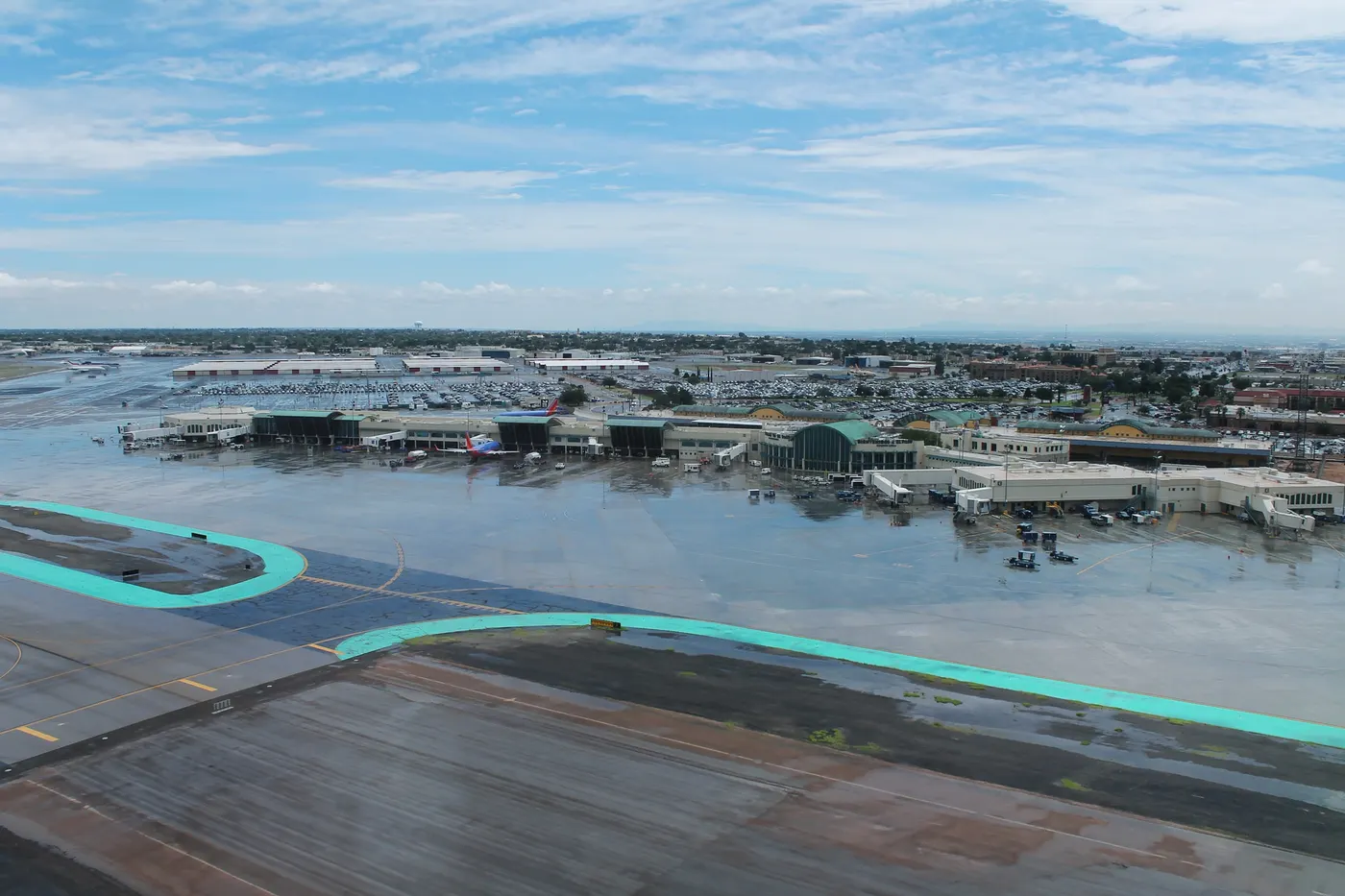
On the night of 10 February 2026 the FAA closed the airspace over El Paso, and a similar area in New Mexico, for a planned ten days, citing "special security reasons". The administration said a "drug cartel drone incursion" had occurred and that "the threat has been neutralized"; the El Paso restriction was lifted in under eight hours. Press reports then told a different story: that Customs and Border Protection had used an experimental military laser against what it believed were cartel drones without coordinating with the FAA, and that at least one target "turned out to be a party balloon." The administration's drone claims were not independently corroborated, and no cartel drone attack within the U.S. had been recorded. Seven arriving and seven departing passenger flights were cancelled and medical evacuation flights rerouted.Wikipedia
Both accounts point the same way. Either a cartel drone reached U.S. airspace over a major city, or authorities could not reliably tell a drone from a balloon before firing a laser at it. In both cases the gap is the same: confident detection and identification of small objects in the air.
El Paso International Airport — closed for "ten days", open in eight hours
The February 2026 restriction disrupted passenger and medical flights and caught local officials and airlines by surprise.
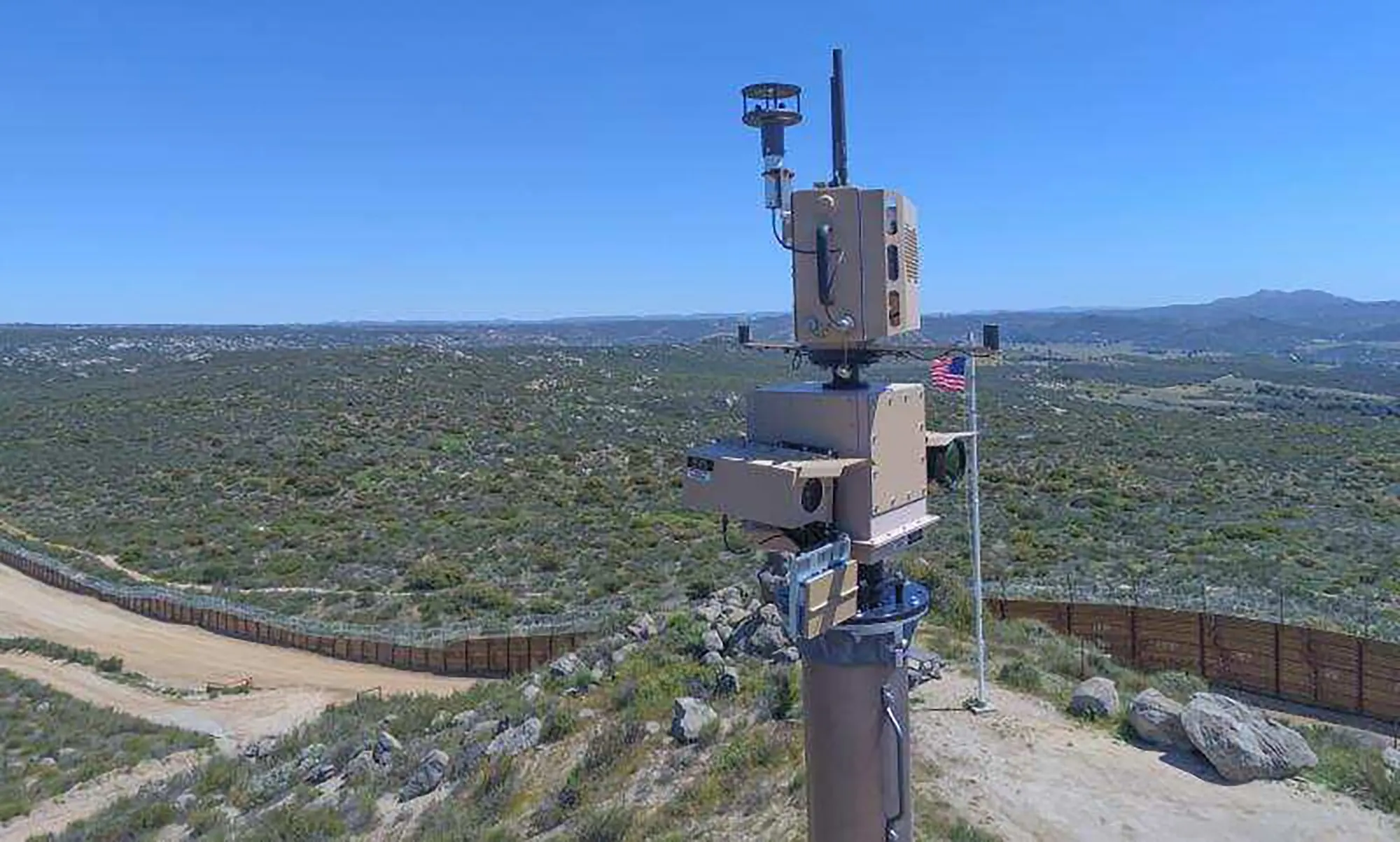
Border Patrol detects drones with radar, radio-frequency sensors and infrared cameras.Cronkite News via KJZZ Its autonomous surveillance towers, pictured above, scan with radar, point a camera at whatever moves and analyse the image, running off-grid on renewable power.Wikimedia Commons Each of those sensors runs into the problems this site has covered:
Radar struggles with bird-sized drones flying low over broken terrain (see our radar series).
RF detection misses drones that fly pre-programmed routes or use links it doesn't recognise.
Cameras need to be pointed, and the border is long and dark.
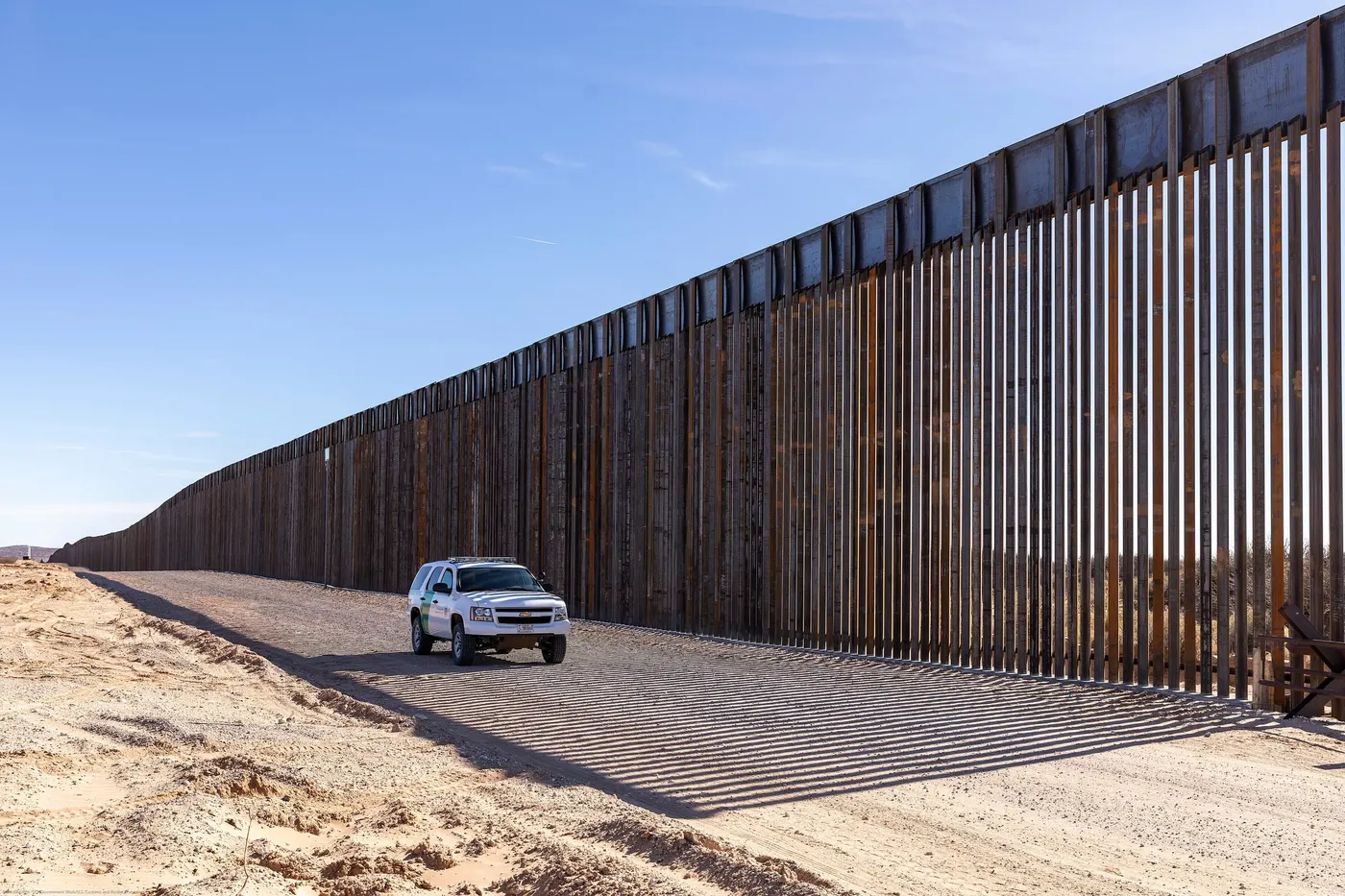
Santa Teresa, New Mexico — a wall that drones fly over
The border wall near El Paso. In February 2026 the airspace west of Santa Teresa was closed for three days alongside El Paso's.
Photo: U.S. Customs and Border Protection · Public domain · Wikimedia Commons
The terrain makes it harder still: canyons, river bottoms and hills give low drones cover, and a drone flying a few metres above the scrub at night is easy to miss. The economics are against the defender too. A scouting quadcopter costs a few hundred dollars, and coverage has to be continuous across thousands of kilometres.
A tower that sees a truck at kilometres may never see a quadcopter skimming the scrub at night. The border's gaps are low, small and dark.
Field 04 — Authority and money
What changed in 2026
The legal and funding picture shifted in 2025–26. The SAFER SKIES Act, in force since July 2026, lets trained state and local police detect drones and, with further certification, disable them. Our report Allowed to Listen, Not to Shoot covers it. DHS announced a $115 million plan to speed counter-drone procurement in January 2026, and FEMA awarded $250 million to the eleven states hosting World Cup events.Cronkite News via KJZZ Arizona gave peace officers immunity from lawsuits for shooting down suspected smuggling drones within 15 miles of the border. Authority and money are arriving faster than coverage.
Confidence
How sure we are, and what would change it
High confidence that drone use at the southern border runs to tens of thousands of flights a year. Several official figures agree on the order of magnitude, though they count different things (flights, drones, detections).
Low-to-moderate confidence in what happened at El Paso. Official statements and press reports conflict, and no official investigation has been published.
Our assessment is that detection coverage, not legal authority, is now the main constraint on countering border drones.
Close — what it means
Covering the gaps between towers
The border drone problem is a coverage problem. The drones are cheap and numerous, they fly low and mostly at night, and many of them send no signal an RF sensor will recognise. Radar towers and cameras will remain the backbone, but there are gaps between them where small, low drones fly unseen.
Passive acoustic sensing is suited to those gaps. Nodes are cheap enough to place densely along crossing points and canyons, run on little power, emit nothing for smugglers to detect, and hear drones whatever their control link. Ukraine has shown the model at national scale; our report Listening to the Sky describes it. At DroSonic we design for border and perimeter security as a primary use.