Ukraine's sea drones have sunk Russian warships, and a Houthi drone boat sank a merchant ship in the Red Sea. These craft sit low in the water, carry no transponder and offer radar little to see. Underwater, though, an engine and a propeller are hard to hide. This report looks at what research on passive hydrophones, from a low-power buoy to a seven-month river trial and three years of estuary recordings, shows about hearing small boats, and what that means for ports, ships and coasts facing uncrewed attack craft.
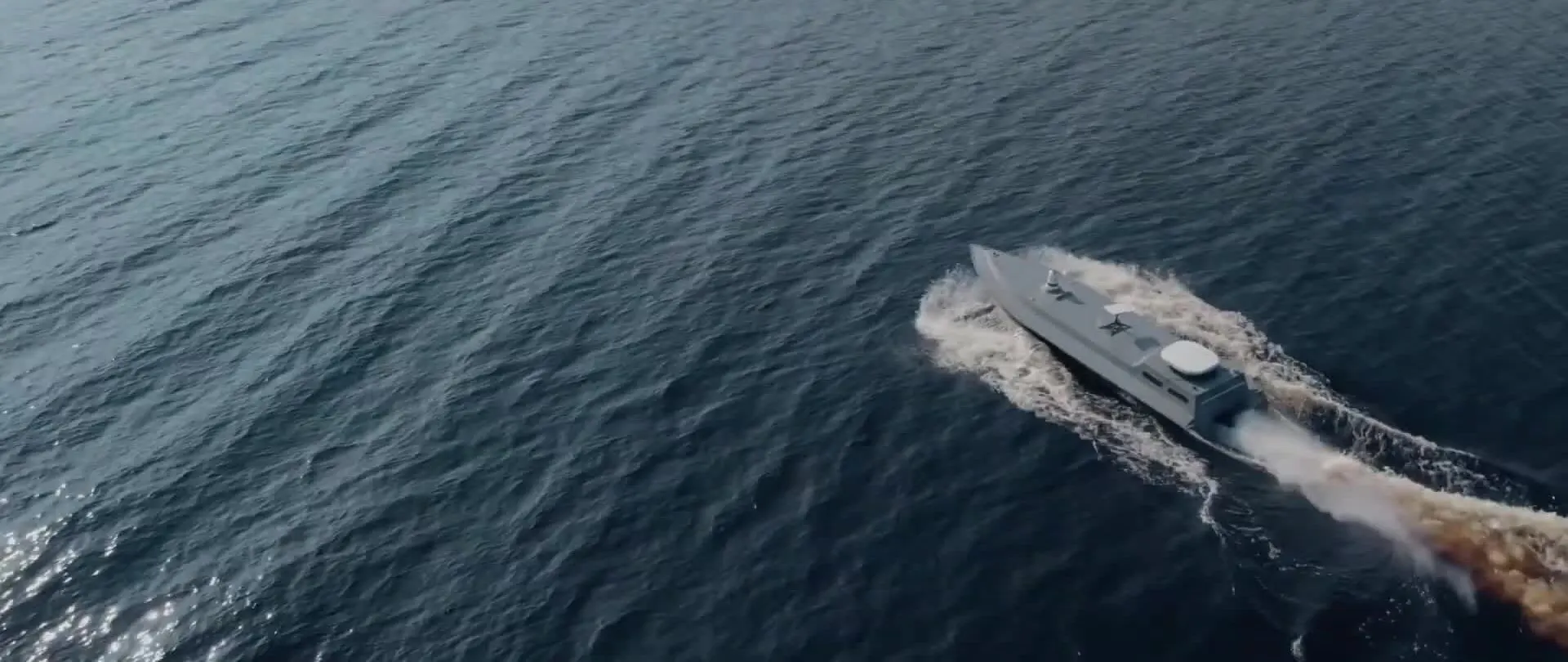
Image: Sea Baby uncrewed surface vessel on sea trials, January 2024 (video frame, cropped) · Security Service of Ukraine · CC BY 4.0 · Wikimedia Commons
Report details
Published
November 2026
Subject
Detecting uncrewed surface vessels and small boats by their underwater sound
Source base
Ukrainian and U.S. official statements, maritime press, Stevens Institute hydrophone research, PLOS ONE estuary study
Method
Set the threat, then assess what published passive-acoustic trials show about small-boat detection
Verdict
The physics favours listening; the evidence is from small boats, not yet from combat sea drones
Sea drones are hard to see and easy to hear. Uncrewed attack boats ride low in the water, carry no transponder and present radar with a small target among the waves, which is why they have been able to reach and sink warships in the Black Sea and a merchant ship in the Red Sea. But they cannot run silent: an engine and a propeller pushing a boat at speed put a steady, recognisable signature into the water. Research on passive hydrophones shows how well that signature carries. A Stevens Institute buoy drawing 1 watt detected a small boat with no transponder at 1.1 km in a shallow, busy river; in an earlier recording a boat's track began 8.7 km out; and a deep-learning method picked vessel noise out of three years of estuary recordings with around 99% accuracy. None of these trials involved combat sea drones, and shallow or noisy water cuts range sharply. But the evidence points to cheap, networked hydrophones as a credible early-warning layer for ports, anchorages and coastal infrastructure.
small boat without AIS detected by a 1 W buoy◆ shallow Hudson River, radar-confirmed
8.7 km
start of one boat's track in an earlier recording◆ Stevens Institute
~99%
vessel detection accuracy over 171,262 recordings◆ South Carolina estuary, vs human review
Key questions
How can you detect a sea drone?
Radar struggles with small, low uncrewed boats, and they carry no AIS transponder. Their engines and propellers, though, produce steady underwater tones that hydrophones can pick up: a low-power Stevens Institute buoy detected a small boat without AIS at 1.1 km in the shallow Hudson River, and another boat's track began 8.7 km away in an earlier recording.
Can hydrophones detect small boats automatically?
Yes. A deep-learning method applied to about 171,000 two-minute recordings from a South Carolina estuary identified vessel noise with around 99% accuracy against human review, after filtering out snapping-shrimp noise.
What sinks have sea drones caused?
Ukrainian sources credit Magura V5 sea drones with eight Russian vessels, including the corvette Ivanovets, the landing ship Tsezar Kunikov and the patrol ship Sergey Kotov in early 2024. In June 2024 a Houthi uncrewed surface vessel struck the merchant ship Tutor in the Red Sea, which sank.
The Ruler — the whole argument
What each sensor sees of a sea drone
Sensor — at sea
What it gives
Against a small uncrewed boat
AISthe ship's own transponder
Identity and position of cooperating ships
Nothing: small boats need not carry it, and attackers will not
Coastal radar
Tracks on the surface
A low, small craft in wave clutter is hard to hold; masts and power needed
Camerasvisible and thermal
Identification once seen
Line of sight, weather and darkness limit it
Hydrophonesunderwater sound
Detection and bearing from engine and propeller tones
Passive, cheap, works at night; range shrinks in shallow, noisy water
The layer this report assessesSensor limits from the Stevens Institute papers cited below
Field 01 — The threat
Small boats that sink big ships
Ukraine turned the uncrewed surface vessel into a weapon of attrition. Its defence intelligence agency says six Magura V5 sea drones attacked the Russian missile corvette Ivanovets on 1 February 2024 and sank it.Defence Intelligence of Ukraine Ukrainian claims credit the Magura V5, a 5.5-metre boat with a 300 kg payload, with eight Russian vessels between November 2023 and August 2024, among them the landing ship Tsezar Kunikov and the patrol ship Sergey Kotov; the larger Magura V7 was reported in May 2025 to have shot down two Su-30 fighters with missiles.Wikipedia
Ivanovets, 1 February 2024 — the attack seen from the sea drones
Footage released by Ukraine's defence intelligence agency of its Group 13 unit's sea-drone attack on the Russian corvette. About two minutes.
Video: Main Directorate of Intelligence of Ukraine (GUR) · CC BY 4.0 · Wikimedia Commons
The weapon has spread. On 12 June 2024 a Houthi uncrewed surface vessel struck the stern of the bulk carrier Tutor in the southern Red Sea; the crew was airlifted off by the U.S. Navy, one sailor was reported missing, and the ship sank.gCaptain
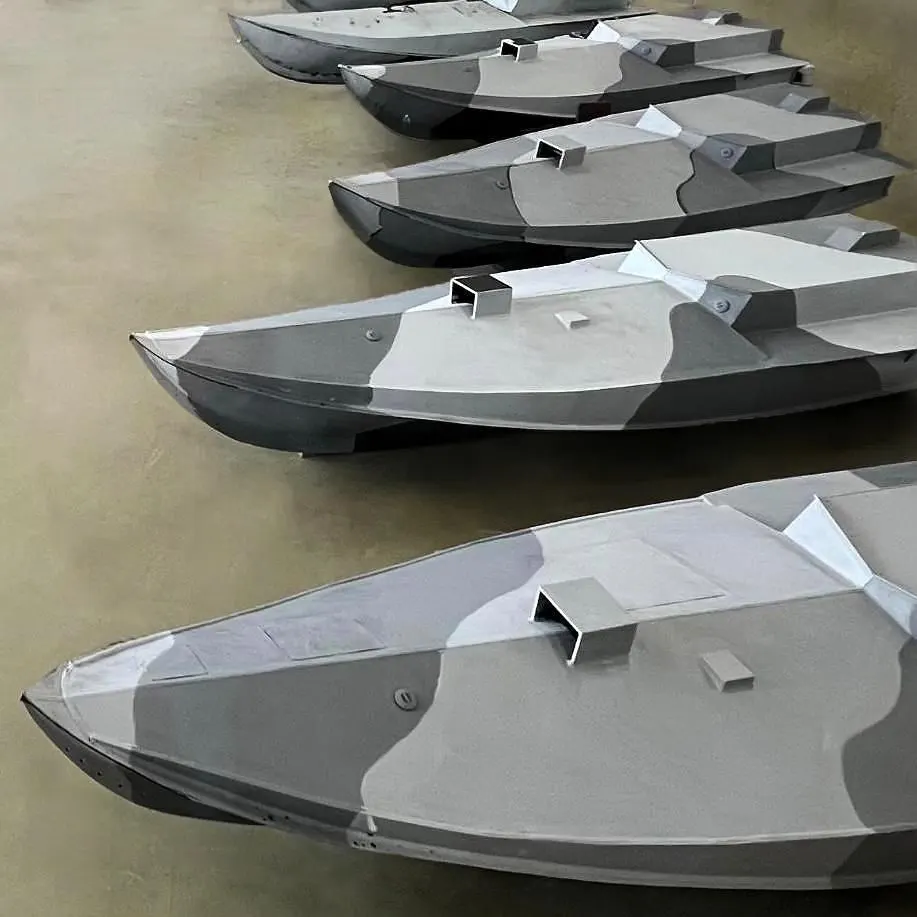
Ukrainian sea drones — low, small, angular
Security Service of Ukraine marine drones, released in August 2023. The SBU says drones of this type attacked the Crimean Bridge in July 2023.
Photo: Security Service of Ukraine press centre · CC BY 4.0 · Wikimedia Commons
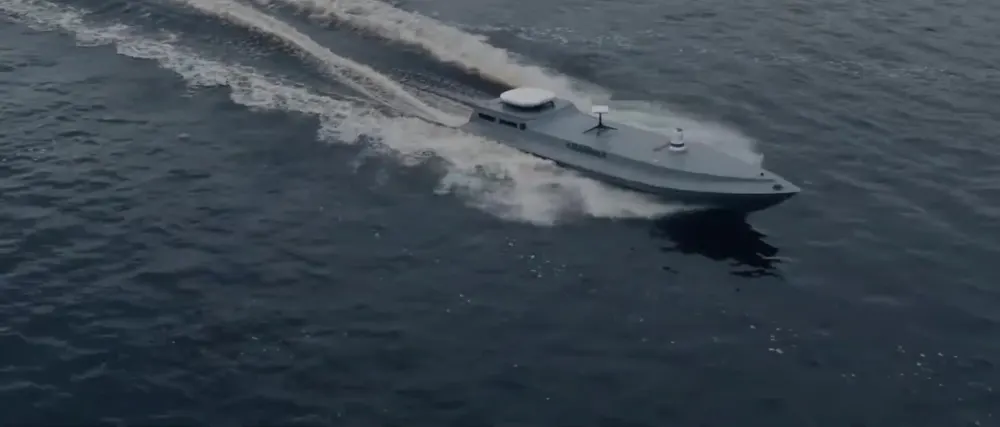
Sea Baby on trials — a wake, an engine, a propeller
Little to see from a distance on radar or by eye; plenty to hear underwater.
Image: Security Service of Ukraine (video frame, cropped) · CC BY 4.0 · Wikimedia Commons
Field 02 — Why radar struggles
No transponder, little to reflect
Coastal surveillance relies mostly on two things: radar, which needs significant infrastructure to deploy and still finds small boats challenging, and AIS, the transponder system larger ships must carry. The small, low-profile boats used for smuggling and other illicit activity belong to a class not required to carry AIS. Researchers at Stevens Institute of Technology, who build passive acoustic systems for maritime surveillance, describe the kamikaze sea drone as a similar but more dangerous target: a craft with a low radar cross-section for which acoustics may be one of the best means of detection.IEEE HST 2022
Sea Baby, January 2024 — a low hull at speed
Ukraine's Security Service showing its Sea Baby uncrewed surface vessel on sea trials. Watch how little of the boat sits above the water. Under a minute; the original music has been removed.
Video: Security Service of Ukraine (SBU) · CC BY 4.0 · Wikimedia Commons
Field 03 — What a hydrophone hears
Engines leave a signature
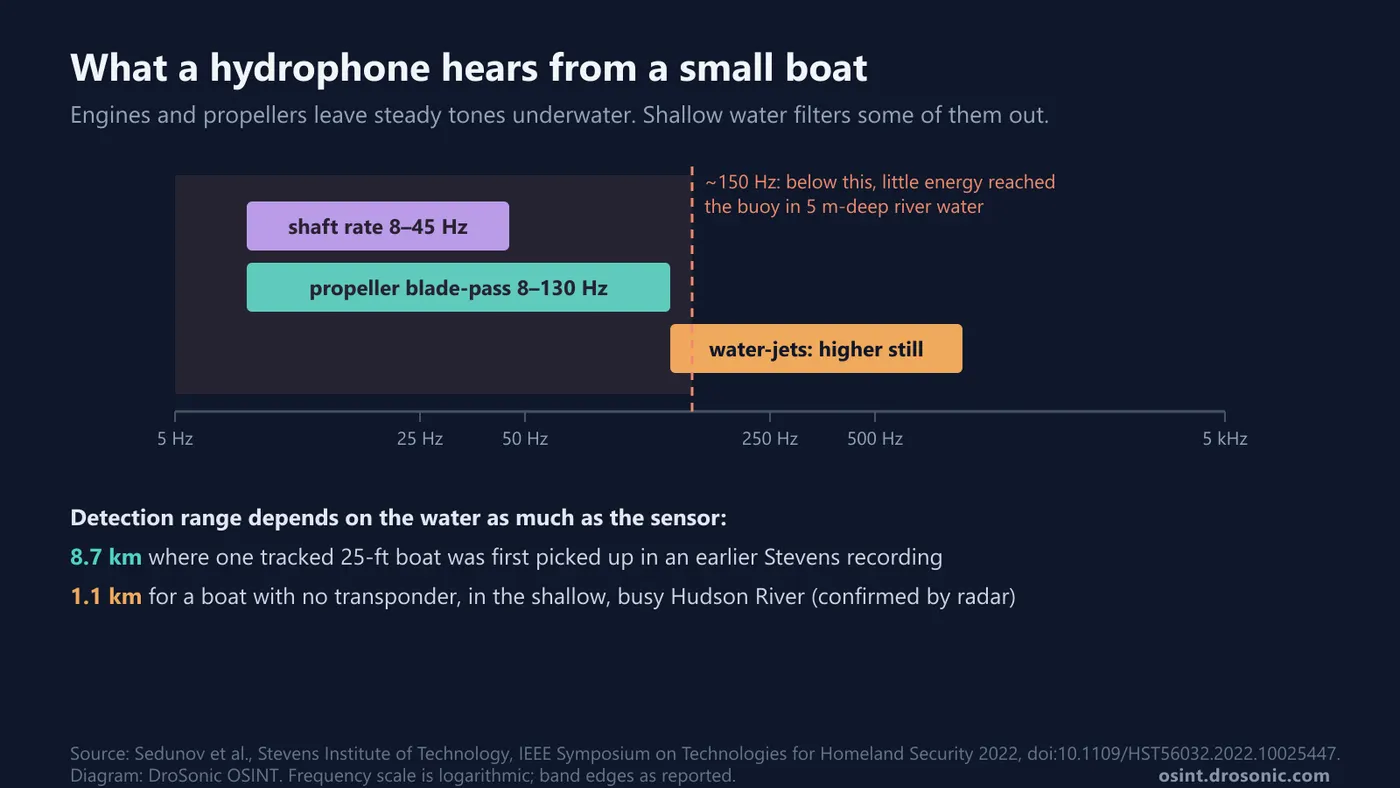
An engine and propeller put narrow, steady tones into the water. Stevens researchers report that small-boat engine sound is tied to the propeller's blade-passing frequency, between about 8 and 130 Hz, and to the shaft rate, between 8 and 45 Hz; water-jet craft, such as personal watercraft and some fast boats, emit higher frequencies still. Their processing looks for those harmonics, and for the rhythm they impose on broadband noise (a technique called DEMON), and tracks them over time so that intermittent sounds such as a cable twanging in the current are ignored.IEEE HST 2022 It is also the principle DroSonic applies in air: its sensors listen for aerial drones' propellers, not boats.DroSonic
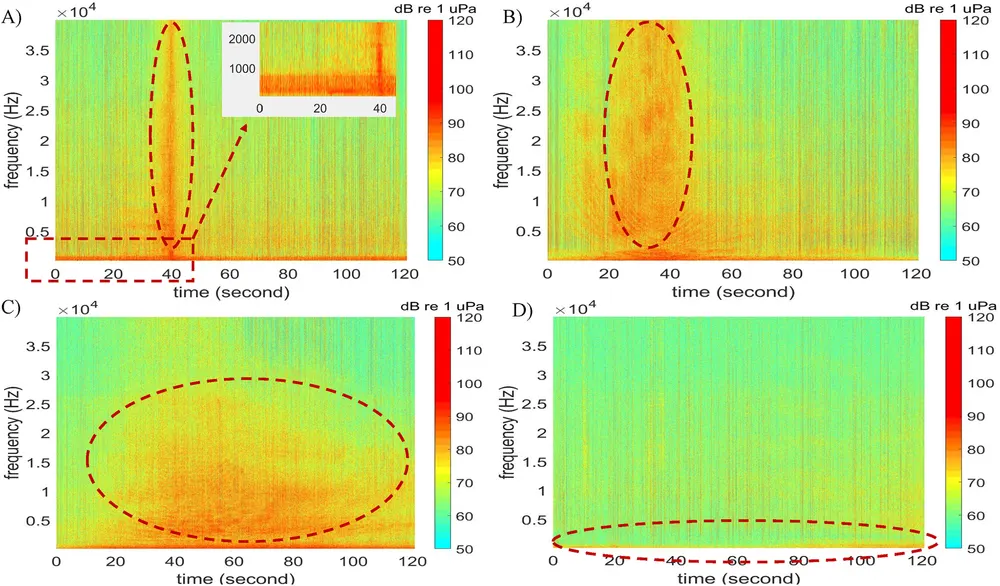
What a hydrophone hears — and what shallow water takes away
The same tones that make a boat detectable are the ones shallow water filters out, which is why range varies so much from site to site.
Diagram: DroSonic OSINT · original · from Sedunov et al., Stevens Institute of Technology, IEEE HST 2022
This is the same principle as listening for an aerial drone: propulsion makes tones, and the tones identify the propulsion. Our report Every Drone Has a Voice sets out the aerial version.
Field 04 — The evidence
A buoy, a river array and three years of estuary sound
A low-power buoy. Stevens built a "smart acoustic buoy" from off-the-shelf parts: an in-house hydrophone, a microcontroller that processes sound on board, GPS, and a long-range radio link to shore. It draws about 1 watt and runs for roughly five days on a 121 Wh battery. Moored in about 5 metres of water in the Hudson River in August 2022, it detected a small boat with no AIS at 1.1 km, confirmed by radar. The shallow water stripped out most energy below about 150 Hz, so the harmonic method worked less well there, but the DEMON method stayed effective. In an earlier recording of a 25-foot outboard boat, the tracked tone began when the boat was 8.7 km away.IEEE HST 2022
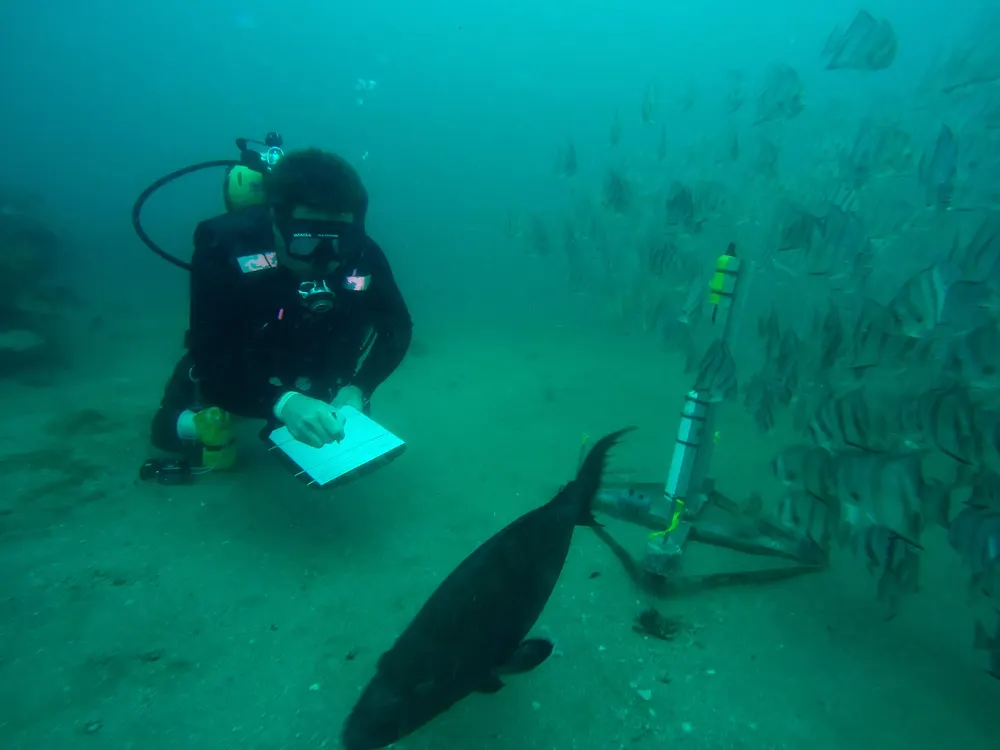
A seabed hydrophone — listening is routine science
NOAA researchers record sound at Gray's Reef National Marine Sanctuary. The same kit that counts fish can hear boats.
Photo: NOAA National Marine Sanctuaries · Public domain · Wikimedia Commons
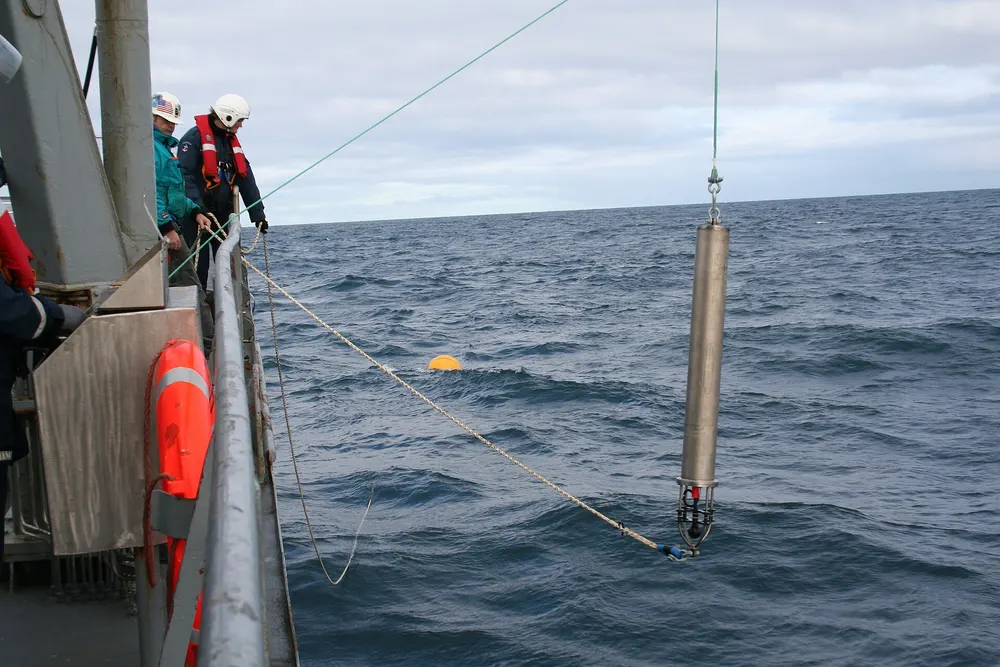
Deployment at sea — a hydrophone goes over the side
A hydrophone lowered into the North Atlantic from an Icelandic Coast Guard cutter to record whales.
Photo: Dave Mellinger, Oregon State University · CC BY-SA 2.0 · Wikimedia Commons
A river array. Stevens' SPADES-2 is a low-cost, bottom-mounted ring of eight hydrophones 2.2 metres across, with a long cable for power and data. Its software finds the direction of sound sources in real time and separates overlapping ones. It was tested for seven months tracking boats in the Hudson River.Stevens Institute of Technology
Three years of estuary sound. Researchers in South Carolina applied a two-step deep-learning method to recordings from three hydrophone stations in the May River estuary: about 171,262 two-minute files from 2017, 2018 and 2021. Compared with human review of each file, it identified the presence of vessels with an average accuracy of around 99%. The recordings were full of competing sounds, from fish choruses to snapping shrimp, which had to be filtered out first.PLOS ONE
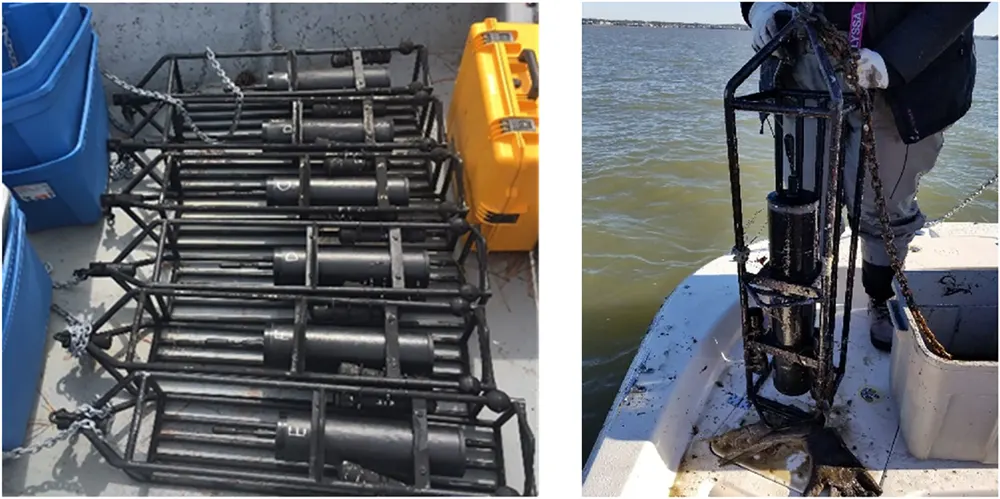
May River recorders — before and after a deployment
The estuary network's hydrophone recorders, which logged sound for years at fixed stations.
No sea-drone trials in the open record. Everything above concerns ordinary small boats. Military sea drones may be quieter or louder; water-jet propulsion would move their sound higher, where the Stevens work found different processing necessary.
Range depends on the water. The same buoy hardware heard one boat 8.7 km away and another only 1.1 km away in shallow river water. Harbours, the places most worth protecting, are often shallow and noisy.
Detection is not identification. A hydrophone hears a boat; knowing it is hostile needs AIS records, radar, cameras or patrols. Even the Stevens buoy trial relied on radar, AIS and cameras on shore to confirm what it heard.IEEE HST 2022
Lab-to-field gaps apply here too. A model trained in one estuary may not transfer to another port; models learn the background sounds of the place they were trained.
Confidence
How sure we are, and what would change it
High confidence that uncrewed surface vessels have sunk warships and a merchant ship, based on official statements and multiple reports, though the full Magura V5 tally rests on Ukrainian claims.
Moderate confidence that passive hydrophones can provide useful early warning against small attack boats. The physics and the small-boat results are solid; direct evidence against combat sea drones is not public.
What would change it: published trials of hydrophone networks against military uncrewed surface vessels, or evidence of sea drones designed for low underwater noise.
DroSonic — our approach
The same principle, in air
DroSonic does not build hydrophones. Its sensors listen in air, for the propellers of aerial drones, using neural networks on low-cost edge hardware.DroSonic We include this report because the physics is shared: propulsion makes tones, tones identify propulsion, and passive listening works at night and emits nothing.
A coastal site that faces drones on the water and in the air would need both layers: hydrophones below the surface and microphones above it. A DroSonic prototype was tested against live aerial drones at DIRT Days 26.04 in September 2026.DroSonic
DIRT Days 26.04 — the airborne half of the picture
DroSonic's test position at the field exercise, listening for aerial drones.
The sea drone repeats a pattern familiar from the air. A cheap, uncrewed craft defeats the sensors built for bigger, cooperative targets: it carries no transponder, offers radar little to reflect, and arrives low and fast. And like the aerial drone, it cannot hide what drives it. Propellers make tones; tones carry. For a port or an anchorage, a ring of low-power hydrophones is an inexpensive way to hear a fast boat coming from beyond visual range, especially at night.
At DroSonic we work on the airborne half of that problem: passive acoustic detection of drones by their rotor sound. The principles carry across the waterline. A coastal site facing both threats needs both kinds of ears, with each feeding the same picture so that operators can see a fast boat and the drones flying above it in one place.
Cite this report
Sea Drones Have a Voice Too: Detecting Sea Drones and Small Boats with Hydrophones
@misc{mujtaba2026seadronesunderwateracousticdetection,
  author       = {Mujtaba, Ghulam},
  title        = {{Sea Drones Have a Voice Too: Detecting Sea Drones and Small Boats with Hydrophones}},
  howpublished = {DroSonic OSINT situation assessment},
  publisher    = {DroSonic},
  year         = {2026},
  month        = nov,
  url          = {https://osint.drosonic.com/assessments/sea-drones-underwater-acoustic-detection.html},
  note         = {Open-source assessment, confidence: moderate}
}
RIS
TY  - ELEC
AU  - Mujtaba, Ghulam
TI  - Sea Drones Have a Voice Too: Detecting Sea Drones and Small Boats with Hydrophones
T2  - DroSonic OSINT
PB  - DroSonic
PY  - 2026
DA  - 2026/11/06
UR  - https://osint.drosonic.com/assessments/sea-drones-underwater-acoustic-detection.html
AB  - Uncrewed attack boats have sunk warships and a merchant ship. They are low and small for radar, but their engines and propellers are loud underwater.
KW  - Maritime
KW  - Acoustic Detection
KW  - Ukraine
LA  - en
ER  -
Ghulam Mujtaba, Ph.D., is the founder and CEO of DroSonic and leads its work on passive acoustic drone detection. A computer engineer with 13 years of experience building machine-learning systems for edge hardware, he holds a Ph.D. in computer engineering from Gachon University in South Korea, was an NSF postdoctoral fellow at West Virginia University in the United States, and is an Assistant Professor of AI and Data Science at Regis University in Denver, Colorado. An IEEE Senior Member, he has published more than 20 papers on deep learning, computer vision and multimedia for edge devices.
Wikipedia — V5: 5.5 m, 300 kg payload; eight Russian vessels credited (Ukrainian claims); V7 Su-30 shootdowns, May 2025
gCaptain — Tutor struck in the stern by an unmanned small craft, 12 June 2024; crew evacuated; one missing; ship sank
IEEE HST 2022 — Sedunov et al.: radar needs infrastructure, small boats hard to detect; small boats need not carry AIS; sea drone kamikaze has low RCS, acoustics may be best
DroSonic — Passive acoustic detection: neural networks on low-cost edge hardware, no emissions
Stevens Institute of Technology — SPADES-2: tethered bottom-mounted 2.2 m circular array, eight hydrophones; seven months in the Hudson River
PLOS ONE — Ji, Marian & Montie 2024: ~171,262 two-minute files; three stations; ~99% vs human review; snapping shrimp removed
DroSonic — DIRT Days 26.04 field test, September 2026