Drone deliveries over prison walls have become routine in Britain, Canada and the United States, and prisons mostly may not jam or shoot them down. Knowing that a drone is overhead is no longer enough: staff need to know whether it dropped something, and where, before a prisoner gets to it. A February 2026 study from Université de Sherbrooke is the first to detect the drop itself, from the change in a drone's propeller pitch as its load falls away. This report sets out the scale of the problem, why the usual sensors leave a gap, and what the new method can and cannot do.
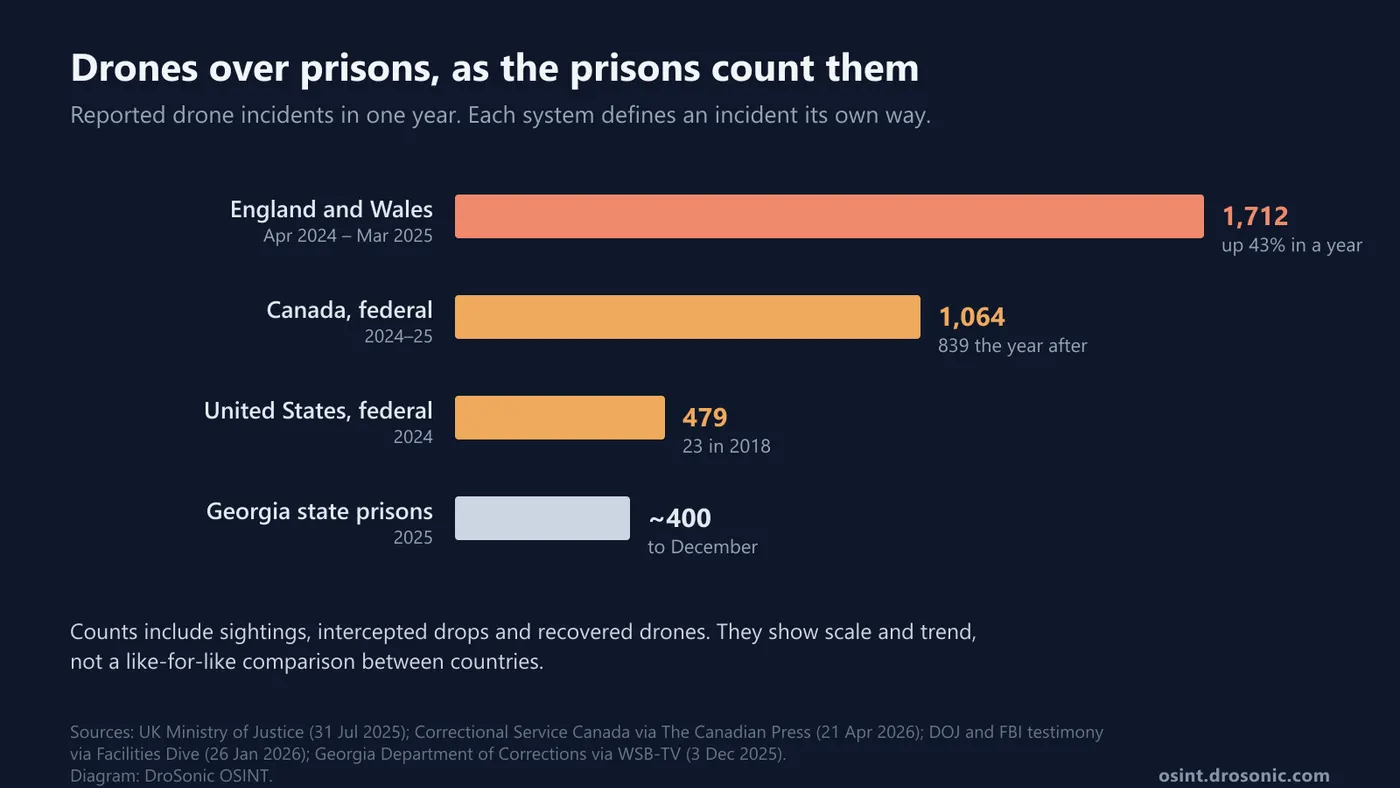
Prisons in Britain, Canada and the United States now record drone deliveries in the hundreds to thousands a year, and the airspace above some of them has in effect been handed to criminal gangs. England and Wales logged 1,712 prison drone incidents in a single year to March 2025; Canada's federal system 1,064; U.S. federal prisons 479 in 2024, against 23 in 2018. Most prisons may not jam or shoot down the drones, so their defence is to detect them and recover what they drop before prisoners do. That makes the critical question not was there a drone? but did it drop something, and where? A February 2026 study from Université de Sherbrooke shows a ground microphone array can answer the first half: it detected 96% of test drops by hearing the drone's propellers slow as the load fell away. The method is young, tested on one drone with a heavy payload, but it points at the gap that radio detectors leave and that prisons most need closed.
1,712
drone incidents at prisons in England and Wales in a year◆ Apr 2024 – Mar 2025, up 43%
1,064
drone incidents at Canada's federal prisons◆ 2024–25
479
at U.S. federal prisons in 2024◆ 23 in 2018
96%
of test package drops detected by sound◆ 8% false alarms, one drone, ≤100 m
Key questions
How many drones fly over prisons?
England and Wales recorded 1,712 prison drone incidents between April 2024 and March 2025, up 43% in a year. Canada's federal prisons reported 1,064 in 2024–25, and U.S. federal prisons 479 in 2024, up from 23 in 2018.
Can a drone detector tell when a drone drops a package?
Research suggests it can. In a 2026 Université de Sherbrooke study, a ground microphone array detected 96% of test package drops, with false alarms on 8% of moments, by hearing the drone's propeller pitch fall as its 500–600 g load was released. It worked to about 100 m with one drone model.
Why don't prisons jam or shoot down drones?
In the U.S., federal law protecting aircraft bars state prisons from shooting down or disabling drones; Georgia's corrections commissioner told lawmakers in December 2025 that they lack the legal authority. Researchers note that local laws often prohibit jamming or interception, which leaves detection and recovery.
The Ruler — the whole argument
What each sensor tells a prison
Sensor — at a prison wall
What it tells staff
Where it falls short
Radio-frequency detectorlistens to the control link
That a drone is near; often its make, model and pilot's position
Encrypted links and pre-programmed or autonomous flights give it little to work with
Radarreflected energy
Position and track at range
Costly; small slow drones can be mistaken for birds
Cameravisible or thermal
What it is and what it carries
Depends on light, weather and line of sight; deliveries likely cluster at night
Microphone arraythe rotor's sound
That a drone is near, its direction, and now whether it dropped its load
Short range (about 100 m in tests); noise; one drone model tested so far
Networked acoustic nodesDroSonic's approach
Several cheap passive sensors along a perimeter, each classifying sound on board
Short range per node, so a wall needs many; drop detection not yet shown by DroSonic
Can hear the drop itself, the moment recovery teams needSensor trade-offs from the Sherbrooke study and Facilities Dive reporting cited below
Field 01 — The scale
Five a day, and rising
In England and Wales, the Ministry of Justice reported 1,712 drone incidents at prisons between April 2024 and March 2025, a 43% rise on the previous year, alongside £900,000 for counter-drone work and £40 million already committed that year to netting, reinforced windows and other security.GOV.UK In January 2025 the Chief Inspector of Prisons said police and the prison service had "in effect ceded the airspace" above two high-security prisons, Manchester and Long Lartin, to organised crime gangs; at Manchester, prisoners were burning holes in supposedly secure windows to keep receiving drone deliveries. He called the failure "a threat to national security".HM Inspectorate of Prisons
Canada's federal prison service reported 1,064 drone incidents in 2024–25 and 839 in 2025–26.CP24 In the United States, federal prisons recorded 479 drone incidents in 2024, up from 23 in 2018, according to Justice Department and FBI testimony.Facilities Dive State systems add their own: Georgia's corrections department told lawmakers it had handled nearly 400 drone contraband incidents in 2025 by early December, rising from 17 in January to 63 in each of September and October.WSB-TV
Drones over prisons — as the prisons count them
Each system defines an incident differently; the figures show scale and trend, not comparable rates.
Diagram: DroSonic OSINT · original · from UK Ministry of Justice, Correctional Service Canada, DOJ/FBI and Georgia DOC figures cited here
The payloads are not trivial. South Carolina officials described seizing a single drone carrying 464 grams of fentanyl, and phones delivered by drone supported a scam run from a Georgia prison that netted $500,000.Facilities Dive Georgia officials also showed lawmakers a confiscated drone able to lift 225 pounds.Capitol Beat
Field 02 — The limits
Detect, but do not touch
Most prisons are not allowed to stop the drones. In the U.S., federal law protecting aircraft means state prisons cannot shoot drones down or disable them, even over their own grounds. "We just don't have the authority, the legal authority, to be able to do it," Georgia's corrections commissioner, Tyrone Oliver, told lawmakers in December 2025.Capitol Beat Our report Allowed to Listen, Not to Shoot sets out who may do what under U.S. law.
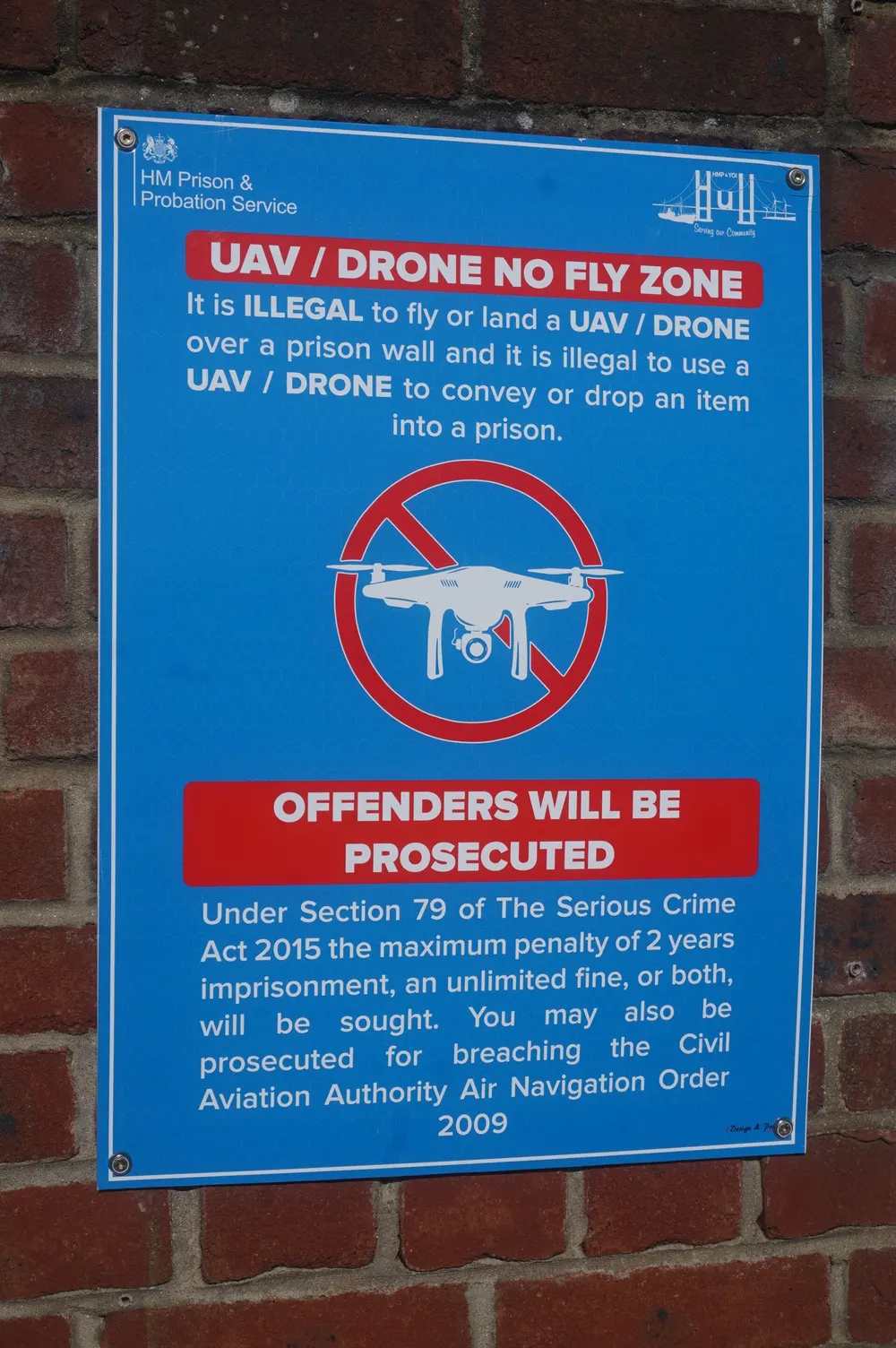
Britain went the other way on airspace: since January 2024, flying a drone within 400 metres of a closed prison or young offender institution in England and Wales has been an offence carrying fines of up to £2,500, so police no longer need evidence of smuggling before acting.DroneLife A no-fly zone still needs a sensor to know when it has been broken.
HMP Hull — the rule on the wall
A no-fly sign citing the Serious Crime Act 2015, photographed in 2022, before the 400 m zones.
So prisons fall back on detection and recovery. Detection systems in use are largely radio-based: tracking technology described in RAND research "homes in on the radio signals that all drones release", and vendors say their tracking data can identify a drone's model and owner.Facilities Dive The same research expects drone activity to be concentrated overnight, when staffing and perimeter coverage are thinnest.Facilities Dive
Field 03 — The gap
Knowing it flew is not knowing it dropped
The Sherbrooke researchers frame the problem precisely. Authorities rely on detection systems to identify and track intrusions in real time "and eventually recover packages dropped within the perimeter". Radio eavesdropping can sometimes extract a drone's position and even its delivery state, they note, but encrypted links or an autonomous drone flying a pre-programmed mission make that strategy inefficient. Microphone arrays are cheap and can locate a sound, but have limited range and are sensitive to noise.Marcoux & Grondin Earlier acoustic research had shown it could tell a loaded drone from an empty one; by the authors' account, nobody had tried to catch the moment of release.Marcoux & Grondin DroSonic's provisional patent application covers acoustic detection, classification and localisation in general; telling a loaded drone from an empty one is the kind of classification this study shows is possible.DroSonic
Field 04 — The method
The pitch of a heavier drone
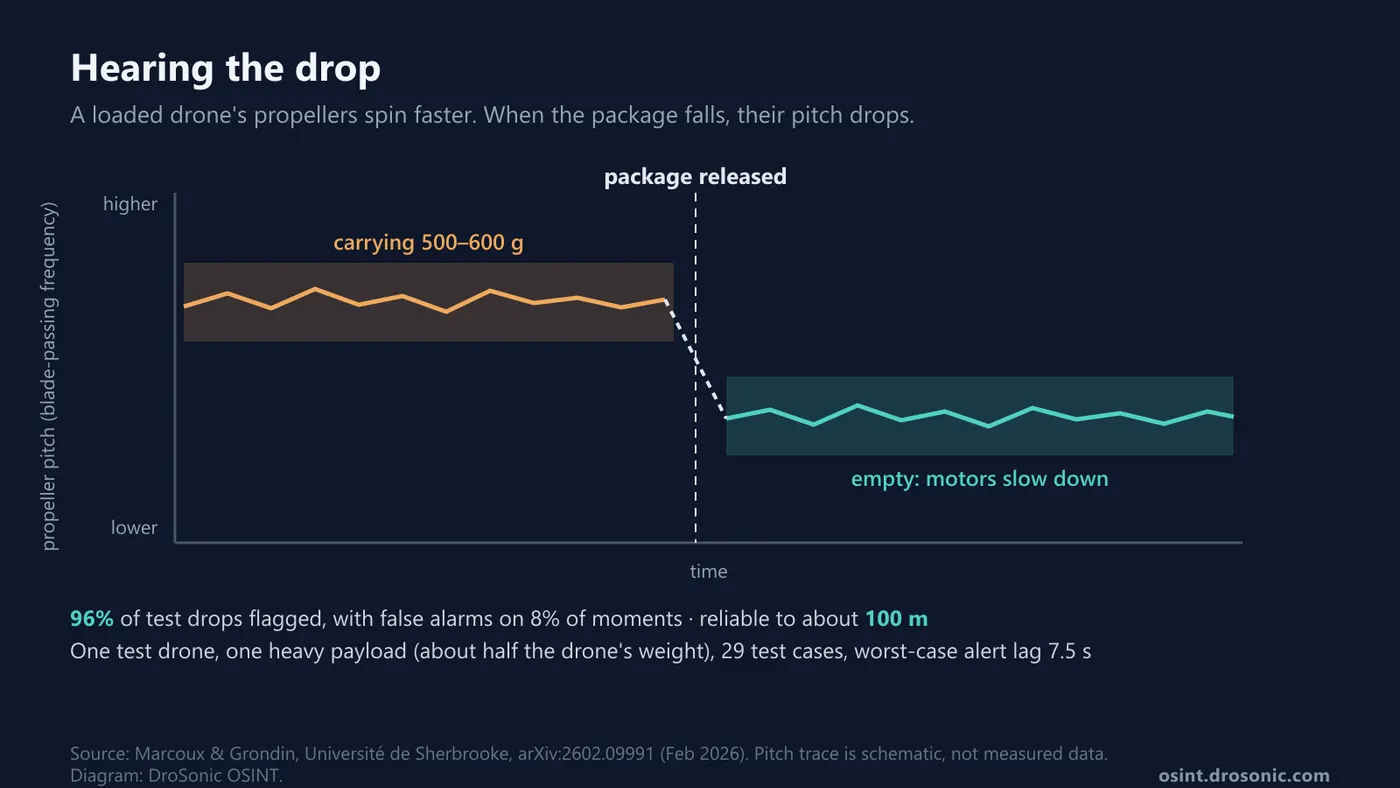
A drone's propellers each produce a tone at their blade-passing frequency: the number of blades multiplied by how fast the motor turns. A heavier drone must spin its motors faster to hover, so its tone sits higher; when the load falls away, the motors slow and the pitch drops. The Sherbrooke system listens for exactly that. A neural network estimates the blade-passing frequencies of the two loudest propellers from three seconds of sound at a time, and a second algorithm compares the spread of those frequencies before and after each moment, flagging a delivery when the shift is large enough.Marcoux & Grondin
Hearing the drop — the pitch falls with the load
Schematic of the Sherbrooke method. The microphones do not hear the package land; they hear the drone get lighter.
Diagram: DroSonic OSINT · original · after Marcoux & Grondin, Université de Sherbrooke, arXiv:2602.09991
The team flew a modified Holybro X500 V2 quadcopter fitted with a release mechanism and an on-board microphone, and recorded it with a 16-microphone ground array: 28 flights, up to 160 metres from the array, with 23 drops of 500–600 g packages and background recordings of highway traffic, voices and a chainsaw.Marcoux & Grondin They have published the recordings.GitHub
The results: the system recognised whether a drone was present with 97% accuracy and estimated its propeller pitch to within about 16 Hz when it was less than 150 metres away. It flagged 96% of delivery moments while raising false alarms on 8% of moments, and the authors judge it reliable to about 100 metres. It coped well with urban noise, which sits mostly at low frequencies, because a drone's rotors also produce a high-pitched component around 5 kHz.Marcoux & Grondin
Field 05 — The limits
One drone, one heavy load
The authors are candid about what the study does not show:
One drone model. The network was trained on a single quadcopter, so other airframes, motors and propellers may confuse it. Detectors trained on narrow data often lose accuracy on drones, microphones and sites they have not heard before.
A heavy payload. The 500–600 g packages were about half the drone's weight, which made the pitch change large. Lighter drops will shift the pitch less and be missed more often.
No position awareness. The algorithm ignores where the drone is and how it moves, so the Doppler effect, wind gusts or deliberate manoeuvres could trigger false alerts. The authors propose adding direction finding.
Small numbers. The delivery tests come down to 29 test cases. And with the longest analysis window, an alert can lag the drop by up to 7.5 seconds.Marcoux & Grondin
Range is the hard constraint at a real prison. At about 100 metres per array, covering a perimeter means several arrays, placed where deliveries actually happen: over exercise yards, near cell-block windows, along the stretches of wall that cameras cover worst.
Confidence
How sure we are, and what would change it
High confidence in the scale and trend of prison drone incidents, which come from official figures in three countries, though each system counts incidents differently.
Moderate confidence that acoustic drop detection can work operationally. The physics is sound and the first results are strong, but they come from one drone, one payload weight and a few dozen events, not a prison.
What would change it: a trial at an operating prison with several drone types and realistic payloads, or evidence that lighter drops (a phone, a few grams of drugs) remain detectable.
DroSonic — our approach
Listening along a wall
A prison perimeter suits short-range acoustic sensing: the threat must come close, and the wall is long and fixed. DroSonic's design is a network of small passive nodes, each running its classifier on low-cost edge hardware, so coverage is a matter of spacing rather than one expensive sensor.DroSonic Because the nodes only listen, they raise none of the legal questions that jamming does for prisons.
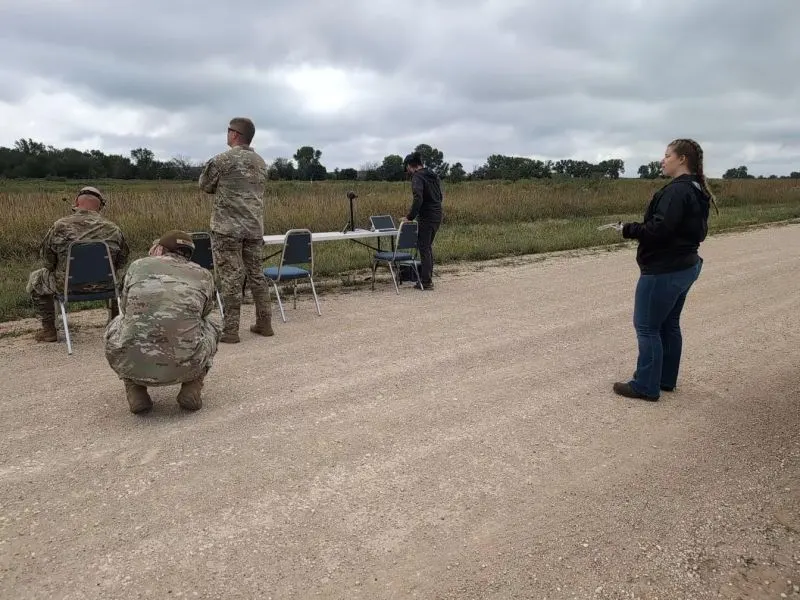
DroSonic has not published results on detecting drops, and this report's evidence comes from one university study. What DroSonic has shown publicly is a prototype tested against live drones at the DIRT Days 26.04 field exercise in September 2026.DroSonic
DIRT Days 26.04 — listening at the edge of a site
DroSonic's test position at the field exercise. A perimeter of nodes is the same idea, along a wall.
A prison is close to the ideal site for acoustic sensing. The perimeter is short and fixed, the threat comes low and slow to a handful of predictable places, and much of it arrives at night when cameras struggle. Radio detectors hear drones on ordinary radio links well. It is our assessment that smugglers will shift towards the pre-programmed routes and encrypted links that the Sherbrooke researchers say defeat radio eavesdropping, as other drone users already have. A microphone hears a drone whatever its link, and the Sherbrooke work shows it may hear more than presence: it may hear the drop.
At DroSonic we build passive acoustic detection for exactly this kind of short, fixed perimeter. The useful system for a prison is layered: radio detection to identify and locate pilots, acoustic arrays to hear every drone and, increasingly, every drop, and recovery teams sent to the right yard while the package is still on the ground. Our explainer What a Microphone Can Hear covers what acoustic sensing can and cannot do.
Cite this report
Hearing the Drop: Prison Drone Drops: Detecting the Delivery by Sound
@misc{mujtaba2026prisondronedropsacousticdetection,
  author       = {Mujtaba, Ghulam},
  title        = {{Hearing the Drop: Prison Drone Drops: Detecting the Delivery by Sound}},
  howpublished = {DroSonic OSINT situation assessment},
  publisher    = {DroSonic},
  year         = {2026},
  month        = oct,
  url          = {https://osint.drosonic.com/assessments/prison-drone-drops-acoustic-detection.html},
  note         = {Open-source assessment, confidence: moderate}
}
RIS
TY  - ELEC
AU  - Mujtaba, Ghulam
TI  - Hearing the Drop: Prison Drone Drops: Detecting the Delivery by Sound
T2  - DroSonic OSINT
PB  - DroSonic
PY  - 2026
DA  - 2026/10/30
UR  - https://osint.drosonic.com/assessments/prison-drone-drops-acoustic-detection.html
AB  - Drones now deliver drugs, phones and weapons into prisons thousands of times a year. New research shows a microphone can tell the moment the package falls.
KW  - Prisons
KW  - Acoustic Detection
KW  - Counter-UAS
LA  - en
ER  -
Ghulam Mujtaba, Ph.D., is the founder and CEO of DroSonic and leads its work on passive acoustic drone detection. A computer engineer with 13 years of experience building machine-learning systems for edge hardware, he holds a Ph.D. in computer engineering from Gachon University in South Korea, was an NSF postdoctoral fellow at West Virginia University in the United States, and is an Assistant Professor of AI and Data Science at Regis University in Denver, Colorado. An IEEE Senior Member, he has published more than 20 papers on deep learning, computer vision and multimedia for edge devices.
HM Inspectorate of Prisons — 14 Jan 2025: ceded the airspace; holes burnt in windows; threat to national security
CP24 — CSC: 1,064 drone incidents 2024-25; 839 in 2025-26
Facilities Dive — 479 incidents at federal prisons in 2024, 23 in 2018 (DOJ/FBI testimony)
WSB-TV — Georgia DOC: nearly 400 incidents in 2025; 17 in January, 63 in Sept and Oct
Capitol Beat — Confiscated drone capable of lifting 225 pounds
DroneLife — 400 m zones around prisons and YOIs; fines up to £2,500; previously needed evidence of smuggling
Marcoux & Grondin — Recover packages dropped in the perimeter; RF fails with encryption or autonomous flight; microphones: cheap, localise, limited range
DroSonic — U.S. provisional patent application 64/148,522, September 2026