Parts 1 and 2 of Sound and Sight showed that sensors work better together. In the field, the hard part is less the algorithm than the plumbing: getting a radar from one maker, a microphone array from another and an interceptor from a third to share one picture. This final part looks at the open standard built for that job, how it has been tested and used, and what it means for the acoustic layer.
The weakest link in counter-drone defence is often the connection between sensors rather than any one sensor. A layered defence mixes radar, radio detectors, cameras and acoustic sensors with jammers, interceptor drones and guns, usually from different makers. A 2025 review of airport drone detection found that in field tests sensor data was often simply overlaid on a screen without true fusion, so one sensor ended up dominating. The answer gaining ground is an open message standard that every component speaks. The leading one is SAPIENT, developed by the UK's Defence Science and Technology Laboratory and published free as BSI Flex 335. The UK Ministry of Defence has adopted it for counter-drone technology, and NATO is adopting it as the basis of a standard recommendation. At a 2021 NATO test it linked 17 sensor modules from different vendors to seven decision modules, and in June 2025 it coordinated the systems that intercepted drones at the NATO summit in The Hague. An acoustic layer is worth most when its detections arrive, in a common format, at the node that fuses them.
70+
sensor-to-command links in one NATO test◆ November 2021, over SAPIENT
17→7
sensor modules from different vendors to decision modules◆ some plug-and-play
June 2025
drones intercepted at the NATO summit◆ systems coordinated through SAPIENT
1 of 25
airport detection studies that used sound alone◆ 2025 systematic review
Key questions
What is SAPIENT in counter-drone defence?
SAPIENT is an open standard and architecture, developed by the UK Ministry of Defence's Defence Science and Technology Laboratory (Dstl), for networking sensors and effectors from different makers. It is published free as BSI Flex 335 (first version July 2023, version 2.0 March 2024), is the UK MOD's standard for counter-drone technology, and is being adopted by NATO as the basis of a standard recommendation for counter-drone systems.
Why do counter-drone systems need a common standard?
Because no single sensor is enough, and a defence typically mixes radar, radio detectors, cameras, acoustic sensors and several kinds of effector from different suppliers. Without a common message format each pairing needs custom integration, and in practice data is often just overlaid on a screen rather than fused. At a 2021 NATO test, SAPIENT linked 17 sensor modules from different vendors to seven decision modules, some with zero integration time.
Where do acoustic sensors fit in a layered counter-drone defence?
As a passive, wide-area early layer: they hear in every direction, emit nothing, need no line of sight to a radio link and are cheap enough to deploy densely. Their detections cue cameras and other sensors and reach operators through the same network. A 2025 review of airport drone detection recommends cameras with infrared plus acoustic sensors as a cost-effective initial layer for perimeters and lower budgets.
The Ruler — the whole argument
Who does what in a layered defence
A layered defence divides the work. Sound has a part in several layers, not just one.
Layer — job
Typical components
Where sound helps
Detectsomething is there
Radar, radio detectors, acoustic arrays
Wide-area, passive; hears radio-silent drones
Cue and confirmwhat is it, exactly where
Cameras, EO/IR, lidar
Points the cameras (Part 1)
Fuse and trackone picture
Fusion and decision nodes
Adds an independent signature (Part 2)
Decidemay we act
Operator, command and control
Corroboration before engaging
Defeatact
Jammers, interceptor drones, guns, missiles
Keeps tracking when jamming fails
Connectthe common language
Open standards such as SAPIENT
Lets any maker's sensor join the network
Detect and cueDroSonic's place
Passive acoustic nodes classifying on board
Hears radio-silent drones and hands a cue to the network
Our reports on jamming and on fibre-optic drones explain why sound matters most when radio-based defeat failsComponents from the sources cited below
Field 01 — The integration problem
Overlay is not fusion
A 2025 systematic review of drone detection at airports, published in the journal Array, is blunt about what goes wrong outside the laboratory. Multi-sensor systems face practical problems of calibration, synchronisation and fusion; "the simple graphical overlay of data from different sensors, without true fusion, was a limitation observed in field tests, where often a single sensor ended up dominating the detection process." Effective fusion needs data aligned in time and in a common frame of reference, or machine learning will learn false correlations.Array
The review's advice to airport operators is layered too. For the most critical zones it favours radar and radio detection for range and reliability; for perimeters or smaller budgets, cameras with infrared for round-the-clock use plus acoustic sensors as "a cost-effective initial layer of defense", with fusion the remaining practical challenge. It also found how thin the research base is: of 25 airport studies reviewed, one used sound alone and two combined sensors.Array Our report Closed on a Sighting shows what the gap costs airports.
Field 02 — A common language
SAPIENT and BSI Flex 335
SAPIENT, short for Sensing for Asset Protection with Integrated Electronic Networked Technology, is in the UK government's words "an open standard and open architecture for networking multiple advanced sensors", using artificial intelligence at the edge and intelligent fusion to manage sensors and effectors where "rapid sensing, autonomous decision making and machine-speed effect are required". The UK Ministry of Defence has adopted it as its standard for counter-drone technology, and its open-source test harness and middleware were released on GitHub in September 2024.GOV.UK
The interface is published free by the British Standards Institution as BSI Flex 335. The first version appeared in July 2023; version 2.0, published on 31 March 2024, added a hierarchy of networked nodes to match military command structures, extended the standard to sensors and effectors on moving platforms, and let sensors from any domain, from chemical detectors to underwater and space sensors, define their own categories and have their data fused.GOV.UK
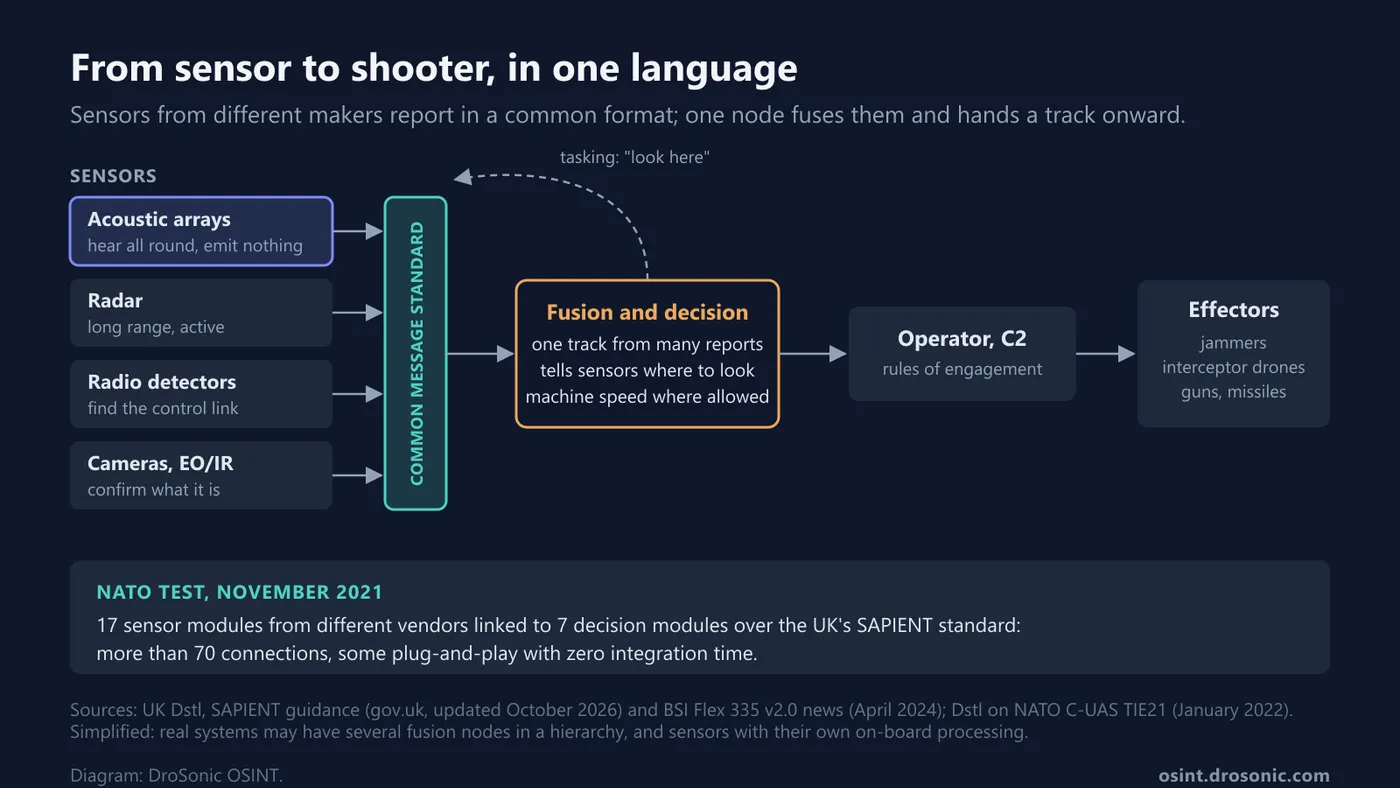
One language — any maker's sensor, one picture
The standard sits between the sensors and the node that fuses them, and between that node and whatever acts.
Diagram: DroSonic OSINT · original · from UK Dstl SAPIENT guidance and NATO TIE21 reporting
Field 03 — Tested, then used
From a NATO trial to a NATO summit
NATO runs a series of counter-drone Technical Interoperability Exercises. At the November 2021 edition in the Netherlands, SAPIENT's interface was tested as a candidate standard: according to Dstl, 17 autonomous sensor modules from different vendors connected to seven decision-making modules, more than 70 connections between counter-drone and command systems were made, and "in some cases this connection was completely plug-and-play, achieving zero-second integration time."ADS Group
One of the first publicised operational uses followed. At the NATO summit in The Hague on 24–25 June 2025, according to Dstl, "numerous unauthorised drones were neutralised" by SAPIENT-compliant technology that coordinated different defence systems and enabled Dutch military forces to intercept them.GOV.UK The UK government now says NATO will adopt SAPIENT as the basis of a standard recommendation (STANREC) for counter-drone systems, following evaluations in that exercise series.GOV.UK
The question for any sensor is no longer only how well it detects. It is whether its detections arrive where they can be used.
Field 04 — Allies wiring it up
Estonia's shared picture
NATO's eastern members are building the same plumbing at speed, partly in response to the base and airport incursions described in Watching the Bases. At Digital Shield 2.0 in Rutja, Estonia, on 5 March 2026, Estonian and allied sensors and command centres were linked into one real-time data network; sensor data passed through command centres to units with CV90 armoured vehicles and Piorun missiles, and new interceptor drones were tested. The Estonian Defence Forces compared the data exchange to the Delta system used in Ukraine. "The goal is to integrate all counter-drone defence systems arriving in the near future," said Maj. Tõnis Pärn of the Estonian Air Force's Air Surveillance Wing.Estonian Defence Forces
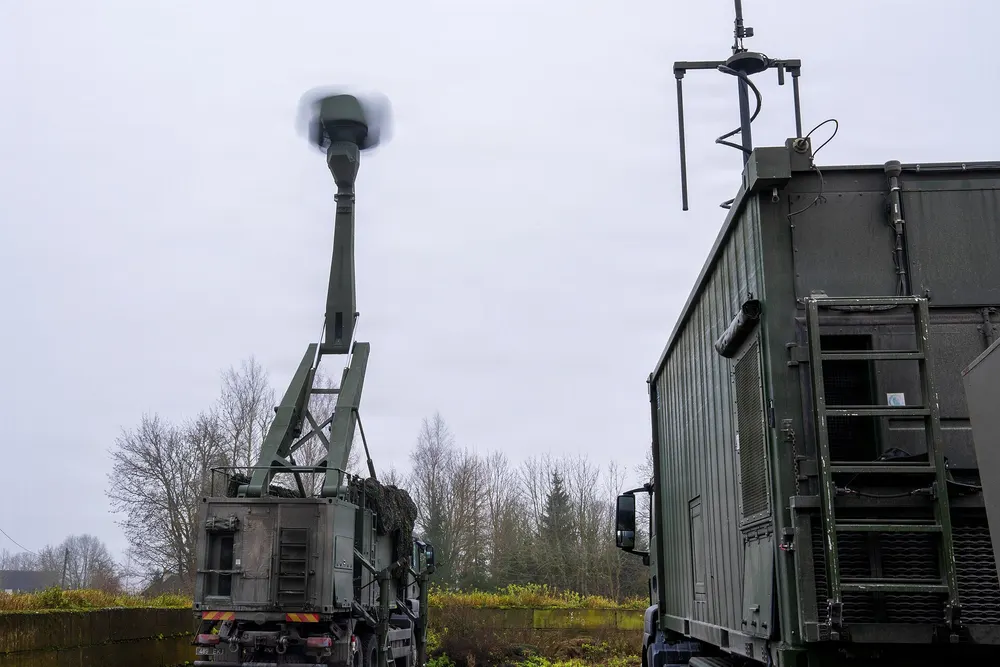
Digital Shield 1.0 — a radar feeds the network
An Estonian Giraffe radar during the first exercise, November 2025, which tested sharing data from active and passive sensors with the Estonian Command and Reporting Center.
Photo: U.S. Army, Capt. Alexander Watkins · Public domain · Wikimedia Commons
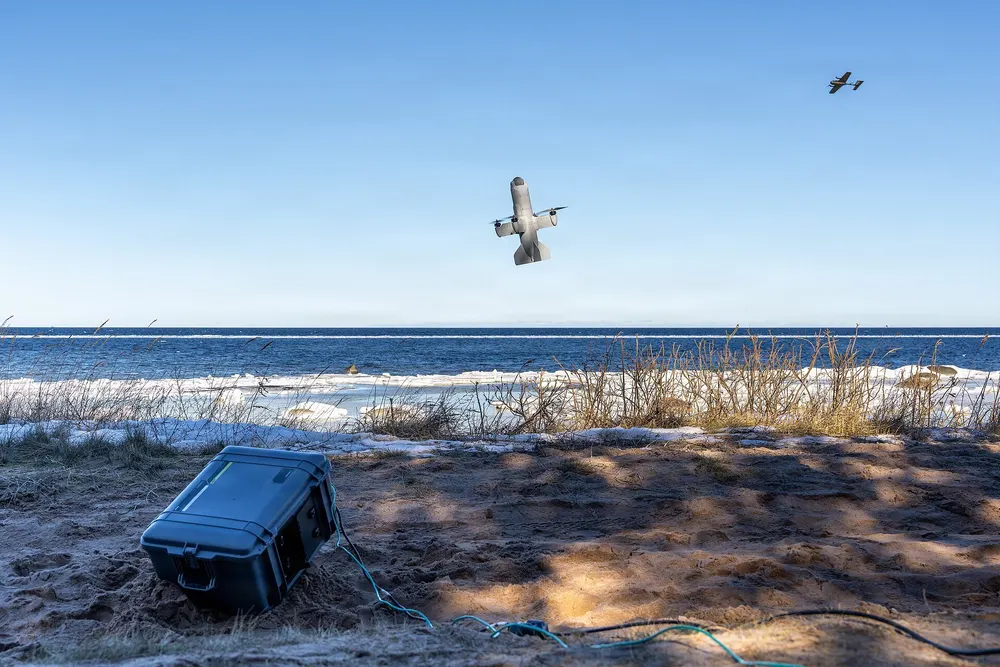
Digital Shield 2.0 — effectors on the same network
Two interceptors and a command-and-control system in use on the Estonian coast, March 2026.
Photo: U.S. Army, Maj. Alexander Watkins · Public domain · Wikimedia Commons
The U.S. Army's Project Flytrap trials in Germany have the same aim at the level of a platoon. In November 2025 the 10th Army Air and Missile Defense Command tested new, lower-cost, portable sensors and shooters for the Eastern Flank Deterrence Line.U.S. Army
Project Flytrap 4.5 — cheaper sensors and shooters, tested together
Soldiers of the 10th Army Air and Missile Defense Command on the trials at Putlos, Germany, November 2025. About a minute.
Video: U.S. Army, Pfc. Luis Jimenez · Public domain · Wikimedia Commons
Field 05 — Where sound plugs in
The acoustic layer on the network
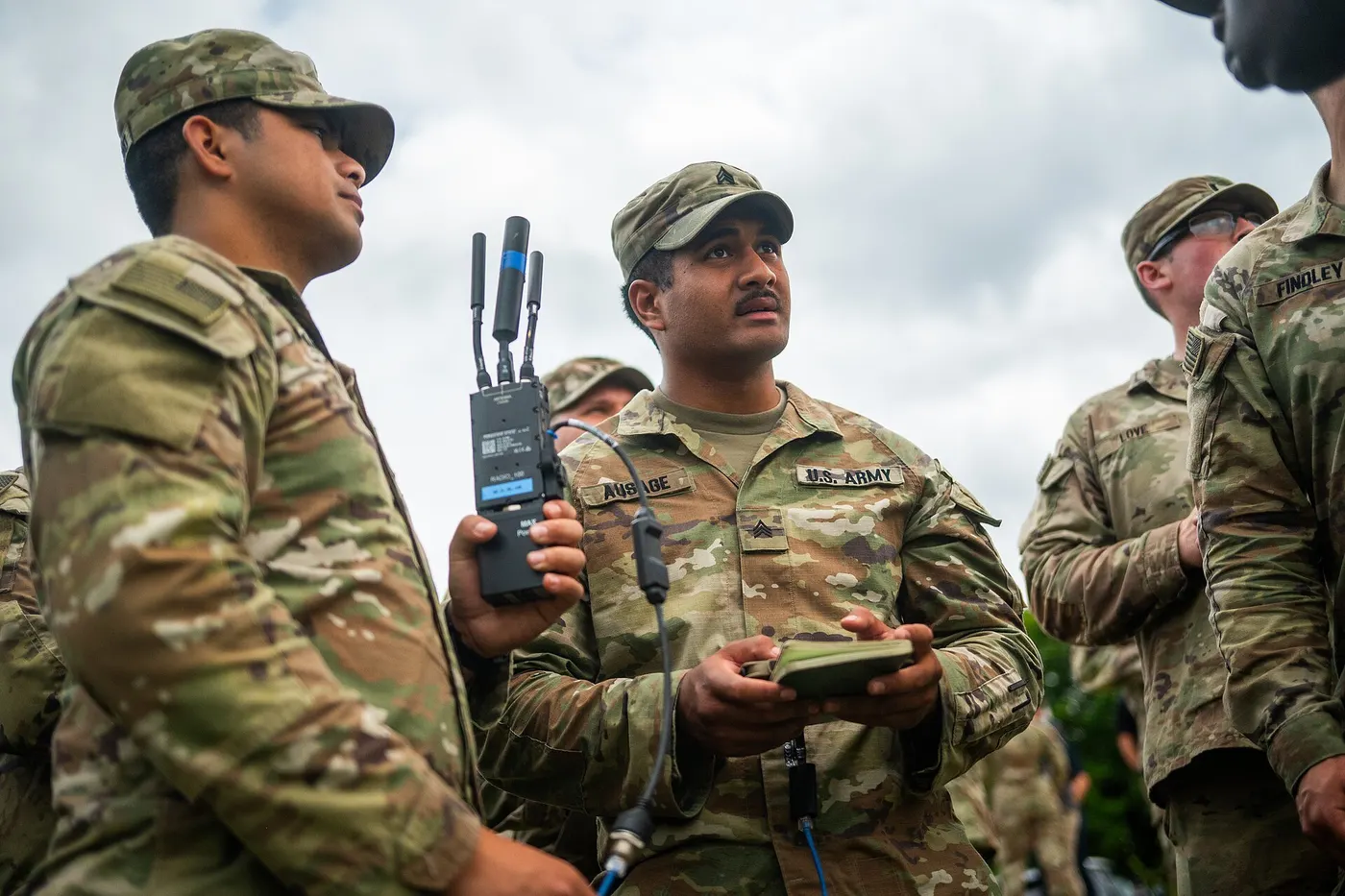
Acoustic sensors are already being wired into these networks. At Project Flytrap in June 2025, soldiers of the 2nd Cavalry Regiment followed the acoustic detections of Squarehead panels on a handheld Nett Warrior device connected to a radio, watching the real-time location of a test drone flying within the panels' range.U.S. Army As early as 2020, DroneShield integrated its radio, radar and camera detectors with Squarehead's Discovair direction-finding acoustic system inside one command-and-control software package, then under evaluation by the U.S. Department of Defense.Unmanned Airspace
Acoustic detections in hand — the ear reports to the soldier
Soldiers track a test drone located by acoustic panels on a handheld device, Project Flytrap, June 2025.
Photo: U.S. Army, Spc. Elijah Magaña · Public domain · Wikimedia Commons
At national scale, Ukraine's Sky Fortress network of thousands of cheap acoustic sensors feeds mobile fire teams, as our report Listening to the Sky describes. In each case the acoustic layer does the same job: hear early, in every direction, without emitting, and pass a cue to whatever can look or act. It matters most when the drone sends no radio signal to find, or when jamming has failed; see When the Detector Stays Silent and When Jamming Stops Working. Who may act on that cue is a separate question. In the United States, for example, the law treats detecting a drone very differently from defeating it, as Allowed to Listen, Not to Shoot explains.
Field 06 — The limits
A standard is not a guarantee
A shared language makes integration possible; it does not make any sensor good. The best-documented results here are self-reported: the 2021 connection counts come from Dstl, and the account of The Hague names neither the number of drones nor the sensors used.GOV.UK Fusing many sensors also concentrates a great deal of data in one place, and the airport review warns that cameras and radio sensors can capture data on the public and staff as well as on drone pilots, so the network needs clear rules on access and retention to avoid "function creep".Array
For anyone specifying a layered system, the questions follow:
Does each sensor speak an open standard, and which version? BSI Flex 335 v2.0 is not the same as earlier interface versions.
What does the sensor report? Direction, position, confidence and classification each help the fusion node differently.
Is the data fused or only overlaid? Ask to see one track built from several sensors, not several tracks on one map.
Can the fusion node task sensors? Cueing cameras from acoustic or radar detections needs a return path.
What still works when radio and GPS are jammed? A layered defence should degrade, not collapse.
Confidence
How sure we are, and what would change it
High confidence in the existence, status and adoption of SAPIENT: the UK government publishes the standard, its history and NATO's intention to adopt it, and Estonian and U.S. Army sources describe allied efforts to link sensors and effectors on shared networks.
Moderate confidence in how well such networks perform. The 2021 trial figures and the account of the 2025 summit come from the standard's developer, with few operational details, and acoustic sensors' place in these networks is shown in trials and vendor integrations rather than published performance data.
What would change it: independent, published results from NATO interoperability exercises, including acoustic sensors, and post-operation reports that say which sensors contributed to an interception.
DroSonic — our approach
The acoustic node on the network
DroSonic's sensors are designed to be one layer among several: networked passive acoustic nodes that detect, classify and locate drones on low-cost edge hardware and pass a cue onward.DroSonic Its U.S. provisional patent application covers that hand-off as tiered defeat cueing.DroSonic
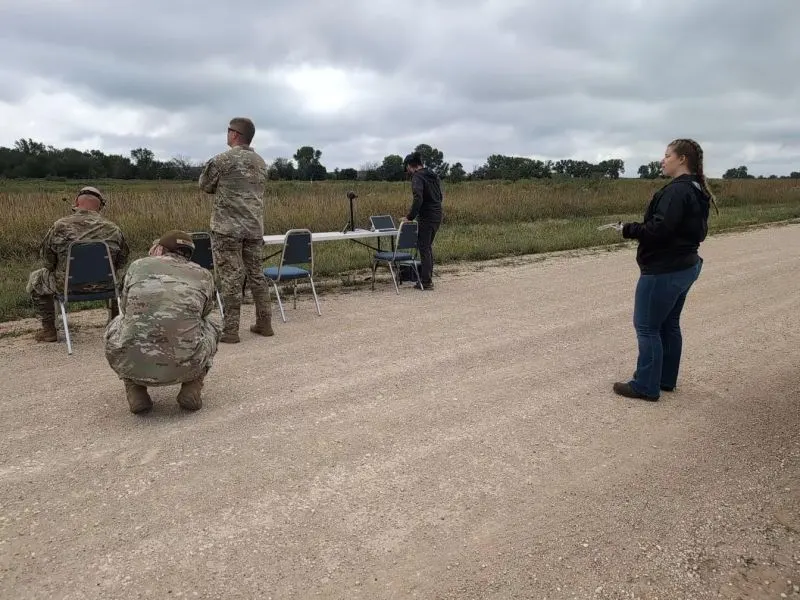
An open standard such as SAPIENT is how a cue like that reaches a fusion node and an effector from another maker. DroSonic has not announced SAPIENT certification; it tested a prototype against live drones at DIRT Days 26.04 in September 2026DroSonic and joined the SOF RACER consortium in October 2026.DroSonic
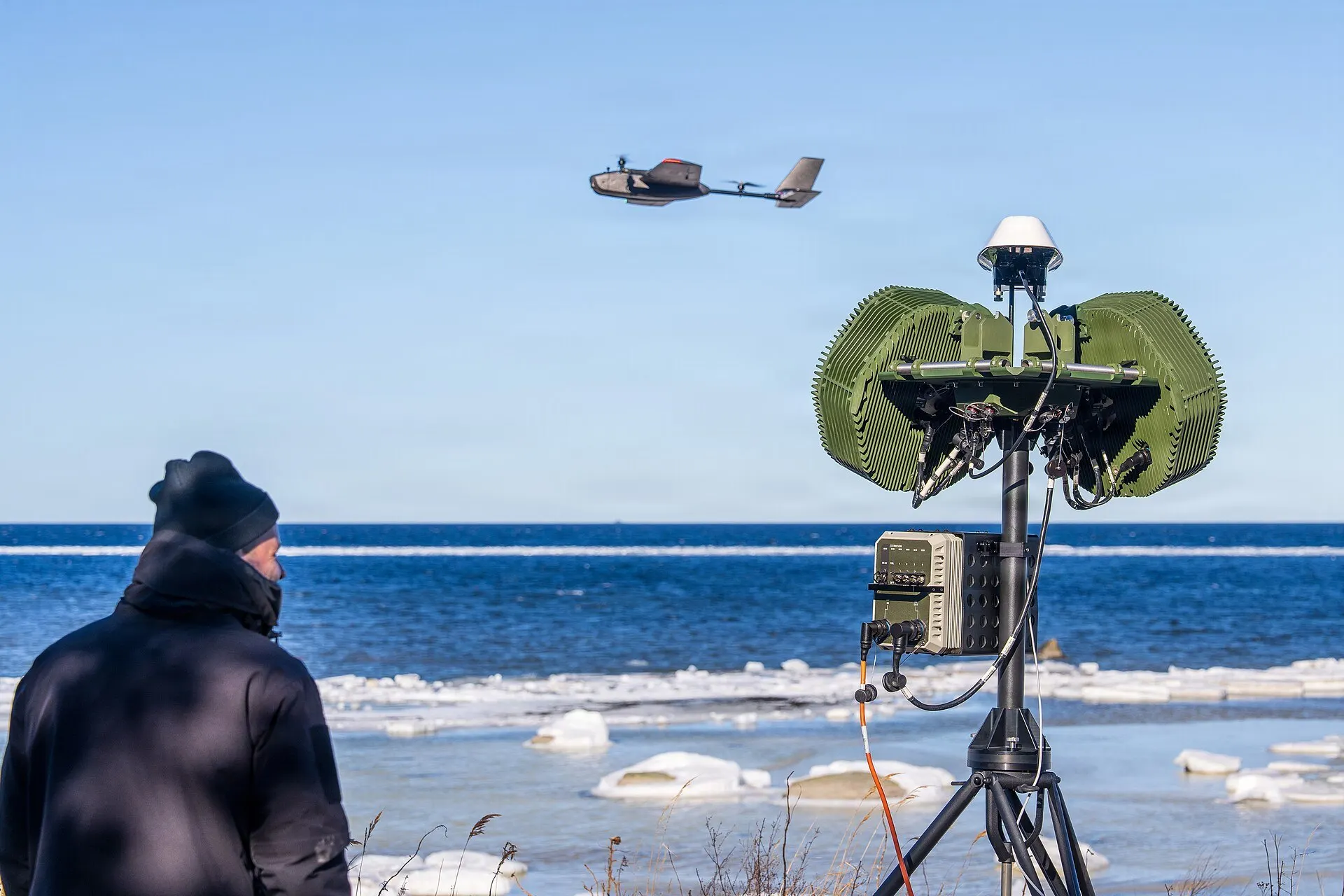
DIRT Days 26.04 — one sensor, one layer
DroSonic's test position at the field exercise. On a real network, its output would be one more feed into a shared picture.
The three parts of Sound and Sight make one argument. A microphone array is the natural wide-area cue for narrow, precise optics (Part 1). Fused with cameras and radio, sound turns three unreliable sensors into one dependable one (Part 2). And neither matters unless the detections reach a shared picture that the people and systems who act can trust, which is what open standards such as SAPIENT are for (Part 3).
DroSonic builds passive acoustic detection to be that early, quiet layer: hearing drones that cameras cannot yet see and radio detectors cannot hear, and handing the cue to the rest of the defence. For us and for anyone else, the test that matters is whether the cue arrives in time and in a form the network can use, which a laboratory score cannot show.
Cite this report
The Layered Picture: Layered Counter-Drone Defence: SAPIENT and Where Acoustic Sensors Fit
TY  - ELEC
AU  - Mujtaba, Ghulam
TI  - The Layered Picture: Layered Counter-Drone Defence: SAPIENT and Where Acoustic Sensors Fit
T2  - DroSonic OSINT
PB  - DroSonic
PY  - 2026
DA  - 2026/11/23
UR  - https://osint.drosonic.com/assessments/layered-counter-drone-sapient.html
AB  - Fusion only matters if the sensors can talk to each other and to whoever acts. An open British standard, now NATO's starting point, is how that is being solved, and where an acoustic layer plugs in.
KW  - Sensor Fusion
KW  - NATO
KW  - Counter-UAS
LA  - en
ER  -
Ghulam Mujtaba, Ph.D., is the founder and CEO of DroSonic and leads its work on passive acoustic drone detection. A computer engineer with 13 years of experience building machine-learning systems for edge hardware, he holds a Ph.D. in computer engineering from Gachon University in South Korea, was an NSF postdoctoral fellow at West Virginia University in the United States, and is an Assistant Professor of AI and Data Science at Regis University in Denver, Colorado. An IEEE Senior Member, he has published more than 20 papers on deep learning, computer vision and multimedia for edge devices.
Array — de Macedo, Caetano & da Costa 2025, Sec. 3: overlay without true fusion; single sensor dominating; synchronisation and calibration challenges
GOV.UK — Dstl SAPIENT guidance, updated 14 October 2026: open standard and architecture; AI at the edge, intelligent fusion; MOD C-UAS standard; test harness and middleware on GitHub, Sept 2024
GOV.UK — 23 April 2024: BSI Flex 335 v1 July 2023; v2.0 31 March 2024; hierarchical nodes; moving platforms; run-time taxonomies for any domain
ADS Group — Dstl, 7 January 2022: TIE21 tested SAPIENT ICD; >70 connections; 17 ASMs from different vendors to 7 DMMs; some plug-and-play, zero-second integration
GOV.UK — Dstl case study, 6 October 2025: NATO summit 24-25 June 2025; numerous unauthorised drones neutralised; SAPIENT coordinated systems; Dutch forces intercepted
Estonian Defence Forces — Digital Shield 2.0, Rutja, 5 March 2026: sensors and command centres on a real-time unified data network; data to CV90 and Piorun units; similar to Ukraine's Delta; interceptor drones tested; Maj. Tõnis Pärn quote
U.S. Army — Project Flytrap 4.5, Putlos, Germany, November 2025: lower-cost portable sensors and shooters for the Eastern Flank Deterrence Line
U.S. Army — Project Flytrap, 5 June 2025: Nett Warrior End User Device on an MPU5 radio tracking Squarehead acoustic detections; real-time location of a test drone
Unmanned Airspace — December 2020: DroneShield RF, radar, camera and EW integrated with Squarehead Discovair G2 acoustic in DroneSentry-C2; under US DoD test evaluation
DroSonic — Passive acoustic detection: neural networks on low-cost edge hardware, no emissions
DroSonic — U.S. provisional patent application 64/148,522, September 2026
DroSonic — DIRT Days 26.04 field test, September 2026
DroSonic — Joined the SOF RACER consortium, October 2026